Simplified Chinese - Basic Price Quantity

Lesson 18 of 156

A busy market stall with a seller and a buyer talking about price and quantity in Simplified Chinese, focused on Basic Price Quantity phrases.

Goal: Buying, checking amounts, and paying

Free Simplified Chinese lessons with guided practice, audio, and speaking support.

Quick and useful — this lesson helps you manage small shopping moments. We'll practice short, natural phrases so you can check prices, ask for more or less, and pay with confidence.

Level A1: In Lesson 18 you'll practice simple shopping phrases like 大概___。(Dàgài ___.), 我要___。(Wǒ yào ___.) and 可以用___付吗?(Kěyǐ yòng ___ fù ma?) to ask about prices, quantities, and payment. This CEFR-aligned lesson focuses on listening, repeating, and short role-play so you can use these lines right away at markets and cafés.

After this lesson you'll be able to:

  • Recognize and say common shopping phrases for price and quantity (A1).
  • Ask and confirm prices, e.g. “___块吗?” (___ kuài ma?).
  • Request more or less, and state when an amount is sufficient.
  • Ask whether a price is per person or total and check payment methods.
Close-up of hands exchanging fruit and money at a Chinese market, representing Simplified Chinese phrases for price and payment.

Ready? Let's go!

When you tap play on phrases, we track your progress through this lesson.

1. Reading + Listening Practice

Hear core phrases, repeat aloud.

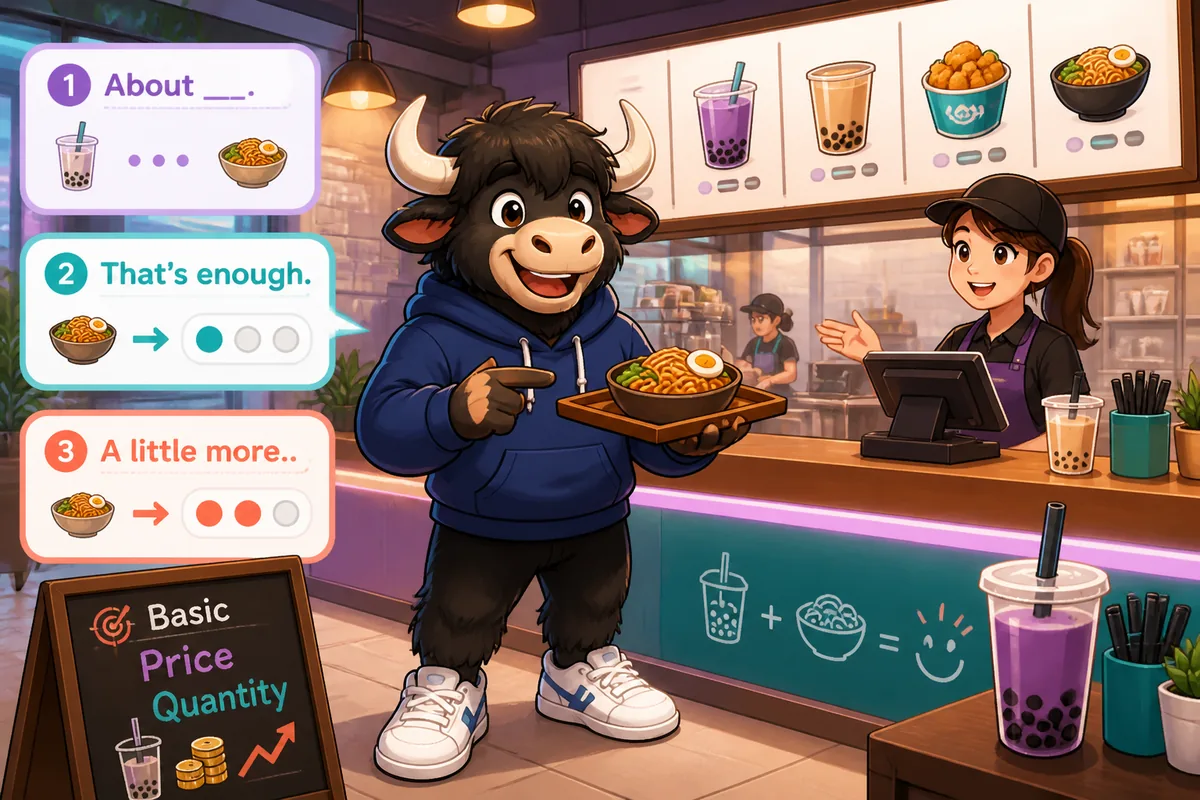
大概___

Dàgài ___.

About ___.

Meaning: About ___.

When to use: Use 大概___。(Dàgài ___.) when you want to give an approximate price, quantity, or time (not exact).

Tip: Don't use 大概 when you need an exact number; it's for estimates.

这件衣服大概一百块。

Zhè jiàn yīfú dàgài yì bǎi kuài.

This shirt is about 100 kuai.
我们大概有三个人去。

Wǒmen dàgài yǒu sān gè rén qù.

About three of us will go.

够了

Gòu le.

That's enough.

Meaning: That's enough.

When to use: Use 够了。(Gòu le.) to say the amount or service provided is sufficient (food, change, help).

不用了,够了,谢谢。

Bú yòng le, gòu le, xièxie.

No need, that's enough, thanks.
这些菜够了,我们吃得下。

Zhèxiē cài gòu le, wǒmen chī dé xià.

These dishes are enough; we can eat them.

再多一点

Zài duō yìdiǎn.

A little more.

Meaning: A little more.

When to use: Use 再多一点。(Zài duō yìdiǎn.) when you want the seller to add a small extra amount (food, weight, portions).

请多给我再多一点米。

Qǐng gěi wǒ zài duō yìdiǎn mǐ.

Please give me a little more rice.
可以再多一点菜吗?我们还想吃点儿。

Kěyǐ zài duō yìdiǎn cài ma? Wǒmen hái xiǎng chī diǎnr.

Could you give a little more food? We want a bit more.

少一点

Shǎo yìdiǎn.

A little less.

Meaning: A little less.

When to use: Use 少一点。(Shǎo yìdiǎn.) to ask for a slightly smaller amount (less spice, less salt, fewer pieces).

请少一点糖,我不太喜欢太甜。

Qǐng shǎo yìdiǎn táng, wǒ bú tài xǐhuan tài tián.

A little less sugar please; I don't like it too sweet.
这份太大了,能少一点吗?

Zhè fèn tài dà le, néng shǎo yìdiǎn ma?

This portion is too big; can it be a little less?

我要___

Wǒ yào ___.

I'll take ___.

Meaning: I'll take ___.

When to use: Use 我要___。(Wǒ yào ___.) when you choose an item or say the quantity you want to buy. For politeness you can also say 我想要___。(Wǒ xiǎng yào ___.)

Tip: Beginners sometimes drop the item after 我要; include the noun or number to be clear (e.g., 我要两个苹果).

我要两斤苹果

Wǒ yào liǎng jīn píngguǒ.

I'll take two jin of apples.
我要一杯拿铁,谢谢。

Wǒ yào yì bēi nátiě, xièxie.

I'll take a latte, thanks.

可以用___付吗?

Kěyǐ yòng ___ fù ma?

Can I pay with ___?

Meaning: Can I pay with ___?

When to use: Use 可以用___付吗?(Kěyǐ yòng ___ fù ma?) to ask if a payment method is accepted (cash, card, apps).

可以用支付宝付吗?

Kěyǐ yòng Zhīfùbǎo fù ma?

Can I pay with Alipay?
请问,可以用信用卡付吗?

Qǐngwèn, kěyǐ yòng xìnyòngkǎ fù ma?

Excuse me, can I pay with a credit card?

是每人还是总共?

Shì měi rén háishi zǒnggòng?

Per person or total?

Meaning: Per person or total?

When to use: Use 是每人还是总共?(Shì měi rén háishi zǒnggòng?) when you need to know whether a price applies per person or is the total amount.

菜单上写二十块,是每人还是总共?

Càidān shàng xiě èrshí kuài, shì měi rén háishi zǒnggòng?

The menu says 20 kuai; is that per person or total?
这个费用是每人还是总共算?

Zhège fèiyòng shì měi rén háishi zǒnggòng suàn?

Is this fee per person or counted altogether?

___块吗

___ kuài ma?

___ dollars?

Meaning: ___ dollars? (___ kuai?)

When to use: Use ___块吗?(___ kuài ma?) to repeat or check a heard price in casual speech. Note: 块 is the common spoken unit for RMB.

Tip: Learners sometimes use 块 with foreign currencies; in Mandarin, 块 usually refers to RMB in everyday speech.

五十块吗?你说五十块?

Wǔshí kuài ma? Nǐ shuō wǔshí kuài?

Fifty kuai? Did you say fifty kuai?
这瓶水三块吗

Zhè píng shuǐ sān kuài ma?

Is this bottle of water three kuai?

2. Conversational Listening Practice

Hear phrases in a real mini-conversation.

Market purchase: Anna buys apples from David

A friendly vendor and customer smiling as they discuss how many items to buy and whether to pay by card or app, showing the shopping context.

What are Anna and David deciding about?

Portrait of Anna in a Simplified Chinese lesson dialogue

Anna

这个苹果大概几块?

Zhè ge píngguǒ dàgài jǐ kuài?

About how much is this apple?

Portrait of David in a Simplified Chinese lesson dialogue

David

大概五块

Dàgài wǔ kuài.

About five kuai.

Portrait of Anna in a Simplified Chinese lesson dialogue

Anna

那我要两个

Nà wǒ yào liǎng gè.

Then I'll take two.

Portrait of David in a Simplified Chinese lesson dialogue

David

两个十块,是每人还是总共?

Liǎng gè shí kuài, shì měi rén háishi zǒnggòng?

Two for ten kuai — per person or total?

Portrait of Anna in a Simplified Chinese lesson dialogue

Anna

十块吗?可以用微信付吗?

Shí kuài ma? Kěyǐ yòng Wēixìn fù ma?

Ten kuai? Can I pay with WeChat?

Portrait of David in a Simplified Chinese lesson dialogue

David

可以。够了,谢谢。

Kěyǐ. Gòu le, xièxie.

Yes. That's enough, thanks.

3. Guided Practice

Quizzes and matching to lock in meaning.

Which phrase means 'That's enough.'?

How do you ask 'Can I pay with cash?' in the pattern we learned?

Which phrase would you use to ask for a slightly smaller portion?

Which question asks whether a price is per person or the total?

You ask: 'Three kuai?' to confirm the price.

摊主说:"这瓶水三块。" 你不太确定,就问:"___"

You say 够了。 to tell them that's enough.

饭太多了,服务员准备再上,你说:"___"

You ask 'Per person or total?' to confirm how the price is counted.

菜单写着“每人二十块”,你想确认,就问:"___"

Match the core phrases

Match the extra phrases

4. Speaking Practice

Say phrases yourself (mic/recording).

Recording stays on your device only. Check speech uses your browser's speech tools when available.

Say this phrase out loud:

大概___

Dàgài ___.

About ___.

Say this phrase out loud:

够了

Gòu le.

That's enough.

Say this phrase out loud:

再多一点

Zài duō yìdiǎn.

A little more.

Say this phrase out loud:

少一点

Shǎo yìdiǎn.

A little less.

Say this phrase out loud:

我要___

Wǒ yào ___.

I'll take ___.

Say this phrase out loud:

可以用___付吗?

Kěyǐ yòng ___ fù ma?

Can I pay with ___?

Say this phrase out loud:

是每人还是总共?

Shì měi rén háishi zǒnggòng?

Per person or total?

Say this phrase out loud:

___块吗

___ kuài ma?

___ kuai?