Small gestures go a long way — and in Chinese a few short phrases will help you stay friendly and clear. This lesson is a quick, practical set of polite frames you can use right away.
Level A1: In Lesson 5 you'll practice essential polite phrases (请___。 Qǐng ___., 谢谢 (Xièxie), 不客气 (Bú kèqi), 不好意思 (Bù hǎoyìsi) and more). We'll listen, repeat, and use these phrases in short dialogues so you can ask for help, apologize, refuse gently, and reply to thanks. CEFR-aligned and made for real life — be ready to sound gracious!
After this lesson you'll be able to:
Learn 13 core polite phrases and when to use them.
Practice asking politely (请___。, 可以请你___吗?) and thanking/responding (谢谢。/不客气。).
Be able to apologize, refuse gently, and offer permission in everyday situations.
Level A1: recognize and say these phrases aloud with correct basic pronunciation.
Ready? Let's go!
When you tap play on phrases, we track your progress through this lesson.
1. Reading + Listening Practice
Hear core phrases, repeat aloud.
请___
Qǐng ___.
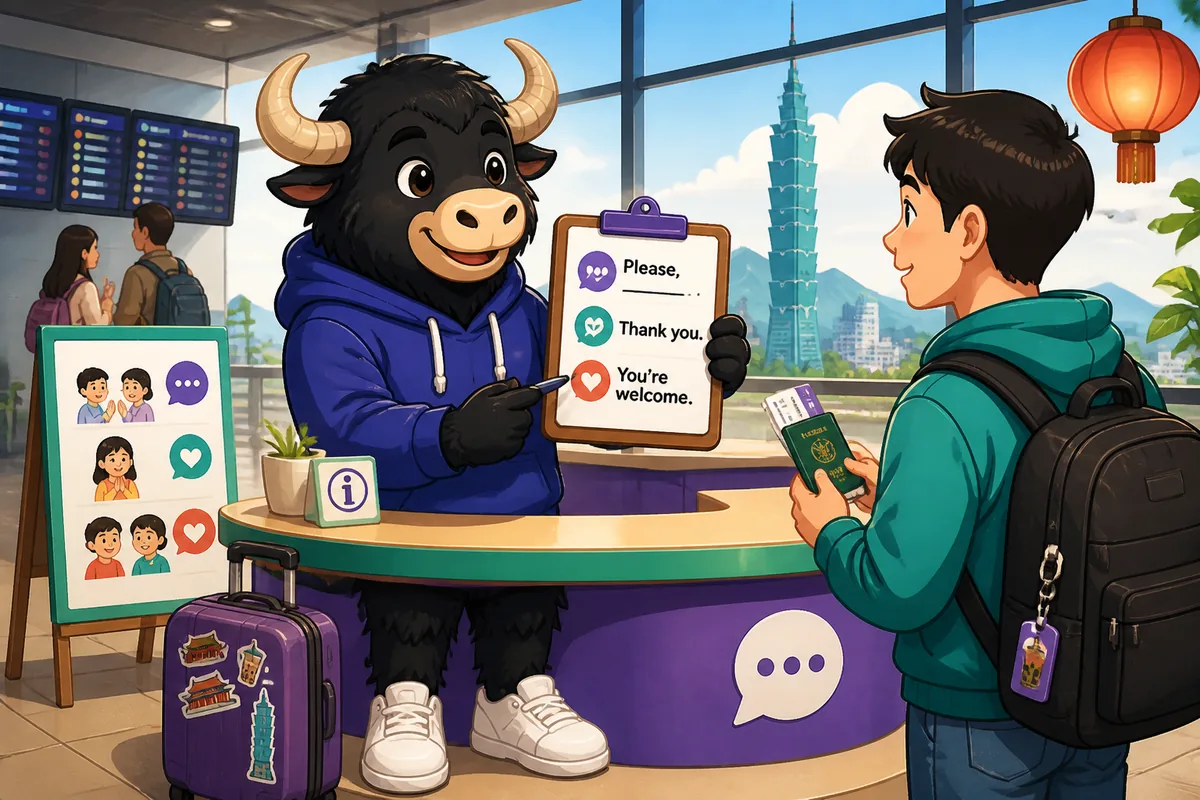
Please, ___ .
Meaning: Please, ___ .
When to use: Put 请 before a verb to make a short polite request (e.g., 请坐。Please sit.). Use it for quick, friendly commands or offers.
Tip: Beginners sometimes put 请 at the end (e.g., *坐请). Remember 请 goes before the action.
请坐
Qǐng zuò.
Please sit.
请看这个
Qǐng kàn zhège.
Please look at this.
谢谢
Xièxie.
Thank you.
Meaning: Thank you.
When to use: Use 谢谢 to show thanks for a small favor, service, or kindness.
谢谢你的帮助
Xièxie nǐ de bāngzhù.
Thanks for your help.
谢谢,我收到了。
Xièxie, wǒ shōu dào le.
Thanks, I received it.
不客气
Bú kèqi.
You're welcome.
Meaning: You're welcome.
When to use: Say 不客气 after someone thanks you. It's the standard polite reply.
— 谢谢你! — 不客气。
— Xièxie nǐ! — Bú kèqi.
— Thank you! — You're welcome.
服务员说:不客气,欢迎下次光临。
Fúwùyuán shuō: Bú kèqi, huānyíng xià cì guānglín.
The server says: You're welcome, please come again.
不好意思
Bù hǎoyìsi.
Excuse me.
Meaning: Excuse me.
When to use: Use 不好意思 to get someone's attention, gently interrupt, or offer a soft apology for a small mistake.
Tip: Don't always use 对不起 instead — 不好意思 is softer for small interruptions.
不好意思,我可以问你一个问题吗?
Bù hǎoyìsi, wǒ kěyǐ wèn nǐ yí ge wèntí ma?
Excuse me, may I ask you a question?
不好意思,能让一下吗?
Bù hǎoyìsi, néng ràng yí xià ma?
Excuse me, could you make room?
对不起
Duìbuqǐ.
Sorry.
Meaning: Sorry.
When to use: Use 对不起 for a clear apology. It's a straightforward way to say sorry for mistakes or problems.
对不起,我来晚了。
Duìbuqǐ, wǒ lái wǎn le.
Sorry, I'm late.
对不起,这是我的错。
Duìbuqǐ, zhè shì wǒ de cuò.
Sorry, this is my fault.
可以请你___吗?
Kěyǐ qǐng nǐ ___ ma?
Could you ___, please?
Meaning: Could you ___, please?
When to use: Use 可以请你___吗? to make a polite spoken request. For extra formality, replace 你 with 您.
可以请你帮我拍照吗?
Kěyǐ qǐng nǐ bāng wǒ pāizhào ma?
Could you take a photo of me, please?
可以请你等我一下吗?
Kěyǐ qǐng nǐ děng wǒ yí xià ma?
Could you wait for me a moment, please?
请你再说一遍,好吗?
Qǐng nǐ zài shuō yí biàn, hǎo ma?
Can you say that again, please?
Meaning: Can you say that again, please?
When to use: Use 请你再说一遍,好吗? when you didn't hear or understand and need someone to repeat.
对不起,我没听清,请你再说一遍,好吗?
Duìbuqǐ, wǒ méi tīng qīng, qǐng nǐ zài shuō yí biàn, hǎo ma?
Sorry, I didn't hear clearly, could you say that again, please?
在电话里:请你再说一遍,好吗?
Zài diànhuà lǐ: Qǐng nǐ zài shuō yí biàn, hǎo ma?
On the phone: Can you say that again, please?
请帮帮我
Qǐng bāngbang wǒ.
Please help me.
Meaning: Please help me.
When to use: Use 请帮帮我 when you need help quickly and politely from someone nearby.
请帮帮我,我的包不见了。
Qǐng bāngbang wǒ, wǒ de bāo bùjiàn le.
Please help me, my bag is missing.
车坏了,请帮帮我一下。
Chē huài le, qǐng bāngbang wǒ yí xià.
The car broke down, please help me a bit.
不好意思,我不行。
Bù hǎoyìsi, wǒ bùxíng.
Sorry, I can't.
Meaning: Sorry, I can't.
When to use: Use 不好意思,我不行。 to gently refuse or explain you can't do something; it's softer than 我不能.
Tip: Beginners sometimes use 我不能 (I cannot) which sounds more direct; 不好意思,我不行 is softer.