Simplified Chinese - Social Fillers

Lesson 84 of 156

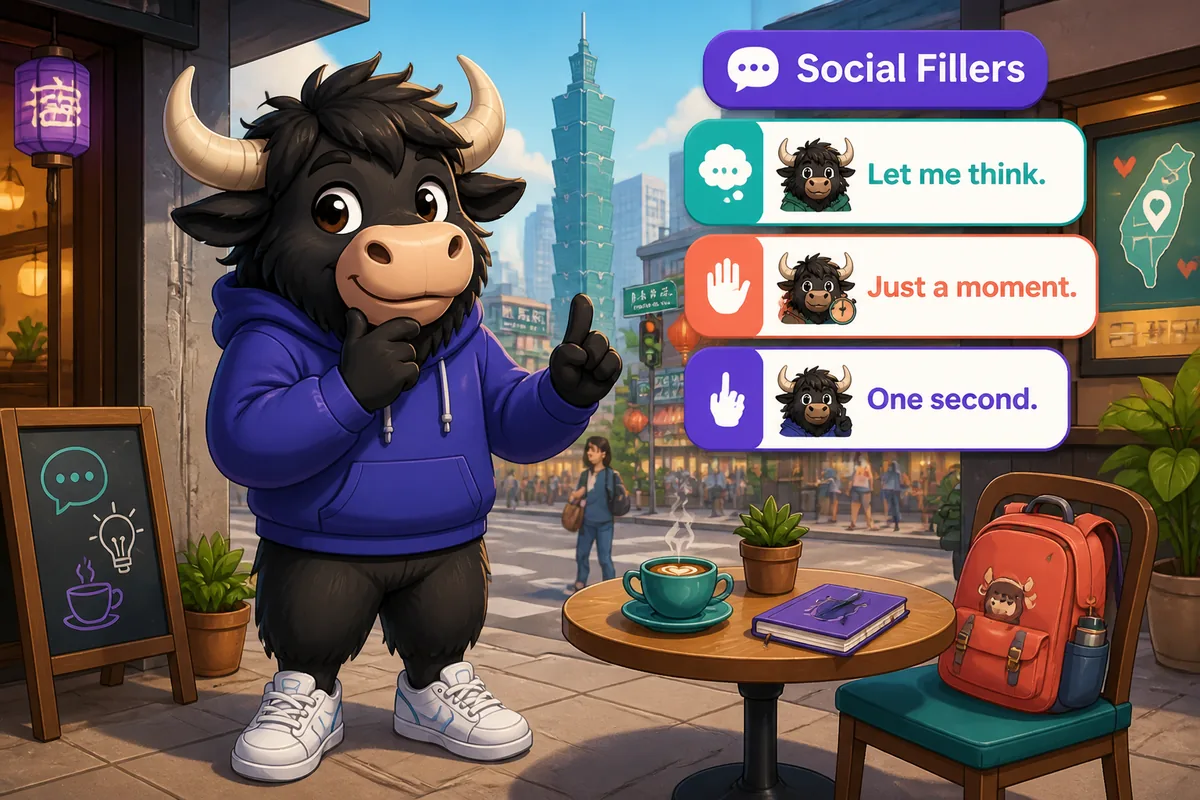
Two friends chatting casually in Simplified Chinese using filler phrases to think and respond; scene shows a casual street café.

Goal: Short phrases that keep conversations flowing

Free Simplified Chinese lessons with guided practice, audio, and speaking support.

Quick and friendly — this lesson helps you stay smooth in everyday talk. You'll listen, repeat, and use small phrases that act as social glue.

Level A2: Lesson 84 teaches short filler phrases (让我想想, 等一下, 怎么说呢, etc.) you can use to pause, buy time, or organize what you want to say. We'll practice hearing them in a short conversation, do quick quizzes, and then you say them out loud so they feel natural.

After this lesson you'll be able to:

  • Recognize and use common Mandarin fillers for pausing and thinking.
  • Practice short frames for clarifying or continuing what you want to say.
  • Build confidence saying these phrases aloud (Level A2).
A learner hears core filler phrases in Simplified Chinese and repeats them aloud; scene shows a headphone and notebook.

Ready? Let's go!

When you tap play on phrases, we track your progress through this lesson.

1. Reading + Listening Practice

Hear core phrases, repeat aloud.

让我想想

Ràng wǒ xiǎngxiang.

Let me think.

Meaning: Let me think.

When to use: Use when you need a brief pause to collect your thoughts before answering.

你想去哪儿?让我想想。

Nǐ xiǎng qù nǎr? Ràng wǒ xiǎngxiang.

Where do you want to go? Let me think.
这个问题很难,嗯,让我想想。

Zhège wèntí hěn nán, ēn, ràng wǒ xiǎngxiang.

This question is hard — well, let me think.

等一下

Děng yíxià.

Just a moment.

Meaning: Just a moment.

When to use: Use to politely ask for a very short pause; common in Mainland Mandarin.

你可以等一下吗?我马上回来。

Nǐ kěyǐ děng yíxià ma? Wǒ mǎshàng huílái.

Can you wait a moment? I'll be right back.
等一下,我要查一下文件。

Děng yíxià, wǒ yào chá yí xià wénjiàn.

Wait a moment, I need to check a document.

等我一秒

Děng wǒ yì miǎo.

One second.

Meaning: One second.

When to use: Casual way to ask for a very brief pause (spoken).

Tip: Learners sometimes say '一秒钟' too formally in fast speech; '等我一秒' sounds more natural casually.

等我一秒,我把手机放好。

Děng wǒ yí miǎo, wǒ bǎ shǒujī fàng hǎo.

Wait one second, I'll put my phone away.
等我一秒,马上发给你。

Děng wǒ yí miǎo, mǎshàng fā gěi nǐ.

One second, I'll send it to you right away.

怎么说呢

Zěnme shuō ne?

How can I say this?

Meaning: How can I say this?

When to use: Use when searching for words or trying to organize what you want to say.

怎么说呢?他有点像以前的老板。

Zěnme shuō ne? Tā yǒudiǎn xiàng yǐqián de lǎobǎn.

How can I say this? He's a bit like my old boss.
这个词怎么说呢?我忘了。

Zhège cí zěnme shuō ne? Wǒ wàng le.

How do you say this word? I forgot.

我的意思是,___。

Wǒ de yìsi shì, ___.

I mean, ___.

Meaning: I mean, ___.

When to use: Use to clarify or restate an idea, often followed by a short explanation.

我的意思是,我们可以早点出发,避免堵车。

Wǒ de yìsi shì, wǒmen kěyǐ zǎodiǎn chūfā, bìmiǎn dǔchē.
I mean, we could leave earlier to avoid traffic.
我不是生气,我的意思是,我需要更多时间。

Wǒ bù shì shēngqì, wǒ de yìsi shì, wǒ xūyào gèng duō shíjiān.

I'm not angry — I mean, I need more time.

嗯,___

Ēn, ___.

Well, ___.

Meaning: Well, ___.

When to use: Use at the start of an answer while you think, to sound natural and conversational.

嗯,可能我们应该再考虑一下预算。

Ēn, kěnéng wǒmen yīnggāi zài kǎolǜ yíxià yùsuàn.

Well, maybe we should reconsider the budget.
嗯,我觉得这个主意不错,但有点贵。

Ēn, wǒ juéde zhège zhǔyi bùcuò, dàn yǒudiǎn guì.

Well, I think this idea is good, but it's a bit expensive.

其实,___

Qíshí, ___.

Actually, ___.

Meaning: Actually, ___.

When to use: Use to offer a small correction or to present a contrast to what was just said.

其实,我昨天已经看过这个电影了。

Qíshí, wǒ zuótiān yǐjīng kàn guo zhège diànyǐng le.

Actually, I already watched that movie yesterday.
他看起来累,其实他睡得很好。

Tā kàn qǐlái lèi, qíshí tā shuì de hěn hǎo.

He looks tired — actually, he slept well.

所以,___

Suǒyǐ, ___.

So, ___.

Meaning: So, ___.

When to use: Use to continue, summarize, or organize what you want to say next.

所以,我们明天早上八点集合。

Suǒyǐ, wǒmen míngtiān zǎoshang bā diǎn jíhé.

So, we'll meet at 8 a.m. tomorrow.
我没听清楚,所以你能再说一遍吗?

Wǒ méi tīng qīngchu, suǒyǐ nǐ néng zài shuō yí biàn ma?

I didn't hear clearly, so can you say that again?

是这样的,___。

Shì zhèyàng de, ___.

The thing is, ___.

Meaning: The thing is, ___.

When to use: Use to softly introduce the main point or reason for what you are saying.

是这样的,我们需要更多时间准备材料。

Shì zhèyàng de, wǒmen xūyào gèng duō shíjiān zhǔnbèi cáiliào.

The thing is, we need more time to prepare the materials.
是这样的,我下周有个重要会议。

Shì zhèyàng de, wǒ xià zhōu yǒu gè zhòngyào huìyì.

The thing is, I have an important meeting next week.

我不太确定,不过___。

Wǒ bú tài quèdìng, búguò ___.

I'm not sure, but ___.

Meaning: I'm not sure, but ___.

When to use: Use when you want to give an uncertain answer while keeping the conversation moving.

我不太确定,不过那家店周日可能关门。

Wǒ bú tài quèdìng, búguò nà jiā diàn zhōurì kěnéng guānmén.

I'm not sure, but that shop might be closed on Sunday.
我不太确定,不过我记得那条路更快。

Wǒ bú tài quèdìng, búguò wǒ jìde nà tiáo lù gèng kuài.

I'm not certain, but I remember that road is faster.

这个问题问得好。

Zhège wèntí wèn de hǎo.“,”dialect_or_region”:“Mainland Mandarin”,“localization_status”:“candidate

That's a good question.

Meaning: That's a good question.

When to use: Use to buy time before answering a question; it acknowledges the question politely.

这个问题问得好,让我想想答案。

Zhège wèntí wèn de hǎo, ràng wǒ xiǎngxiang dá'àn.

That's a good question — let me think of an answer.
老师说,'这个问题问得好',然后给了详细解释。

Lǎoshī shuō, 'Zhège wèntí wèn de hǎo', ránhòu gěi le xiángxì jiěshì.

The teacher said, 'That's a good question,' then gave a detailed explanation.

我刚才在说什么来着?

Wǒ gāngcái zài shuō shénme láizhe?“,”dialect_or_region”:“Mainland Mandarin”,“localization_status”:“candidate

What was I saying?

Meaning: What was I saying?

When to use: Use after losing your train of thought and trying to recover the topic.

我刚才在说什么来着?我忘了接下来要说的重点。

Wǒ gāngcái zài shuō shénme láizhe? Wǒ wàng le jiēxiàlái yào shuō de zhòngdiǎn.

What was I saying just now? I forgot the main point I was going to make.
对不起,我刚才停顿了——我刚才在说什么来着?

Duìbuqǐ, wǒ gāngcái tíngdùn le — wǒ gāngcái zài shuō shénme láizhe?

Sorry, I paused earlier — what was I saying?

我说到哪儿了

Wǒ shuō dào nǎr le?“,”dialect_or_region”:“Mainland Mandarin”,“localization_status”:“candidate

Where was I?

Meaning: Where was I?

When to use: Use to return to a previous point after a pause or interruption.

Tip: Learners sometimes use these interchangeably; '我说到哪儿了?' is for resuming a point, while '我刚才在说什么来着?' is for recovering a lost train of thought.

我说到哪儿了?哦,对,是关于会议时间的安排。

Wǒ shuō dào nǎr le? Ó, duì, shì guānyú huìyì shíjiān de ānpái.

Where was I? Oh right, it was about scheduling the meeting.
给我两秒,我看一下笔记。嗯,我说到哪儿了?

Gěi wǒ liǎng miǎo, wǒ kàn yí xià bǐjì. Ēn, wǒ shuō dào nǎr le?

Give me two seconds to check my notes. Hmm, where was I?

2. Conversational Listening Practice

Hear phrases in a real mini-conversation.

Making weekend plans

Anna and David discuss weekend plans in Simplified Chinese, using fillers like 让我想想 and 等我一秒 to buy time.

What activity does David suggest?

Portrait of Anna in a Simplified Chinese lesson dialogue

Anna

你周末有安排吗?

Nǐ zhōumò yǒu ānpái ma?

Do you have plans for the weekend?

Portrait of David in a Simplified Chinese lesson dialogue

David

让我想想

Ràng wǒ xiǎngxiang.

Let me think.

Portrait of Anna in a Simplified Chinese lesson dialogue

Anna

等我一秒,我看一下日历。

Děng wǒ yí miǎo, wǒ kàn yíxià rìlì.

One second, I'll check the calendar.

Portrait of David in a Simplified Chinese lesson dialogue

David

怎么说呢?我不太确定,不过我想去爬山。

Zěnme shuō ne? Wǒ bú tài quèdìng, búguò wǒ xiǎng qù páshān.

How can I say this? I'm not sure, but I want to go hiking.

Portrait of Anna in a Simplified Chinese lesson dialogue

Anna

所以,周六早上出发?

Suǒyǐ, zhōu liù zǎoshang chūfā?

So, leave Saturday morning?

Portrait of David in a Simplified Chinese lesson dialogue

David

是这样的,早上空气比较好。

Shì zhèyàng de, zǎoshang kōngqì bǐjiào hǎo.

The thing is, mornings have better air.

3. Guided Practice

Quizzes and matching to lock in meaning.

Which phrase means 'Let me think.'?

Which phrase is a casual way to say 'One second'?

Which phrase would you use to introduce a correction or contrast (like 'Actually,...')?

Which phrase is commonly used to buy time before answering a question?

This question is a bit complicated; I'll first say, 'Let me think.' then answer.

这个问题有点复杂,我会先说:___ 然后回答。

Sorry, I paused earlier — what was I saying? I forgot what I was going to say next.

对不起,我刚才停顿了——___ 我忘了接下来要说什么。

After finishing a point, if you want to restate it, you can say 'I mean, ...' and then add details.

说完了一个观点后,想要重新说明时可以说:___,然后补充细节。

Match the core phrases

Match the extra phrases

4. Speaking Practice

Say phrases yourself (mic/recording).

Recording stays on your device only. Check speech uses your browser's speech tools when available.

Say this phrase out loud:

让我想想

Ràng wǒ xiǎngxiang.

Let me think.

Say this phrase out loud:

等一下

Děng yíxià.

Just a moment.

Say this phrase out loud:

等我一秒

Děng wǒ yí miǎo.

One second.

Say this phrase out loud:

怎么说呢

Zěnme shuō ne?

How can I say this?

Say this phrase out loud:

我的意思是,___。

Wǒ de yìsi shì, ___.

I mean, ___.

Say this phrase out loud:

嗯,___

Ēn, ___.

Well, ___.

Say this phrase out loud:

其实,___

Qíshí, ___.

Actually, ___.

Say this phrase out loud:

所以,___

Suǒyǐ, ___.

So, ___.

Say this phrase out loud:

是这样的,___。

Shì zhèyàng de, ___.

The thing is, ___.

Say this phrase out loud:

我不太确定,不过___。

Wǒ bú tài quèdìng, búguò ___.

I'm not sure, but ___.

Say this phrase out loud:

这个问题问得好。

Zhège wèntí wèn de hǎo.

That's a good question.

Say this phrase out loud:

我刚才在说什么来着?

Wǒ gāngcái zài shuō shénme láizhe?

What was I saying?

Say this phrase out loud:

我说到哪儿了

Wǒ shuō dào nǎr le?

Where was I?