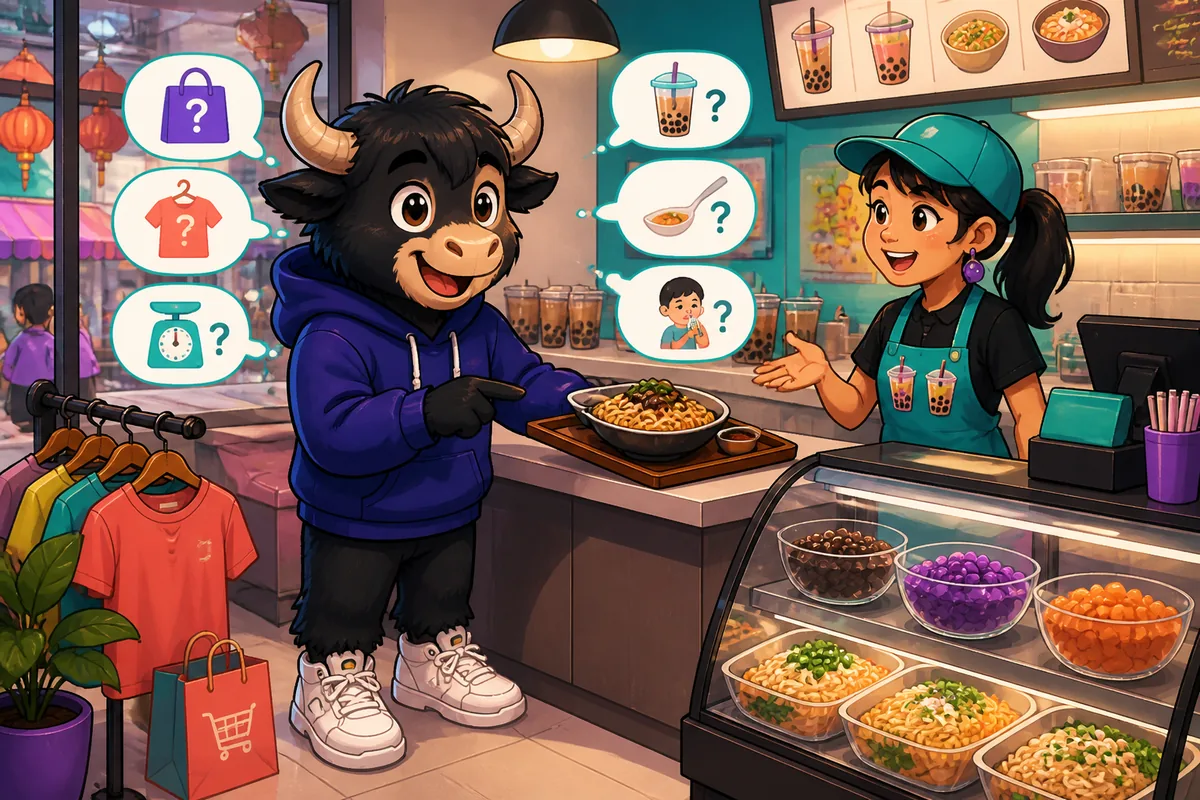
这个怎么卖
Zhè ge zěnme mài?
How is this sold / How much is this?
Meaning: How is this sold / How much is this?
When to use: Ask this to find out the price or how the item is sold (per piece, per jin/weight, or with a set price).
Examples ▼ 这苹果看起来新鲜,老板,***这个怎么卖?***
Zhè píngguǒ kàn qǐlái xīnxiān, lǎobǎn, zhè ge zěnme mài?
These apples look fresh. Boss, how are these sold?/How much are they?
我想买这条裙子,小姐,这件衣服***这个怎么卖?***
Wǒ xiǎng mǎi zhè tiáo qúnzi, xiǎojiě, zhè jiàn yīfu zhè ge zěnme mài?
I want this skirt — miss, how much is this?
能试一下吗
Néng shì yíxià ma?
Can I try it?
Meaning: Can I try it?
When to use: Ask when you want to try on clothes, shoes, or test a product before buying.
Examples ▼ 这双鞋看起来不错,老板,***能试一下吗?***
Zhè shuāng xié kàn qǐlái búcuò, lǎobǎn, néng shì yíxià ma?
These shoes look nice — boss, can I try them on?
这台相机我没用过,***能试一下吗?***
Zhè tái xiàngjī wǒ méi yòng guo, néng shì yíxià ma?
I haven't used this camera before. Can I try it?
能尝一下吗
Néng cháng yíxià ma?
Can I taste it?
Meaning: Can I taste it?
When to use: Use this at food stalls or markets when you want a sample bite or sip.
Examples ▼ 这个葡萄看起来很好吃,老板,***能尝一下吗?***
Zhè ge pútáo kàn qǐlái hěn hǎochī, lǎobǎn, néng cháng yíxià ma?
These grapes look delicious — boss, can I taste one?
摊主在卖烤肉,***能尝一下吗?***
Tān zhǔ zài mài kǎoròu, néng cháng yíxià ma?
The vendor is selling grilled meat — can I taste it?
还有别的吗
Hái yǒu bié de ma?
Do you have any others?
Meaning: Do you have any others?
When to use: Ask this when you want to see more options of the same item (different style, size, or batch).
Examples ▼ 这件有点小,店员,***还有别的吗?***
Zhè jiàn yǒu diǎn xiǎo, diànyuán, hái yǒu bié de ma?
This one is a bit small — clerk, do you have any others?
我想要不同款式的包包,请问***还有别的吗?***
Wǒ xiǎng yào bùtóng kuǎnshì de bāobāo, qǐngwèn hái yǒu bié de ma?
I want different styles of bags — do you have any others?
有没有小一点的?
Yǒu méiyǒu xiǎo yìdiǎn de?
Do you have a smaller one?
Meaning: Do you have a smaller one?
When to use: Use when an item is too big and you want a smaller size or portion.
Examples ▼ 这条裤子有点宽,老板,***有没有小一点的?***
Zhè tiáo kùzi yǒu diǎn kuān, lǎobǎn, yǒu méiyǒu xiǎo yìdiǎn de?
These pants are a bit wide — boss, do you have a smaller one?
这个杯子太大了,有没有小一点的?
Zhè ge bēizi tài dà le, yǒu méiyǒu xiǎo yìdiǎn de?
This cup is too big — do you have a smaller one?
有没有大一点的?
Yǒu méiyǒu dà yìdiǎn de?
Do you have a bigger one?
Meaning: Do you have a bigger one?
When to use: Use when the item is too small and you need a larger size or portion.
Examples ▼ 这件T恤太紧了,店员,***有没有大一点的?***
Zhè jiàn T xù tài jǐn le, diànyuán, yǒu méiyǒu dà yìdiǎn de?
This T-shirt is too tight — clerk, do you have a bigger one?
我需要更大的行李箱,请问有大一点的吗?
Wǒ xūyào gèng dà de xínglǐxiāng, qǐngwèn yǒu dà yìdiǎn de ma?
I need a bigger suitcase — do you have a larger one?
有别的颜色吗
Yǒu bié de yánsè ma?
Do you have other colors?
Meaning: Do you have other colors?
When to use: Ask when you like an item but want to see it in different colors.
Examples ▼ 我喜欢这条裙子,小姐,***有别的颜色吗?***
Wǒ xǐhuan zhè tiáo qúnzi, xiǎojiě, yǒu bié de yánsè ma?
I like this dress — miss, do you have other colors?
这双鞋只有黑色吗?有没有别的颜色?
Zhè shuāng xié zhǐ yǒu hēisè ma? Yǒu méiyǒu bié de yánsè?
Are these shoes only black? Do you have other colors?
太大了
Tài dà le.
It’s too big.
Meaning: It’s too big.
When to use: Give feedback when a piece of clothing or an item is larger than you want.
Tip: Beginners sometimes say 太大 instead of 太大了 and sound less natural.
Examples ▼ 这件外套穿上去有点松,太大了。
Zhè jiàn wàitào chuān shàng qù yǒu diǎn sōng, tài dà le.
This coat feels loose when I put it on — it's too big.
这双鞋我穿着不稳,感觉太大了。
Zhè shuāng xié wǒ chuān zhe bù wěn, gǎnjué tài dà le.
These shoes feel unstable on me — they're too big.
太小了
Tài xiǎo le.
It’s too small.
Meaning: It’s too small.
When to use: Give feedback when something doesn't fit because it's too small.
Examples ▼ 我试过那条裙子,结果太小了。
Wǒ shì guo nà tiáo qúnzi, jiéguǒ tài xiǎo le.
I tried that skirt — it's too small.
这件衬衫扣不上,太小了。
Zhè jiàn chènshān kòu bu shàng, tài xiǎo le.
This shirt won't button — it's too small.
正好
Zhèng hǎo.
Just right.
Meaning: Just right.
When to use: Say this when the fit, size, or amount is perfect — a positive short response.
Examples ▼ 我试穿后觉得正好,可以结帐了。
Wǒ shì chuān hòu juéde zhèng hǎo, kěyǐ jiézhàng le.
After trying it on I think it's just right — I can pay.
这杯咖啡的甜度正好,不用加糖了。
Zhè bēi kāfēi de tiándù zhèng hǎo, bùyòng jiā táng le.
The sweetness of this coffee is just right — no need to add sugar.
我要这个
Wǒ yào zhè ge.
I’ll take this one.
Meaning: I’ll take this one.
When to use: Use this to tell the seller which item you choose when you're ready to buy.
Examples ▼ 好,我要这个,麻烦帮我包好。
Hǎo, wǒ yào zhè ge, máfan bāng wǒ bāo hǎo.
Okay, I'll take this one — please wrap it for me.
这个价格合适,我要这个。
Zhè ge jiàgé héshì, wǒ yào zhè ge.
This price is reasonable — I'll take this one.
就要这个吧
Jiù yào zhè ge ba.
Let’s go with this one.
Meaning: Let’s go with this one.
When to use: A softer, slightly tentative way to decide on an item after looking at options.
Examples ▼ 看了半天,还是就要这个吧。
Kàn le bàntiān, háishì jiù yào zhè ge ba.
After looking for a while, let's go with this one.
价格和颜色都合适,就要这个吧。
Jiàgé hé yánsè dōu héshì, jiù yào zhè ge ba.
The price and color fit — let's go with this one.
先不要了
Xiān bú yào le.
I won’t take it for now.
Meaning: I won’t take it for now.
When to use: Polite way to decline after looking — you might still come back later.
Examples ▼ 谢谢,我先不要了,再考虑一下。
Xièxie, wǒ xiān bú yào le, zài kǎolǜ yíxià.
Thanks, I won't take it for now — I'll think about it.
这个价钱太高了,先不要了。
Zhè ge jiàqian tài gāo le, xiān bú yào le.
This price is too high — I won't take it for now.
Which phrase would you use to ask if you can taste a fruit sample? 先不要了 有没有别的颜色? 能尝一下吗 这个怎么卖
If a shirt is too tight, which phrase would you say? 太小了 正好 太大了 能试一下吗
You want to see more color options for a bag. Which phrase fits? 有别的颜色吗 有没有大一点的? 先不要了 就要这个吧
You decide to buy the selected item now but want to sound casual — which phrase do you use? 太大了 有没有小一点的? 能尝一下吗 我要这个
I tried that coat and it feels too big; do you have a smaller size? 我试了那件外套,感觉 ___,请问有小一号的吗?
Wǒ shì le nà jiàn wàitào, gǎnjué ___, qǐngwèn yǒu xiǎo yī hào de ma?
就要这个吧 太小了 太大了 先不要了
I like this T‑shirt and want to see other colors — you'd ask: Do you have other colors? 这件T恤我很喜欢,想看看其他颜色,你会问店员:___
Zhè jiàn T xù wǒ hěn xǐhuan, xiǎng kàn kàn qítā yánsè, nǐ huì wèn diànyuán: ___
先不要了 能试一下吗 太小了 有没有别的颜色?
At the fruit stall you want to try a sample and politely say: Can I taste it? 在水果摊前,你想尝尝样品,可以礼貌地说:___
Zài shuǐguǒ tān qián, nǐ xiǎng cháng cháng yàngpǐn, kěyǐ lǐmào de shuō: ___
有没有大一点的? 这个怎么卖 能尝一下吗 我要这个
这个怎么卖 Zhè ge zěnme mài? 能试一下吗 Néng shì yíxià ma? 能尝一下吗 Néng cháng yíxià ma? 有没有小一点的? Yǒu méiyǒu xiǎo yìdiǎn de? 有没有大一点的? Yǒu méiyǒu dà yìdiǎn de? 有别的颜色吗 Yǒu bié de yánsè ma? 太大了 Tài dà le. 太小了 Tài xiǎo le. How is this sold?/How much is this? Can I try it? Can I taste it? Do you have a smaller one? Do you have a bigger one? Do you have other colors? It's too big. It's too small.
正好 Zhèng hǎo. 我要这个 Wǒ yào zhè ge. 就要这个吧 Jiù yào zhè ge ba. 先不要了 Xiān bú yào le. 还有别的吗 Hái yǒu bié de ma? 多少钱 Duōshao qián? Just right. I'll take this one. Let's go with this one. I won't take it for now. Do you have any others? How much is it? (extra common shopping phrase)
Recording stays on your device only. Check speech uses your browser's speech tools when available.
Say this phrase out loud:
这个怎么卖
Zhè ge zěnme mài?
How is this sold / How much is this?
Check speech
Record Play back
Say this phrase out loud:
能试一下吗
Néng shì yíxià ma?
Can I try it?
Check speech
Record Play back
Say this phrase out loud:
能尝一下吗
Néng cháng yíxià ma?
Can I taste it?
Check speech
Record Play back
Say this phrase out loud:
还有别的吗
Hái yǒu bié de ma?
Do you have any others?
Check speech
Record Play back
Say this phrase out loud:
有没有小一点的?
Yǒu méiyǒu xiǎo yìdiǎn de?
Do you have a smaller one?
Check speech
Record Play back
Say this phrase out loud:
有没有大一点的?
Yǒu méiyǒu dà yìdiǎn de?
Do you have a bigger one?
Check speech
Record Play back
Say this phrase out loud:
有别的颜色吗
Yǒu bié de yánsè ma?
Do you have other colors?
Check speech
Record Play back
Say this phrase out loud:
太大了
Tài dà le.
It's too big.
Check speech
Record Play back
Say this phrase out loud:
太小了
Tài xiǎo le.
It's too small.
Check speech
Record Play back
Say this phrase out loud:
正好
Zhèng hǎo.
Just right.
Check speech
Record Play back
Say this phrase out loud:
我要这个
Wǒ yào zhè ge.
I'll take this one.
Check speech
Record Play back
Say this phrase out loud:
就要这个吧
Jiù yào zhè ge ba.
Let's go with this one.
Check speech
Record Play back
Say this phrase out loud:
先不要了
Xiān bú yào le.
I won't take it for now.
Check speech
Record Play back