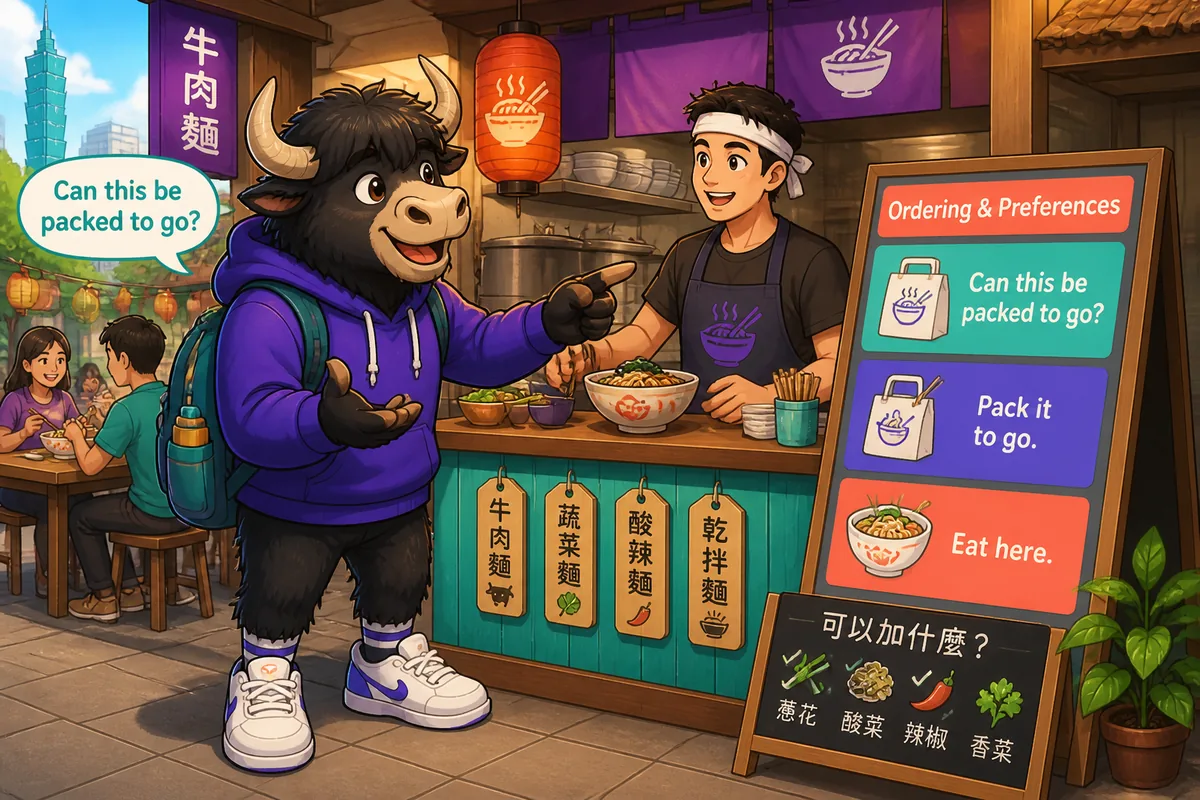
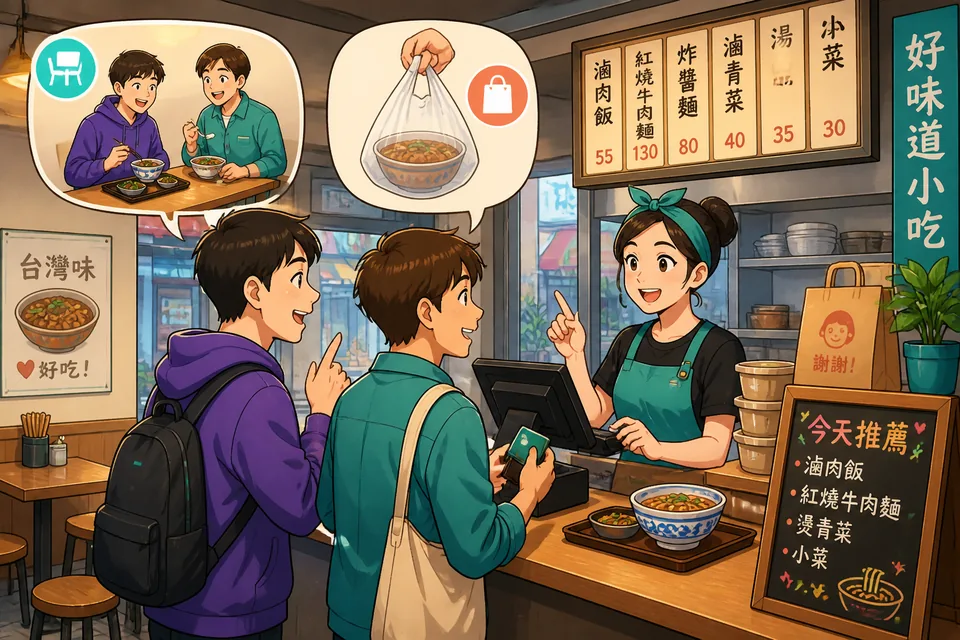
能打包吗
Néng dǎbāo ma?
Can this be packed to go?
Meaning: Can this be packed to go?
When to use: Ask this when you want leftovers or to take your meal away.
Examples ▼ 我们吃不完,这个能打包吗?
wǒmen chī bù wán, zhè ge néng dǎbāo ma?
We can't finish—can this be packed?
服务员,能打包吗?
fúwùyuán, néng dǎbāo ma?
Waiter, can you pack this to go?
打包带走
Dǎbāo dàizǒu.
Pack it to go.
Meaning: Pack it to go.
When to use: Tell the staff you want the food packed for takeaway.
Examples ▼ 这些菜太多了,请帮我打包带走。
zhèxiē cài tài duō le, qǐng bāng wǒ dǎbāo dàizǒu.
There’s too much food, please pack it to go.
我们打包带走吧,回家再吃。
wǒmen dǎbāo dàizǒu ba, huíjiā zài chī.
Let's pack it to go and eat at home.
在这儿吃
Zài zhèr chī.
Eat here.
Meaning: Eat here.
When to use: Say this when the staff asks whether you want dine-in or takeaway.
Examples ▼ 我在这儿吃,不用打包。
wǒ zài zhèr chī, bú yòng dǎbāo.
I'll eat here, no need to pack.
我们在这儿吃,来两碗米饭。
wǒmen zài zhèr chī, lái liǎng wǎn mǐfàn.
We'll eat here; bring two bowls of rice.
少放辣
Shǎo fàng là.
Put less chili.
Meaning: Put less chili.
When to use: Use this when you want a dish with less spiciness.
Tip: Sometimes learners say 不要辣 when they mean 'a little less'; 不要辣 means no spice at all.
Examples ▼ 我不太能吃辣,菜里少放辣可以吗?
wǒ bù tài néng chī là, cài lǐ shǎo fàng là kěyǐ ma?
I can’t eat much spice—can you put less chili in the dish?
这汤太辣了,下次请少放辣。
zhè tāng tài là le, xià cì qǐng shǎo fàng là.
This soup is too spicy—please put less chili next time.
不要辣
Bú yào là.
No spicy food / no chili.
Meaning: No spicy food / no chili.
When to use: Say this simply when you want no spiciness at all.
Examples ▼ 我不吃辣,不要辣,谢谢。
wǒ bù chī là, bú yào là, xièxie.
I don't eat spicy food—no spice, thanks.
请把麻辣去掉,我要不要辣的版本。
qǐng bǎ málà qùdiào, wǒ yào bú yào là de bǎnběn.
Please remove the numb-spice; I want the non-spicy version.
微辣就行
Wēilà jiù xíng.
Mild spicy is fine.
Meaning: Mild spicy is fine.
When to use: Use this to ask for a mild level of spiciness.
Examples ▼ 我能吃一点辣,微辣就行。
wǒ néng chī yìdiǎn là, wēi là jiù xíng.
I can eat a little spice; mild spicy is fine.
不要太辣,请做成微辣就行。
bú yào tài là, qǐng zuò chéng wēi là jiù xíng.
Not too spicy please, mild is fine.
不要香菜
Bú yào xiāngcài.
No cilantro.
Meaning: No cilantro.
When to use: Say this when you want cilantro removed from a dish.
Examples ▼ 我对香菜过敏,不要香菜。
wǒ duì xiāngcài guòmǐn, bú yào xiāngcài.
I'm allergic to cilantro—no cilantro please.
这个凉拌菜不要香菜,拜托了。
zhè ge liángbàn cài bú yào xiāngcài, bàituō le.
Please don't put cilantro in this salad.
少放盐
Shǎo fàng yán.
Use less salt.
Meaning: Use less salt.
When to use: Ask for less salt for health or taste reasons.
Examples ▼ 医生说少盐,菜里请少放盐。
yīshēng shuō shǎo yán, cài lǐ qǐng shǎo fàng yán.
Doctor said less salt—please put less salt in the dish.
这道菜有点咸,可以少放盐吗?
zhè dào cài yǒu diǎn xián, kěyǐ shǎo fàng yán ma?
This dish is a bit salty—can you use less salt?
不要放___
Bú yào fàng ___.
Don’t add ___.
Meaning: Don’t add ___.
When to use: A flexible pattern to tell staff not to add a specific ingredient.
Tip: Beginners sometimes say 不要后面直接加名词 without 放 (e.g., 不要葱). Using 不要放___ is clearer in ordering contexts.
Examples ▼ 不要放葱,谢谢。
bú yào fàng cōng, xièxie.
Don’t add green onions, thanks.
这碗汤不要放味精,我怕味精。
zhè wǎn tāng bú yào fàng wèijīng, wǒ pà wèijīng.
Don't add MSG to this soup; I'm sensitive to it.
多加一点___。
Duō jiā yìdiǎn ___.
Add a little more ___.
Meaning: Add a little more ___.
When to use: Use this when you want extra sauce, topping, or an ingredient.
Examples ▼ 这面条可以多加一点辣吗?
zhè miàntiáo kěyǐ duō jiā yìdiǎn là ma?
Can you add a little more chili to these noodles?
请多加一点酱油,我喜欢咸一点的味道。
qǐng duō jiā yìdiǎn jiàngyóu, wǒ xǐhuan xián yìdiǎn de wèidào.
Please add a little more soy sauce; I like it saltier.
有菜单吗
Yǒu càidān ma?
Do you have a menu?
Meaning: Do you have a menu?
When to use: Ask staff for a menu in a restaurant or small eatery.
Examples ▼ 你好,有菜单吗?
nǐ hǎo, yǒu càidān ma?
Hello, do you have a menu?
我们要点菜,请给我们菜单。
wǒmen yào diǎn cài, qǐng gěi wǒmen càidān.
We want to order—please give us the menu.
有推荐的吗
Yǒu tuījiàn de ma?
Do you have any recommendations?
Meaning: Do you have any recommendations?
When to use: Ask staff or friends what they recommend when you’re unsure what to order.
Examples ▼ 第一次来,有推荐的吗?
dì yī cì lái, yǒu tuījiàn de ma?
First time here—do you have any recommendations?
这家店特色菜是什么?有推荐的吗?
zhè jiā diàn tèsè cài shì shénme? yǒu tuījiàn de ma?
What are the specialties here? Any recommendations?
这个好吃吗
Zhè ge hǎochī ma?
Is this tasty?
Meaning: Is this tasty?
When to use: Ask staff or friends whether a dish tastes good.
Examples ▼ 这个好吃吗?我第一次看到这个菜。
zhè ge hǎochī ma? wǒ dì yī cì kàn dào zhè ge cài.
Is this tasty? It's my first time seeing this dish.
你常来这里吃吗?这个好吃吗?
nǐ cháng lái zhèlǐ chī ma? zhè ge hǎochī ma?
Do you come here often? Is this good?
How do you ask for the menu? 有菜单吗 打包带走 有推荐的吗 在这儿吃
Which phrase tells the staff not to add cilantro? 不要辣 不要香菜 少放盐 能打包吗
If you want mild spice, which phrase fits best? 多加一点辣 不要辣 微辣就行 少放辣
How would you tell the staff to pack your leftovers? 能打包吗 打包带走 在这儿吃 有推荐的吗
Pack it to go. 服务员:这道菜太多了,您要打包吗?顾客:___
fúwùyuán: zhè dào cài tài duō le, nín yào dǎbāo ma? gùkè: ___
打包带走 多加一点盐 在这儿吃 有菜单吗
No cilantro. 我对香菜过敏,点菜的时候我会说:___
wǒ duì xiāngcài guòmǐn, diǎn cài de shíhou wǒ huì shuō: ___
不要香菜 在这儿吃 有推荐的吗 不要辣
Mild spicy is fine. 朋友:这道菜很辣,你想要什么辣度?我:___
péngyou: zhè dào cài hěn là, nǐ xiǎng yào shénme làdù? wǒ: ___
微辣就行 不要放盐 有菜单吗 能打包吗
能打包吗 néng dǎbāo ma? 打包带走 dǎbāo dàizǒu. 在这儿吃 zài zhèr chī. 少放辣 shǎo fàng là. 不要辣 bú yào là. 微辣就行 wēi là jiù xíng. 不要香菜 bú yào xiāngcài. 少放盐 shǎo fàng yán. Can this be packed to go? Pack it to go. Eat here. Put less chili. No spicy. Mild spicy is fine. No cilantro. Use less salt.
不要放__ bú yào fàng ___. 多加一点__ duō jiā yìdiǎn ___. 有菜单吗 yǒu càidān ma? 有推荐的吗 yǒu tuījiàn de ma? 这个好吃吗 zhè ge hǎochī ma? 打包可以吗 dǎbāo kěyǐ ma? Don’t add ___. Add a little more ___. Do you have a menu? Do you have any recommendations? Is this tasty? Can you pack it? (alternate phrasing)
Recording stays on your device only. Check speech uses your browser's speech tools when available.
Say this phrase out loud:
能打包吗
néng dǎbāo ma?
Can this be packed to go?
Check speech
Record Play back
Say this phrase out loud:
打包带走
dǎbāo dàizǒu.
Pack it to go.
Check speech
Record Play back
Say this phrase out loud:
在这儿吃
zài zhèr chī.
Eat here.
Check speech
Record Play back
Say this phrase out loud:
少放辣
shǎo fàng là.
Put less chili.
Check speech
Record Play back
Say this phrase out loud:
不要辣
bú yào là.
No spicy food / no chili.
Check speech
Record Play back
Say this phrase out loud:
微辣就行
wēi là jiù xíng.
Mild spicy is fine.
Check speech
Record Play back
Say this phrase out loud:
不要香菜
bú yào xiāngcài.
No cilantro.
Check speech
Record Play back
Say this phrase out loud:
少放盐
shǎo fàng yán.
Use less salt.
Check speech
Record Play back
Say this phrase out loud:
不要放___
Bú yào fàng ___.
Don’t add ___.
Check speech
Record Play back
Say this phrase out loud:
多加一点___。
Duō jiā yìdiǎn ___.
Add a little more ___.
Check speech
Record Play back
Say this phrase out loud:
有菜单吗
yǒu càidān ma?
Do you have a menu?
Check speech
Record Play back
Say this phrase out loud:
有推荐的吗
yǒu tuījiàn de ma?
Do you have any recommendations?
Check speech
Record Play back
Say this phrase out loud:
这个好吃吗
zhè ge hǎochī ma?
Is this tasty?
Check speech
Record Play back