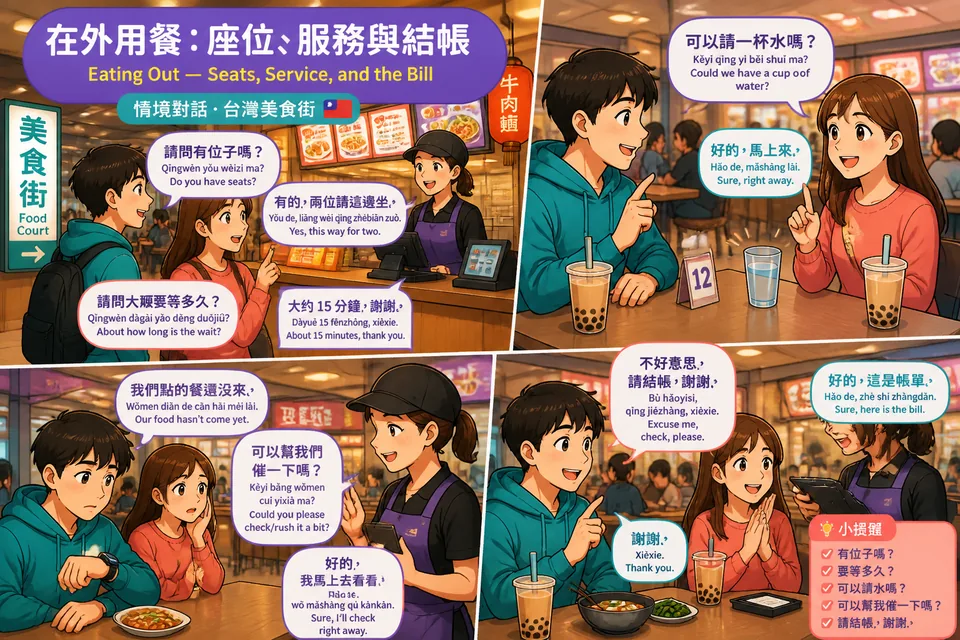
Simplified Chinese - Eating Out — Seats, Service, and the Bill

Lesson 156 of 156

A busy Chinese restaurant entrance with a host checking seats; Simplified Chinese restaurant phrases for seating and the bill.

Goal: Common restaurant phrases for checking food, seating, and paying

Free Simplified Chinese lessons with guided practice, audio, and speaking support.

Welcome — let’s make Chinese at restaurants feel easy. In this short lesson you’ll hear, repeat, and use key phrases for seating, waiting, and paying in mainland China. Have fun and try them aloud!

Level A1: This lesson focuses on practical restaurant phrases like asking “有位子吗?(Yǒu wèizi ma?)” and saying “麻烦结账。(Máfan jiézhàng.)”. You'll practice checking if the food has arrived, asking staff to hurry an order, asking about waits and water, and choosing how to pay. (CEFR-aligned).

After this lesson you'll be able to:

  • Recognize and say basic restaurant phrases used in mainland China (A1).
  • Ask about seats and wait time: 有位子吗?(Yǒu wèizi ma?) / 要等多久?(Yào děng duōjiǔ?).
  • Tell staff the food hasn’t arrived and ask them to hurry: 菜还没上。(Cài hái méi shàng.) / 麻烦催一下。(Máfan cuī yíxià.).
  • Ask about water and handle paying: 水是免费的吗?(Shuǐ shì miǎnfèi de ma?) / 分开付。(Fēnkāi fù.) / 一起付。(Yìqǐ fù.) / 麻烦结账。(Máfan jiézhàng.).
Customers at a restaurant counter asking 有位子吗? and the host checking the wait — Simplified Chinese food-and-drink scene.

Ready? Let's go!

When you tap play on phrases, we track your progress through this lesson.

1. Reading + Listening Practice

Hear core phrases, repeat aloud.

菜还没上

Cài hái méi shàng.

The food hasn’t come yet.

Meaning: The food hasn’t come yet.

When to use: Say this when your ordered dishes still haven't arrived and you want to tell a server.

Tip: Sometimes learners say 上菜还没 which is understandable but less natural than 菜还没上。

我们点的菜还没上,能帮我们看一下吗?

Wǒmen diǎn de cài hái méi shàng, néng bāng wǒmen kàn yíxià ma?

Our order hasn't arrived — could you check for us?
服务员,菜还没上,我有点着急。

Fúwùyuán, cài hái méi shàng, wǒ yǒu diǎn zháojí.

Waiter, the food hasn't come yet — I'm a bit worried.

麻烦催一下

Máfan cuī yíxià.

Could you please check/rush it a bit?

Meaning: Could you please check/rush it a bit?

When to use: Use this politely to ask staff to hurry a delayed dish.

Tip: Beginners sometimes say 快一点 which is OK but can sound blunt in polite contexts—麻烦催一下 is softer.

我们的菜晚了,麻烦催一下可以吗?

Wǒmen de cài wǎn le, máfan cuī yíxià kěyǐ ma?

Our food is late, could you please push them to hurry?
抱歉,麻烦催一下,我赶时间。

Bàoqiàn, máfan cuī yíxià, wǒ gǎn shíjiān.

Sorry, please hurry it — I'm on a schedule.

麻烦结账

Máfan jiézhàng.

Check, please.

Meaning: Check, please.

When to use: Say this when you're ready to pay and want the bill.

吃好了,麻烦结账。

Chī hǎo le, máfan jiézhàng.

We're done eating, check please.
服务员,麻烦结账,我们要走了。

Fúwùyuán, máfan jiézhàng, wǒmen yào zǒu le.

Waiter, check please — we're leaving.

分开付

Fēnkāi fù.

Pay separately.

Meaning: Pay separately.

When to use: Use at the end of a meal when each person pays their own share.

Tip: Don't say 分付 — native speakers say 分开付 or 一人一份结账.

这次我们想分开付,每个人付自己的。

Zhè cì wǒmen xiǎng fēnkāi fù, měi gè rén fù zìjǐ de.

This time we'd like to pay separately; everyone pays their own.
服务员,可以分开付吗?

Fúwùyuán, kěyǐ fēnkāi fù ma?

Waiter, can we pay separately?

一起付

Yìqǐ fù.

Pay together.

Meaning: Pay together.

When to use: Use when one person will pay for the whole table or the group wants a single bill.

这次我请客,大家一起付就好。

Zhè cì wǒ qǐngkè, dàjiā yìqǐ fù jiù hǎo.

I'll pay this time — paying together is fine.
如果没人介意,我们就一起付吧。

Rúguǒ méi rén jièyì, wǒmen jiù yìqǐ fù ba.

If no one minds, let's pay together.

有位子吗

Yǒu wèizi ma?

Are there seats available?

Meaning: Are there seats available?

When to use: Ask this at the restaurant entrance or a busy café when you need a table.

你好,请问有位子吗?我们有四个人。

Nǐ hǎo, qǐngwèn yǒu wèizi ma? Wǒmen yǒu sì gè rén.

Hello, are there seats? We are four people.
现在有位子吗?不用预约吧?

Xiànzài yǒu wèizi ma? Bù yòng yùyuē ba?

Are there seats now? No reservation needed, right?

要等多久

Yào děng duōjiǔ?

How long is the wait?

Meaning: How long is the wait?

When to use: Use when the restaurant is full or a service is busy and you want an estimated wait time.

人很多,请问要等多久?

Rén hěn duō, qǐngwèn yào děng duōjiǔ?

There are many people — how long is the wait?
我们只有半小时,服务员能告诉我们要等多久吗?

Wǒmen zhǐ yǒu bàn xiǎoshí, fúwùyuán néng gàosù wǒmen yào děng duōjiǔ ma?

We only have half an hour — can the waiter tell us how long we'll wait?

水是免费的吗

Shuǐ shì miǎnfèi de ma?

Is the water free?

Meaning: Is the water free?

When to use: Ask this in cafés or restaurants where bottled water may cost extra.

请问,水是免费的吗?我们需要两杯。

Qǐngwèn, shuǐ shì miǎnfèi de ma? Wǒmen xūyào liǎng bēi.

Excuse me, is the water free? We need two cups.
菜单上没写水价,请问水是免费的吗?

Càidān shàng méi xiě shuǐ jià, qǐngwèn shuǐ shì miǎnfèi de ma?

The menu doesn't list water price — is water free?

2. Conversational Listening Practice

Hear phrases in a real mini-conversation.

At a busy restaurant entrance and then at the table — asking about seats, wait time, water, late food, and paying.

Two people at a table talking to staff: asking about late dishes, water, and how to pay — Simplified Chinese phrases shown.

What does Anna ask first when she arrives?

Portrait of Anna in a Simplified Chinese lesson dialogue

Anna

你好,请问有位子吗?

Nǐ hǎo, qǐngwèn yǒu wèizi ma?

Hello, are there seats available?

Portrait of David in a Simplified Chinese lesson dialogue

David

现在很忙,可能要等二十分钟。

Xiànzài hěn máng, kěnéng yào děng èrshí fēnzhōng.

It's busy now; you might wait about 20 minutes.

Portrait of Anna in a Simplified Chinese lesson dialogue

Anna

那我们就等。顺便问一下,水是免费的吗?

Nà wǒmen jiù děng. Shùnbiàn wèn yíxià, shuǐ shì miǎnfèi de ma?

Okay we'll wait. By the way, is the water free?

Portrait of David in a Simplified Chinese lesson dialogue

David

服务员说茶水是免费的,我们先坐吧。

Fúwùyuán shuō cháshuǐ shì miǎnfèi de, wǒmen xiān zuò ba.

The waiter said tea/water is free — let's sit first.

Portrait of Anna in a Simplified Chinese lesson dialogue

Anna

我们的菜还没上,麻烦催一下好吗?

Wǒmen de cài hái méi shàng, máfan cuī yíxià hǎo ma?

Our food hasn't arrived — could you please hurry it?

Portrait of David in a Simplified Chinese lesson dialogue

David

好的,我去催。吃完了要麻烦结账,我们一起付还是分开付?

Hǎo de, wǒ qù cuī. Chī wán le yào máfan jiézhàng, wǒmen yìqǐ fù háishì fēnkāi fù?

Okay, I'll hurry them. When finished, check please — do we pay together or separately?

Portrait of Anna in a Simplified Chinese lesson dialogue

Anna

这次我请,一起付。

Zhè cì wǒ qǐng, yìqǐ fù.

I'll treat this time — pay together.

3. Guided Practice

Quizzes and matching to lock in meaning.

Which phrase means: 'Pay separately.'?

Which phrase asks: 'Are there seats available?'

Which phrase would you say when the dishes are late and you want staff to hurry them?

Which phrase means 'Check, please.'?

We've already waited 20 minutes and the food hasn't arrived. Could you ask the waiter to hurry it?

我们已经等了二十分钟,菜还没上,能不能请服务员___。

We're finished and ready to leave — Waiter, check please.

吃完了,大家准备走了,服务员,麻烦___。

There are many people at the entrance; someone quickly asks, 'How long is the wait?'

门口人很多,接待员说可能要等,很快有人问:'___'?

Match the core phrases

Match the extra phrases

4. Speaking Practice

Say phrases yourself (mic/recording).

Recording stays on your device only. Check speech uses your browser's speech tools when available.

Say this phrase out loud:

菜还没上

Cài hái méi shàng.

The food hasn’t come yet.

Say this phrase out loud:

麻烦催一下

Máfan cuī yíxià.

Could you please check/rush it a bit?

Say this phrase out loud:

麻烦结账

Máfan jiézhàng.

Check, please.

Say this phrase out loud:

分开付

Fēnkāi fù.

Pay separately.

Say this phrase out loud:

一起付

Yìqǐ fù.

Pay together.

Say this phrase out loud:

有位子吗

Yǒu wèizi ma?

Are there seats available?

Say this phrase out loud:

要等多久

Yào děng duōjiǔ?

How long is the wait?

Say this phrase out loud:

水是免费的吗

Shuǐ shì miǎnfèi de ma?

Is the water free?