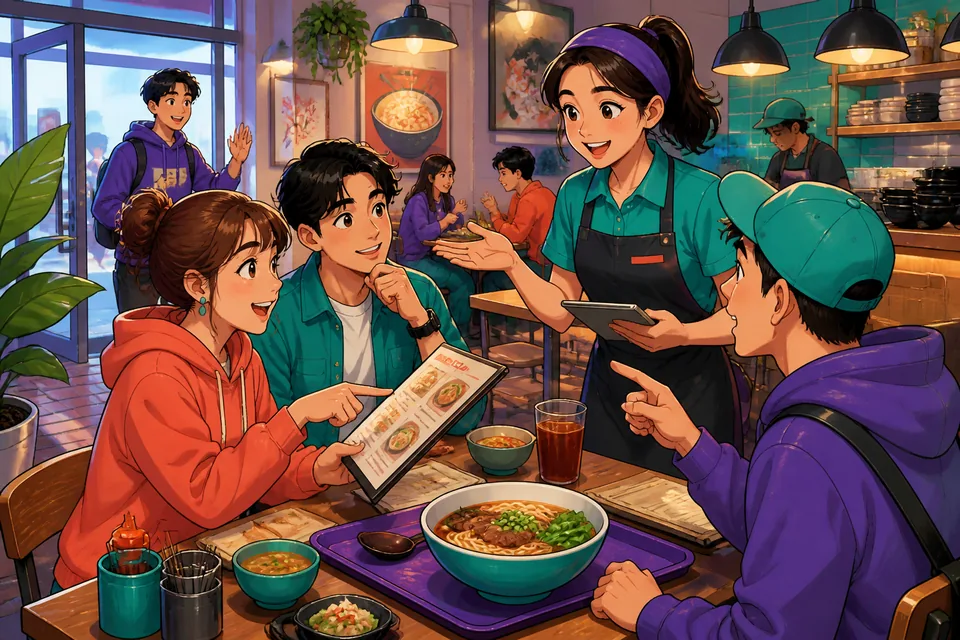
Welcome — ready for a cozy café scene? This lesson is quick, practical, and full of phrases you can use at real cafés and casual restaurants. Say each line out loud, then try the mini-dialogue and practice activities to lock them in.
Level A2: In this short lesson you'll learn polite, everyday phrases for asking about seats, checking the menu, ordering, changing an order, and splitting the bill. We'll practice core café lines like 我们有预订,名字是___。, 可以看一下菜单吗? and 可以分开结账吗?. The lesson is CEFR-aligned and focused on usable speech you can say right away — no fluff, just good café talk.
After this lesson you'll be able to:
Ask if there’s a table available and request seating politely (e.g. ___位,谢谢。).
Order food and drinks, ask for small changes (e.g. ___可以不要___吗?) and ask whether a dish is spicy (这道菜辣吗?).
Handle common dining interactions: request water, confirm a reservation, ask to split the bill, and say you’re ready to order. (Level A2)
Ready? Let's go!
When you tap play on phrases, we track your progress through this lesson.
1. Reading + Listening Practice
Hear core phrases, repeat aloud.
___位,谢谢。
___ wèi, xièxie.
A table for ___, please.
Meaning: A table for ___, please.
When to use: Use when you arrive and tell the host how many people are in your party. Replace ___ with a number word plus 位 (e.g. 两位).
Tip: Beginners sometimes say 人 instead of 位; 位 is the natural measure word for seats.
两位,谢谢
Liǎng wèi, xièxie.
A table for two, please.
四位,谢谢,我们有小孩。
Sì wèi, xièxie, wǒmen yǒu xiǎohái.
A table for four, please — we have kids.
现在有位子吗
xiànzài yǒu wèizi ma?
Do you have a table available?
Meaning: Do you have a table available?
When to use: Ask the host or server when you’re not sure if there’s seating now. Useful at busy cafés and restaurants.
现在有位子吗?我们想坐外面。
Xiànzài yǒu wèizi ma? Wǒmen xiǎng zuò wàimiàn.
Do you have a table now? We’d like to sit outside.
现在有位子吗?我们只有两个人。
Xiànzài yǒu wèizi ma? Wǒmen zhǐ yǒu liǎng ge rén.
Is there a table now? We’re only two people.
可以看一下菜单吗?
kěyǐ kàn yíxià càidān ma?
Can I see the menu, please?
Meaning: Can I see the menu, please?
When to use: Ask this when you want to look at the menu — at the table or at the counter. Polite and widely used.
请问可以看一下菜单吗?
Qǐngwèn kěyǐ kàn yíxià càidān ma?
Excuse me, can I see the menu?
服务员,麻烦可以看一下菜单吗?
Fúwùyuán, máfan kěyǐ kàn yíxià càidān ma?
Server, could I please see the menu?
我要___,谢谢。
wǒ yào ___, xièxie.
I'd like ___, please.
Meaning: I'd like ___, please.
When to use: Use to order a specific dish or drink; add 谢谢 to be polite. Replace ___ with the item name.
Tip: Some learners overuse 我想要; 我要 is fine and very common in spoken ordering.
我要一杯拿铁,谢谢。
Wǒ yào yì bēi nátiě, xièxie.
I’d like a latte, please.
我要这份牛肉面,谢谢。
Wǒ yào zhè fèn niúròu miàn, xièxie.
I’ll have this beef noodle dish, thanks.
___可以不要___吗?
___ kěyǐ bú yào ___ ma?
Can I get ___ without ___?
Meaning: Can I get ___ without ___?
When to use: Use to ask for an item without a certain ingredient or option (e.g. 不要辣、不要洋葱). Keep phrasing polite with 可以...吗?
Tip: Don’t put 不要 after the item only; the natural polite question is 'X 可以不要 Y 吗?'.
汉堡可以不要洋葱吗?
Hànbǎo kěyǐ bú yào yángcōng ma?
Can the burger be without onions?
咖啡可以不要牛奶吗?
Kāfēi kěyǐ bú yào niúnǎi ma?
Can the coffee be without milk?
这道菜辣吗
zhè dào cài là ma?
Is this dish spicy?
Meaning: Is this dish spicy?
When to use: Ask about a menu item you think might be spicy. Use this before ordering if you avoid spicy food.
While looking at the menu, Anna saw beef but didn't want it; she said to the server: 'Can the burger be without onions? (example of removing an ingredient)'
看菜单时,Anna看到牛肉但不想吃,她对服务员说:___
Kàn càidān shí, Anna kàn dào niúròu dàn bù xiǎng chī, tā duì fúwùyuán shuō: ___
Match the core phrases
Match the extra phrases
4. Speaking Practice
Say phrases yourself (mic/recording).
Recording stays on your device only. Check speech uses your browser's speech tools when available.