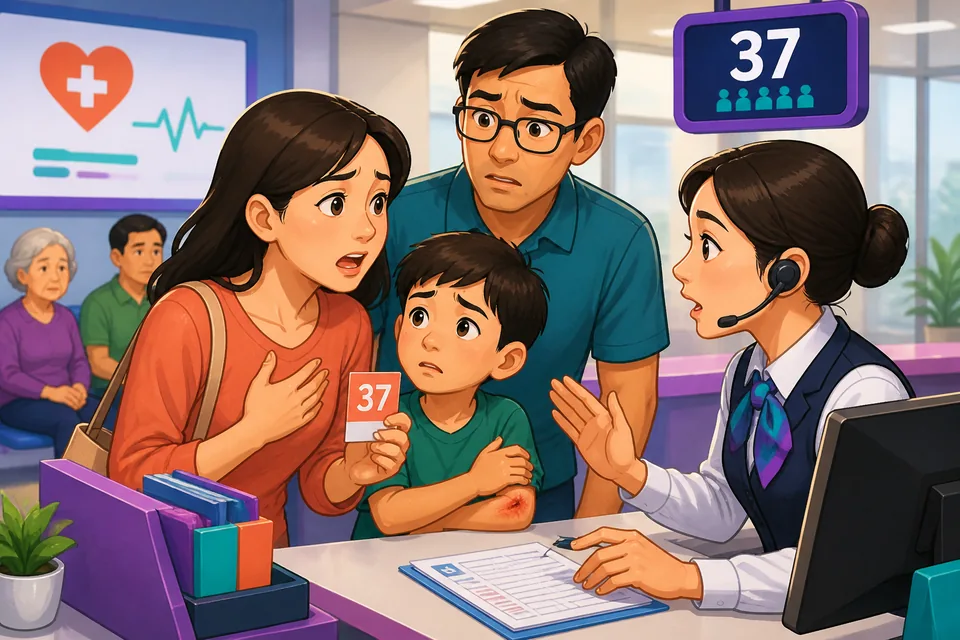
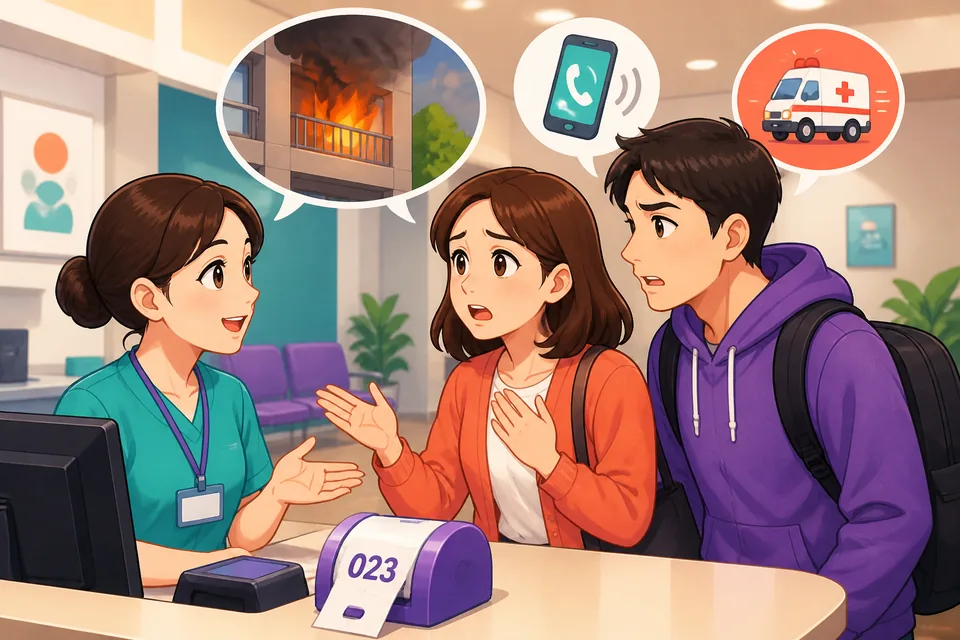
这是紧急情况
Zhè shì jǐnjí qíngkuàng.
This is an emergency.
Meaning: This is an emergency.
When to use: Say this to alert others immediately when something dangerous or urgent is happening.
Examples ▼ 有人叫:"这是紧急情况!",大家赶快离开。
Yǒu rén jiào: "Zhè shì jǐnjí qíngkuàng!", dàjiā gǎnkuài líkāi.
Someone shouts, "This is an emergency!" — everyone evacuates quickly.
看到楼下着火,他对路人说:这是紧急情况。
Kàn dào lóuxià zháohuǒ, tā duì lùrén shuō: Zhè shì jǐnjí qíngkuàng.
He sees a fire below and tells passersby, "This is an emergency."
我现在需要帮助。
Wǒ xiànzài xūyào bāngzhù.
I need help right now.
Meaning: I need help right now.
When to use: Use this to ask people nearby for immediate assistance — clear and direct.
Tip: Beginners sometimes drop 现在 (xiànzài) and say 需要帮助, which sounds less urgent. Add 马上 (mǎshàng) for extra urgency.
Examples ▼ 医生不在,我现在需要帮助,有人帮忙吗?
Yīshēng bú zài, wǒ xiànzài xūyào bāngzhù, yǒu rén bāngmáng ma?
The doctor isn’t here; I need help right now. Can anyone help?
我现在需要帮助,我喘不上气!
Wǒ xiànzài xūyào bāngzhù, wǒ chuǎn bù shàng qì!
I need help now, I can’t breathe!
请打急救电话
Qǐng dǎ jíjiù diànhuà.
Please call emergency services.
Meaning: Please call emergency services.
When to use: Ask someone to contact police, ambulance, or fire department right away.
Tip: Learners may mix up emergency numbers. In mainland China use 120 for ambulance, 119 for fire, 110 for police.
Examples ▼ 请打急救电话,那里有人受伤了。
Qǐng dǎ jíjiù diànhuà, nàlǐ yǒu rén shòushāng le.
Please call emergency services — someone is injured over there.
着火了!请打急救电话!
Zháohuǒ le! Qǐng dǎ jíjiù diànhuà!
Fire! Please call emergency services!
有人受伤了
Yǒu rén shòushāng le.
Someone is hurt.
Meaning: Someone is hurt.
When to use: Report that a person has been injured so others can respond or call help.
Examples ▼ 小心,前面有人受伤了,别靠近。
Xiǎoxīn, qiánmiàn yǒu rén shòushāng le, bié kàojìn.
Careful — someone is hurt ahead; don’t get too close.
刚刚车祸后,有人受伤了,我们需要急救。
Gānggāng chēhuò hòu, yǒu rén shòushāng le, wǒmen xūyào jíjiù.
After the crash, someone was hurt; we need urgent medical help.
着火了
Zháohuǒ le.
There is a fire.
Meaning: There is a fire.
When to use: Shout this to warn people and call attention to a fire quickly.
Examples ▼ 厨房着火了,大家快跑!
Chúfáng zháohuǒ le, dàjiā kuài pǎo!
The kitchen is on fire — everyone run!
着火了,请按灭火器按钮!
Zháohuǒ le, qǐng àn mièhuǒqì ànniǔ!
There’s a fire — press the fire extinguisher button!
最近的医院在哪儿?
Zuìjìn de yīyuàn zài nǎr?
Where is the nearest hospital?
Meaning: Where is the nearest hospital?
When to use: Ask this when you need medical treatment and want directions.
Examples ▼ 他问:最近的医院在哪儿?我们可以开车送他去。
Tā wèn: Zuìjìn de yīyuàn zài nǎr? Wǒmen kěyǐ kāichē sòng tā qù.
He asks: "Where is the nearest hospital?" — we can drive him there.
请问,最近的医院在哪儿?我朋友受伤了。
Qǐngwèn, zuìjìn de yīyuàn zài nǎr? Wǒ péngyǒu shòushāng le.
Excuse me, where is the nearest hospital? My friend is hurt.
我觉得不安全
Wǒ juéde bù ānquán.
I don't feel safe.
Meaning: I don't feel safe.
When to use: Use when you want to tell someone you feel threatened or uneasy.
Examples ▼ 这条路太暗了,我觉得不安全,能一起走吗?
Zhè tiáo lù tài àn le, wǒ juéde bù ānquán, néng yìqǐ zǒu ma?
This street is too dark; I don’t feel safe. Can we walk together?
夜里独自回家时,我会说:我觉得不安全。
Yèli dúzì huí jiā shí, wǒ huì shuō: Wǒ juéde bù ānquán.
When I walk home alone at night, I say: I don't feel safe.
请陪着我
Qǐng péizhe wǒ.
Please stay with me.
Meaning: Please stay with me.
When to use: Ask someone nearby to remain beside you when you’re scared, injured, or alone.
Examples ▼ 手术后她很害怕,对护士说:请陪着我。
Shǒushù hòu tā hěn hàipà, duì hùshi shuō: Qǐng péizhe wǒ.
After surgery she was scared and told the nurse: Please stay with me.
我在街角等救护车,请陪着我,不要走开。
Wǒ zài jiējiǎo děng jiùhùchē, qǐng péizhe wǒ, búyào zǒukāi.
I’m at the corner waiting for the ambulance — please stay with me, don’t leave.
我喘不上气
Wǒ chuǎn bù shàng qì.
I can't breathe.
Meaning: I can't breathe.
When to use: Say this immediately if you’re having trouble breathing; people will understand this as a medical emergency.
Tip: Learners sometimes say 我不能呼吸了 which is very literal and sounds more dramatic; 我喘不上气 is the more natural spoken line.
Examples ▼ 他突然说:我喘不上气,大家赶紧叫医生!
Tā tūrán shuō: Wǒ chuǎn bù shàng qì, dàjiā gǎnjǐn jiào yīshēng!
He suddenly says: I can't breathe — everyone call a doctor!
过敏反应很严重,我喘不上气,需要注射肾上腺素。
Guòmǐn fǎnyìng hěn yánzhòng, wǒ chuǎn bù shàng qì, xūyào zhùshè shènshàngxiàn sù.
A severe allergic reaction — I can't breathe and need an epinephrine injection.
能帮我给我的___打电话吗?
Néng bāng wǒ gěi wǒ de ___ dǎ diànhuà ma?
Can you call my ___?
Meaning: Can you call my ___?
When to use: Ask someone to phone a specific person (family, friend) for help or to come pick you up.
Examples ▼ 我头晕,能帮我给我的妈妈打电话吗?
Wǒ tóuyūn, néng bāng wǒ gěi wǒ de māmā dǎ diànhuà ma?
I'm dizzy — can you call my mom for me?
受伤了,你能帮我给我的朋友打电话吗?他们知道我在哪儿。
Shòushāng le, nǐ néng bāng wǒ gěi wǒ de péngyǒu dǎ diànhuà ma? Tāmen zhīdào wǒ zài nǎr.
I'm hurt — can you call my friend? They know where I am.
你受伤了吗
Nǐ shòushāng le ma?
Are you hurt?
Meaning: Are you hurt?
When to use: Use to quickly check whether one person is injured after a fall or accident.
Examples ▼ 他扶起摔倒的人,问:你受伤了吗?
Tā fú qǐ shuāidǎo de rén, wèn: Nǐ shòushāng le ma?
He helps up the fallen person and asks, "Are you hurt?"
车祸后,旁边的人不停地问:你受伤了吗?
Chēhuò hòu, pángbiān de rén bùtíng de wèn: Nǐ shòushāng le ma?
After the accident, people nearby keep asking: Are you hurt?
大家都没事吧
Dàjiā dōu méi shì ba?
Is everyone okay?
Meaning: Is everyone okay?
When to use: Ask this to check the safety of a group after an emergency like a fire or crash.
Examples ▼ 报警后,他急着问:大家都没事吧?
Bàojǐng hòu, tā jí zhe wèn: Dàjiā dōu méi shì ba?
After calling the police, he anxiously asks: Is everyone okay?
地铁停电后,乘客互相问:大家都没事吧?
Dìtiě tíngdiàn hòu, chéngkè hùxiāng wèn: Dàjiā dōu méi shì ba?
After the subway power cut, passengers ask each other: Is everyone okay?
请不要动
Qǐng búyào dòng.
Please don't move.
Meaning: Please don't move.
When to use: Tell someone not to move if they may have a serious injury (neck, back) or before first aid arrives.
Examples ▼ 看到脖子可能受伤,他稳住人说:请不要动。
Kàn dào bózi kěnéng shòushāng, tā wěnzhù rén shuō: Qǐng búyào dòng.
Seeing a possible neck injury, he stabilizes the person and says: Please don't move.
警察到来前,旁人对受伤者说:请不要动,我们在等救护车。
Jǐngchá dàolái qián, pángrén duì shòushāng zhě shuō: Qǐng búyào dòng, wǒmen zài děng jiùhùchē.
Before police arrive, bystanders tell the injured: Please don't move, we’re waiting for the ambulance.
Which phrase means 'Please call emergency services'? 你受伤了吗 请打急救电话 我觉得不安全
If someone says '我喘不上气', what is happening? They can't breathe. They don't feel safe. They are asking where the hospital is.
Which question asks for the location of medical help? 请不要动 最近的医院在哪儿? 这是紧急情况
You are alone and scared — which phrase asks someone to stay with you? 着火了 大家都没事吧 请陪着我
Smoke is coming out downstairs; the neighbor shouts: 'There is a fire.' 楼下冒出浓烟,邻居大声喊:"___"。
Lóuxià mào chū nóng yān, línjū dà shēng hǎn: "___".
最近的医院在哪儿? 请陪着我 着火了 我觉得不安全
You fall on the road; a bystander seeing your condition says: 'Please don't move.' 你在路上摔倒,旁人看到你的情况,说:"___"。
Nǐ zài lùshàng shuāidǎo, pángrén kàn dào nǐ de qíngkuàng, shuō: "___".
请不要动 能帮我给我的妈妈打电话吗? 请打急救电话 大家都没事吧
I'm outside the hospital and need family to pick me up. I say to a passerby: 'Can you call my mom?' 我在医院外,需要家人接我。我对路人说:"___"
Wǒ zài yīyuàn wài, xūyào jiārén jiē wǒ. Wǒ duì lùrén shuō: "___"
我喘不上气 能帮我给我的妈妈打电话吗? 这是紧急情况 我觉得不安全
这是紧急情况 Zhè shì jǐnjí qíngkuàng. 我现在需要帮助。 Wǒ xiànzài xūyào bāngzhù. 请打急救电话 Qǐng dǎ jíjiù diànhuà. 有人受伤了 Yǒu rén shòushāng le. 着火了 Zháohuǒ le. 最近的医院在哪儿? Zuìjìn de yīyuàn zài nǎr? 我觉得不安全 Wǒ juéde bù ānquán. 请陪着我 Qǐng péizhe wǒ. This is an emergency. I need help right now. Please call emergency services. Someone is hurt. There is a fire. Where is the nearest hospital? I don't feel safe. Please stay with me.
我喘不上气 Wǒ chuǎn bù shàng qì. 能帮我给我的___打电话吗? Néng bāng wǒ gěi wǒ de ___ dǎ diànhuà ma? 你受伤了吗 Nǐ shòushāng le ma? 大家都没事吧 Dàjiā dōu méi shì ba? 请不要动 Qǐng búyào dòng. 救护车来了 Jiùhùchē lái le. I can't breathe. Can you call my ___? Are you hurt? Is everyone okay? Please don't move. The ambulance is here.
Recording stays on your device only. Check speech uses your browser's speech tools when available.
Say this phrase out loud:
这是紧急情况
Zhè shì jǐnjí qíngkuàng.
This is an emergency.
Check speech
Record Play back
Say this phrase out loud:
我现在需要帮助。
Wǒ xiànzài xūyào bāngzhù.
I need help right now.
Check speech
Record Play back
Say this phrase out loud:
请打急救电话
Qǐng dǎ jíjiù diànhuà.
Please call emergency services.
Check speech
Record Play back
Say this phrase out loud:
有人受伤了
Yǒu rén shòushāng le.
Someone is hurt.
Check speech
Record Play back
Say this phrase out loud:
着火了
Zháohuǒ le.
There is a fire.
Check speech
Record Play back
Say this phrase out loud:
最近的医院在哪儿?
Zuìjìn de yīyuàn zài nǎr?
Where is the nearest hospital?
Check speech
Record Play back
Say this phrase out loud:
我觉得不安全
Wǒ juéde bù ānquán.
I don't feel safe.
Check speech
Record Play back
Say this phrase out loud:
请陪着我
Qǐng péizhe wǒ.
Please stay with me.
Check speech
Record Play back
Say this phrase out loud:
我喘不上气
Wǒ chuǎn bù shàng qì.
I can't breathe.
Check speech
Record Play back
Say this phrase out loud:
能帮我给我的___打电话吗?
Néng bāng wǒ gěi wǒ de ___ dǎ diànhuà ma?
Can you call my ___?
Check speech
Record Play back
Say this phrase out loud:
你受伤了吗
Nǐ shòushāng le ma?
Are you hurt?
Check speech
Record Play back
Say this phrase out loud:
大家都没事吧
Dàjiā dōu méi shì ba?
Is everyone okay?
Check speech
Record Play back
Say this phrase out loud:
请不要动
Qǐng búyào dòng.
Please don't move.
Check speech
Record Play back