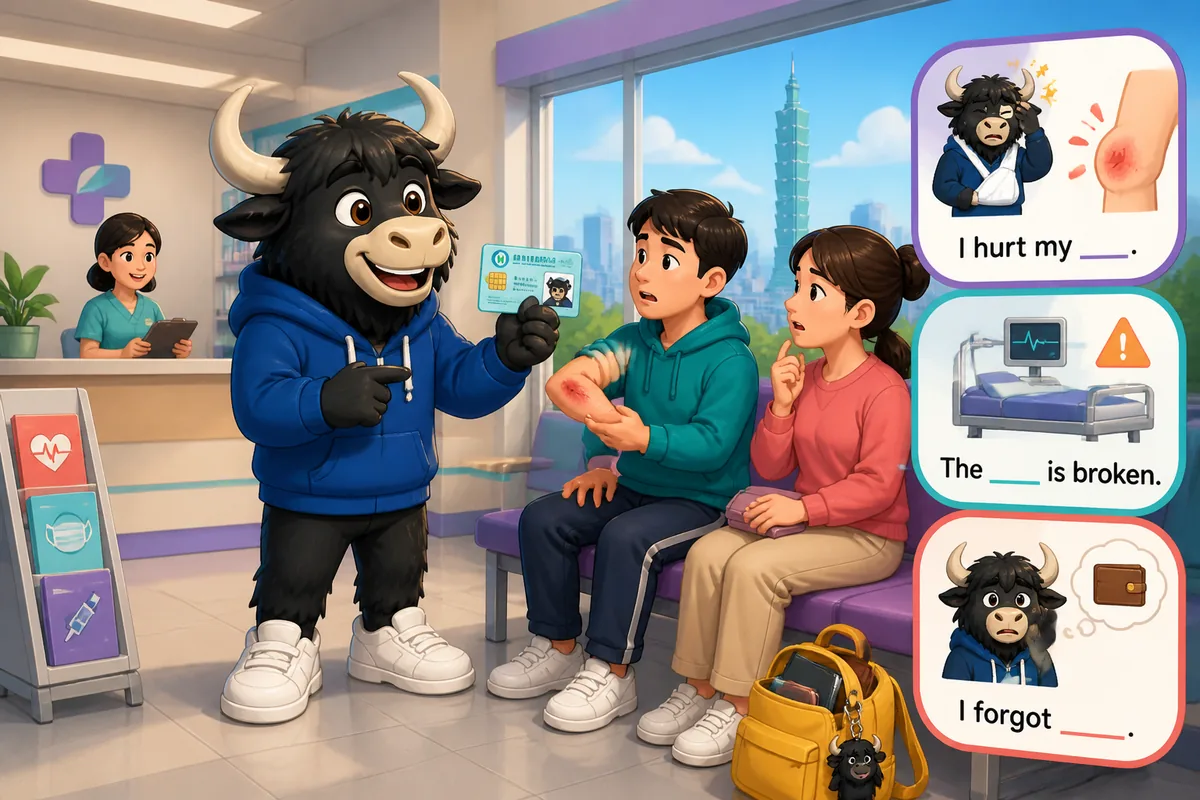
Welcome to Lesson 24! Ready to explain small problems in Chinese? This short lesson helps you say what went wrong — from a twisted ankle to a broken phone. Listen, repeat, then use the phrases in real situations.
Level A1: In Lesson 24 you'll learn simple ways to report everyday problems — e.g. 我的___受伤了 (Wǒ de ___ shòushāng le), ___坏了 (___ huài le), 我忘了___ (Wǒ wàng le ___), 我错过了___ (Wǒ cuòguò le ___), 我迟到了 (Wǒ chídào le), 我付不了钱 (Wǒ fù bù liǎo qián) and 太___了 (Tài ___ le). This CEFR-aligned mini-lesson focuses on hearing, repeating, and using these short statements so you can explain mishaps clearly.
After this lesson you'll be able to:
Learn and pronounce 7 useful problem statements (Level A1).
Be able to say which body part is injured with 我的___受伤了 (Wǒ de ___ shòushāng le).
Explain broken things (___坏了, ___ huài le), forgetting (我忘了___, Wǒ wàng le ___) and missing things (我错过了___, Wǒ cuòguò le ___).
Say basic timing and payment problems: 我迟到了 (Wǒ chídào le) and 我付不了钱 (Wǒ fù bù liǎo qián).
Ready? Let's go!
When you tap play on phrases, we track your progress through this lesson.
1. Reading + Listening Practice
Hear core phrases, repeat aloud.
我的___受伤了。
Wǒ de ___ shòushāng le.
I hurt my ___.
Meaning: I hurt my ___.
When to use: Use this to tell someone a part of your body is injured. You can say the body part in the blank: 我的脚受伤了 (Wǒ de jiǎo shòushāng le).
Tip: Beginners sometimes say 我受伤了 without specifying the part — add the body part (我的腿、我的手) for clarity.
我的脚受伤了
Wǒ de jiǎo shòushāng le.
My foot is injured.
我的手受伤了,所以不能拿东西。
Wǒ de shǒu shòushāng le, suǒyǐ bùnéng ná dōngxi.
My hand is injured, so I can't carry things.
___坏了
___ huài le.
The ___ is broken.
Meaning: The ___ is broken.
When to use: Use this for machines, devices, or objects that stopped working: 手机坏了 (Shǒujī huài le).
我的手机坏了,不能发消息。
Wǒ de shǒujī huài le, bùnéng fā xiāoxi.
My phone is broken, I can't send messages.
这台打印机坏了,需要修理。
Zhè tái dǎyìnjī huài le, xūyào xiūlǐ.
This printer is broken and needs repair.
我忘了___
Wǒ wàng le ___.
I forgot ___.
Meaning: I forgot ___.
When to use: Use this to say you forgot something like keys, a ticket, or a name: 我忘了带钥匙 (Wǒ wàng le dài yàoshi).
Tip: Don’t confuse 我忘了 and 我忘记了 — both are correct, but 我忘了 is more common in casual speech.
对不起,我忘了带钥匙。
Duìbuqǐ, wǒ wàng le dài yàoshi.
Sorry, I forgot to bring my keys.
我忘了明天的会议时间。
Wǒ wàng le míngtiān de huìyì shíjiān.
I forgot the meeting time for tomorrow.
我错过了___。
Wǒ cuòguò le ___.
I missed ___.
Meaning: I missed ___.
When to use: Use this for missing transport or events: 我错过了飞机 (Wǒ cuòguò le fēijī) or 我错过了会议 (Wǒ cuòguò le huìyì).
Tip: Beginners sometimes say 我没赶上… (I didn't catch…) instead — both are fine; 我错过了 focuses on 'missed'.
不好意思,我错过了早上的火车。
Bù hǎoyìsi, wǒ cuòguò le zǎoshang de huǒchē.
Sorry, I missed the morning train.
我错过了会议,所以现在补看录音。
Wǒ cuòguò le huìyì, suǒyǐ xiànzài bǔ kàn lùyīn.
I missed the meeting, so I'm catching up with the recording now.
我迟到了
Wǒ chídào le.
I'm late.
Meaning: I'm late.
When to use: Use 我迟到了 to tell someone you arrived after the scheduled time.