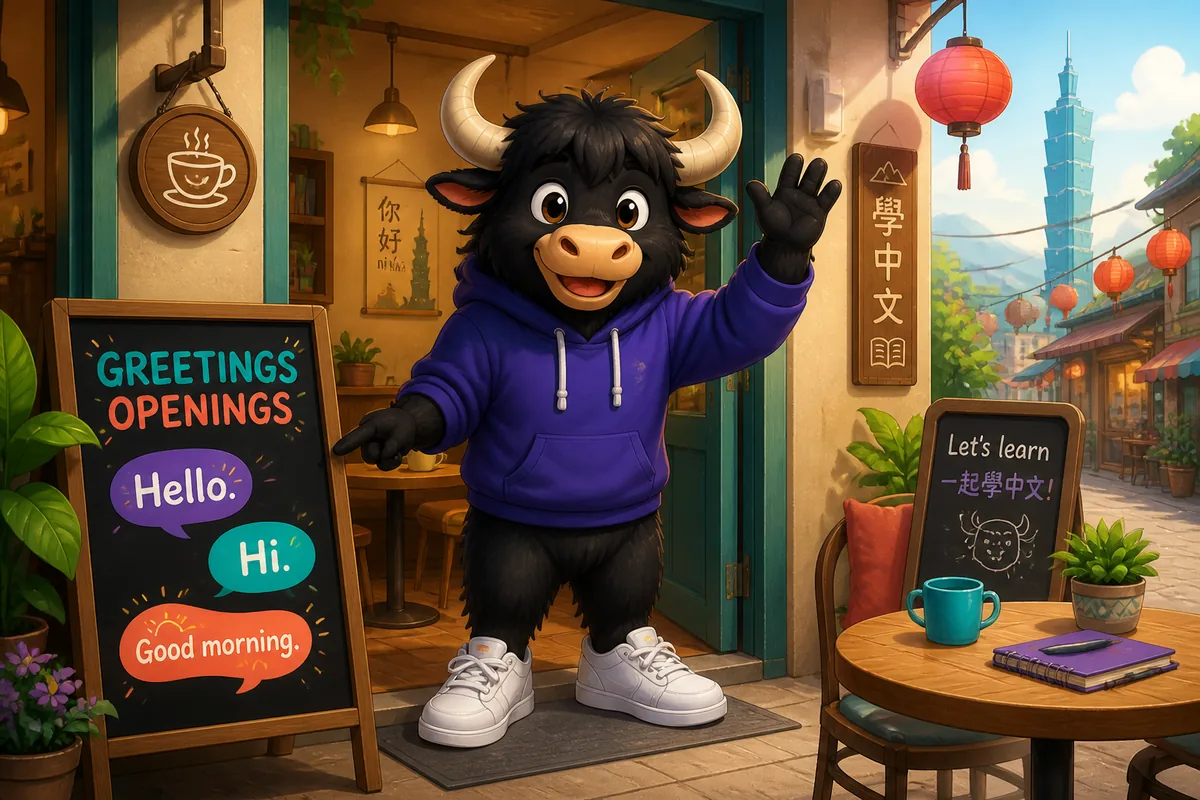
Welcome to Lesson 1! Yak Yacker lessons are short and friendly: first you listen to useful phrases, then you practice with quizzes, and finally you speak them out loud.
This lesson is about simple openings — greetings, quick questions, and how to introduce yourself. Have fun and repeat aloud!
Level A1: This lesson teaches core greetings (你好, 嗨), time-specific hellos (早上好, 下午好, 晚上好), short ways to ask how someone is (你好吗?) and reply (挺好的,谢谢。), simple introductions (我叫___, 你叫什么名字?), and polite openers for joining or starting a chat (我可以加入吗?, 你现在方便吗?, 欢迎!, 今天天气不错。). You'll listen, repeat, and practice these everyday openings — CEFR-aligned and ready for real conversations.
After this lesson you'll be able to:
Level A1: Learn 13 common greetings and opening phrases in spoken Mandarin (你好, 嗨, 早上好, etc.).
Be able to ask and answer “How are you?” and give a short self-introduction (我叫___)。
Use polite openings to join conversations or start small talk (我可以加入吗?, 你现在方便吗?).
Ready? Let's go!
When you tap play on phrases, we track your progress through this lesson.
1. Reading + Listening Practice
Hear core phrases, repeat aloud.
你好
nǐ hǎo
Hello.
Meaning: Hello.
When to use: General greeting for most situations. For greater politeness, use 您好 (nín hǎo).
Tip: Don’t use 你好 with someone you must show formal respect to; use 您好 instead.
你好,我叫李华。
nǐ hǎo, wǒ jiào Lǐ Huá.
Hello, I'm Li Hua.
你好!今天你看起来很高兴。
nǐ hǎo! jīntiān nǐ kàn qǐlái hěn gāoxìng.
Hello! You seem happy today.
嗨
hāi
Hi.
Meaning: Hi.
When to use: Casual greeting among friends, classmates, or young people.
Tip: Avoid 嗨 in formal settings (boss, teacher). It’s casual.
嗨,今天晚上有空吗?
hāi, jīntiān wǎnshang yǒu kòng ma?
Hi, are you free tonight?
嗨,久不见
hāi, jiǔ bù jiàn!
Hi — long time no see!
早上好
zǎo shang hǎo
Good morning.
Meaning: Good morning.
When to use: Use in the morning; '早' is a shorter, more casual alternative.
早上好,今天我们八点开会。
zǎo shang hǎo, jīntiān wǒmen bā diǎn kāihuì.
Good morning, our meeting is at eight today.
对面那位说:早上好!
duìmiàn nà wèi shuō: zǎo shang hǎo!
The person across said: Good morning!
下午好
xià wǔ hǎo
Good afternoon.
Meaning: Good afternoon.
When to use: Use in the afternoon hours. For evening greetings use 晚上好。
下午好,我们开始上课吧。
xià wǔ hǎo, wǒmen kāishǐ shàngkè ba.
Good afternoon, let's start class.
下午好,咖啡想要什么?
xià wǔ hǎo, kāfēi xiǎng yào shénme?
Good afternoon, what coffee would you like?
晚上好
wǎn shang hǎo
Good evening.
Meaning: Good evening.
When to use: Polite evening greeting. Often used in formal or service settings.
晚上好,欢迎来到我们的活动。
wǎn shang hǎo, huānyíng lái dào wǒmen de huódòng.
Good evening, welcome to our event.
到了饭馆,服务员说:晚上好!
dào le fànguǎn, fúwùyuán shuō: wǎn shang hǎo!
At the restaurant, the server said: Good evening!
你好吗
nǐ hǎo ma
How are you?
Meaning: How are you?
When to use: A basic A1 question to ask how someone is feeling. Friends may use 最近怎么样? for more casual small talk.
你好吗?好久没见了!
nǐ hǎo ma? hǎo jiǔ méi jiàn le!
How are you? Long time no see!
早上好,你好吗?
zǎo shang hǎo, nǐ hǎo ma?
Good morning, how are you?
挺好的,谢谢
tǐng hǎo de, xiè xie
I'm good, thanks.
Meaning: I'm good, thanks.
When to use: Short, natural reply to 'How are you?'.
A: 你好吗? B: 挺好的,谢谢。
A: nǐ hǎo ma? B: tǐng hǎo de, xiè xie.
A: How are you? B: I'm good, thanks.
我最近很忙,但挺好的,谢谢。
wǒ zuìjìn hěn máng, dàn tǐng hǎo de, xiè xie.
I've been busy recently, but I'm good, thanks.
我叫___
wǒ jiào ___
I'm ___.
Meaning: I'm ___.
When to use: Natural way to tell someone your name: 我叫 + name. Use 我是 + role or identity sometimes.
Tip: Beginner mistake: using 我是 only for names — 我是 can sound more formal or reference a role; 用 我叫 to say your name.