Simplified Chinese - Travel Experience

Lesson 65 of 156

A traveler with a backpack looking at a map in Simplified Chinese, showing the theme Travel Experience — a photo of a windy coastal road.

Goal: Tell a short travel story about surprises and what you learned

Free Simplified Chinese lessons with guided practice, audio, and speaking support.

Welcome back — you're on lesson 65! Today we'll tell travel stories: the good, the messy, and the memorable. Have fun practicing these real-life phrases and repeating them aloud.

Level B1: In this lesson you’ll practice useful chunks for describing trips that didn’t go as planned — explain what happened on the way, say you got lost, compare expectations with reality, mention people you met, photos you took, and what you’ll do next time. This CEFR-aligned lesson focuses on short story frames you can reuse in conversations.

After this lesson you'll be able to:

  • Be able to explain that a trip didn’t go as planned using 这次旅行没按计划来。 (Zhè cì lǚxíng méi àn jìhuà lái.)
  • Introduce an unexpected event on the way: 去的路上,发生了___。 (Qù de lùshang, fāshēng le ___.)
  • Say you got lost and found your way back: 我迷路了,但后来找到了回去的路。 (Wǒ mílù le, dàn hòulái zhǎodào le huíqù de lù.)
  • Describe comparisons, people met, photos, and plans for next time using the lesson frames.
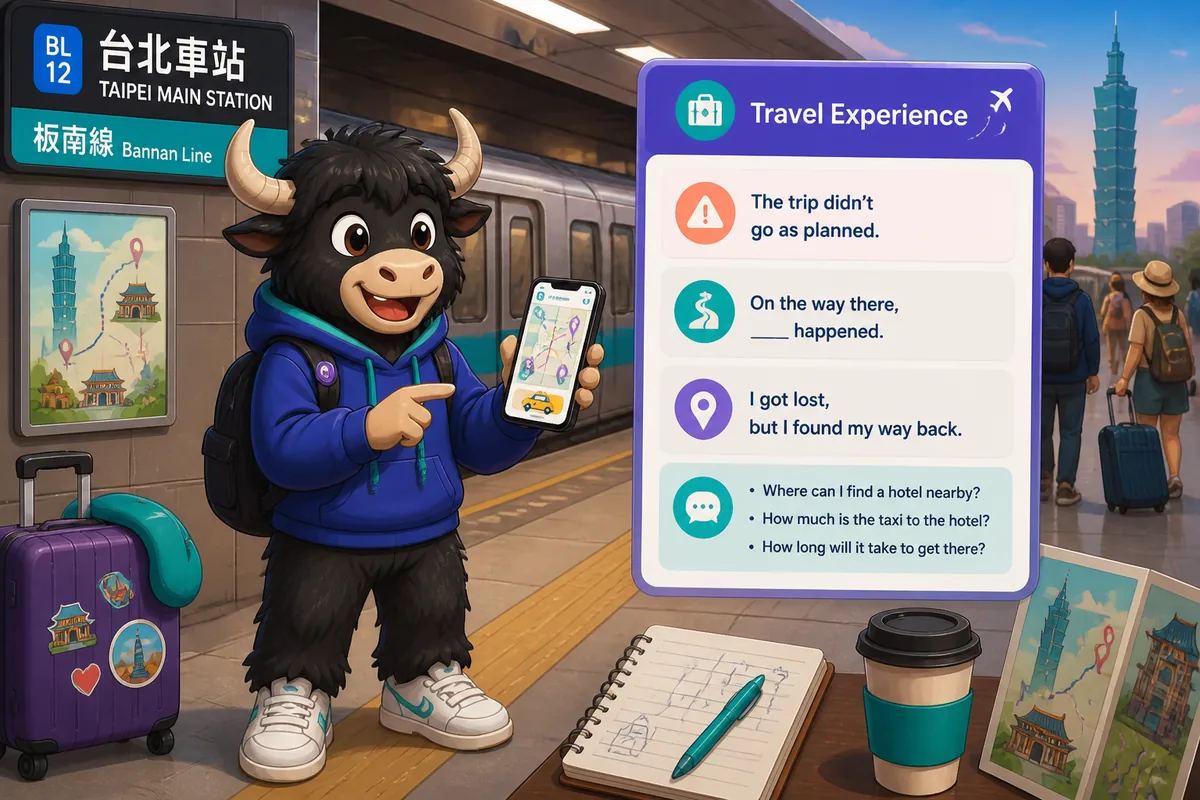
Two friends talking beside a train station about a trip that didn't go as planned, with Chinese phrases visible on a notebook.

Ready? Let's go!

When you tap play on phrases, we track your progress through this lesson.

1. Reading + Listening Practice

Hear core phrases, repeat aloud.

这次旅行没按计划来。

Zhè cì lǚxíng méi àn jìhuà lái.

The trip didn't go as planned.

Meaning: The trip didn’t go as planned.

When to use: Use this neutral spoken phrase to summarize that your trip had unexpected problems or changes.

Tip: Don't drop the '来' if you want the casual spoken tone; alternatively you can say 没有按计划进行 in more formal contexts.

这次旅行没按计划来,因为天气突然变坏了。

Zhè cì lǚxíng méi àn jìhuà lái, yīnwèi tiānqì tūrán biàn huài le.

The trip didn’t go as planned because the weather suddenly got worse.
我们订的火车晚点,这次旅行没按计划来。

Wǒmen dìng de huǒchē wǎndiǎn, zhè cì lǚxíng méi àn jìhuà lái.

Our train was delayed; the trip didn’t go as planned.

去的路上,发生了___。

Qù de lùshang, fāshēng le ___.

On the way there, ___ happened.

Meaning: On the way there, ___ happened.

When to use: Start a travel story by describing a specific incident on the route — fill the blank with an event or accident.

去的路上,发生了大暴雨,我们只好躲在加油站。

Qù de lùshang, fāshēng le dà bàoyǔ, wǒmen zhǐhǎo duǒ zài jiāyóuzhàn.

On the way there, a heavy storm happened, so we had to hide at a gas station.
去的路上,发生了堵车,结果我们迟到了两个小时。

Qù de lùshang, fāshēng le dǔchē, jiéguǒ wǒmen chídào le liǎng gè xiǎoshí.

On the way there, there was a traffic jam and we were two hours late.

我迷路了,但后来找到了回去的路。

Wǒ mílù le, dàn hòulái zhǎodào le huíqù de lù.

I got lost, but I found my way back.

Meaning: I got lost, but I found my way back.

When to use: Use this short story frame when describing a minor getting-lost episode while travelling or walking around a new place.

Tip: Beginners sometimes say 我找到了路 back-to-back; include 回去的路 to clarify 'the way back'.

我迷路了,但后来找到了回去的路,多亏街上那位好心人。

Wǒ mílù le, dàn hòulái zhǎodào le huíqù de lù, duōkuī jiē shàng nà wèi hǎoxīn rén.

I got lost, but later found my way back, thanks to a kind person on the street.
在老城区我迷路了,但后来找到了回去的路,风景比我想的更美。

Zài lǎo chéngqū wǒ mílù le, dàn hòulái zhǎodào le huíqù de lù, fēngjǐng bǐ wǒ xiǎng de gèng měi.

I got lost in the old town, but later found my way back; the scenery was more beautiful than I expected.

它比我想的更___。

Tā bǐ wǒ xiǎng de gèng ___.

It was more ___ than I expected.

Meaning: It was more ___ than I expected.

When to use: Fill the blank with an adjective (e.g., 有意思,难,贵) to compare your expectations with reality.

那个博物馆比我想的更有意思,展品很多。

Nàgè bówùguǎn bǐ wǒ xiǎng de gèng yǒuyìsi, zhǎnpǐn hěn duō.

The museum was more interesting than I thought; it had many exhibits.
那家饭店比我想的更贵,但味道很好。

Nà jiā fàndiàn bǐ wǒ xiǎng de gèng guì, dàn wèidào hěn hǎo.

That restaurant was more expensive than I expected, but the food was good.

我遇到了一些___的人。

Wǒ yùdào le yìxiē ___ de rén.

I met some people who ___ .

Meaning: I met some people who ___.

When to use: Use this frame to mention people you met during the trip — describe them before 的人 (e.g., 很热情 的人).

我遇到了一些很热情的人,他们带我们参观了市场。

Wǒ yùdào le yìxiē hěn rèqíng de rén, tāmen dài wǒmen cānguān le shìchǎng.

I met some very friendly people who took us to the market.
在火车上我遇到了一些来自北京的人,他们给了我很多建议。

Zài huǒchē shàng wǒ yùdào le yìxiē láizì Běijīng de rén, tāmen gěi le wǒ hěn duō jiànyì.

On the train I met some people from Beijing who gave me lots of advice.

我拍了很多___的照片。

Wǒ pāi le hěn duō ___ de zhàopiàn.

I took a lot of photos of ___ .

Meaning: I took a lot of photos of ___.

When to use: Use this to report what you photographed on the trip — fill the blank with people, places, or sights.

我拍了很多古建筑的照片,光线很美。

Wǒ pāi le hěn duō gǔ jiànzhù de zhàopiàn, guāngxiàn hěn měi.

I took a lot of photos of old buildings; the light was beautiful.
每天早上我都会拍很多海边的照片,颜色很特别。

Měi tiān zǎoshang wǒ dūhuì pāi hěn duō hǎibiān de zhàopiàn, yánsè hěn tèbié.

Every morning I took lots of photos of the seaside; the colors were special.

下次我会___。

Xià cì wǒ huì ___.

Next time, I would ___ .

Meaning: Next time, I would ___.

When to use: Say what you will change or do on a future trip — follow with a verb or short phrase (e.g., 早点出发、带更多钱).

下次我会早点出发,这样可以避开高峰期。

Xià cì wǒ huì zǎodiǎn chūfā, zhèyàng kěyǐ bìkāi gāofēngqī.

Next time I'll leave earlier to avoid rush hour.
下次我会带更多现金,很多小店不刷卡。

Xià cì wǒ huì dài gèng duō xiànjīn, hěn duō xiǎodiàn bù shuākǎ.

Next time I'll bring more cash; many small shops don't take cards.

我永远忘不了___的那一刻。

Wǒ yǒngyuǎn wàngbùliǎo ___ de nà yí kè.

I'll never forget the moment when ___ .

Meaning: I’ll never forget the moment when ___.

When to use: Use this to end a travel story with a vivid, personal memory — fill with an action or event (e.g., 看到大海).

我永远忘不了看到日出的那一刻,天空像被染过一样。

Wǒ yǒngyuǎn wàngbùliǎo kàn dào rìchū de nà yí kè, tiānkōng xiàng bèi rǎn guò yíyàng.

I’ll never forget the moment I saw the sunrise; the sky looked dyed.
我永远忘不了和新朋友一起在桥上唱歌的那一刻。

Wǒ yǒngyuǎn wàngbùliǎo hé xīn péngyǒu yìqǐ zài qiáo shàng chànggē de nà yí kè.

I’ll never forget the moment singing on the bridge with new friends.

2. Conversational Listening Practice

Hear phrases in a real mini-conversation.

Anna tells David about a trip that went wrong but left great memories.

Close-up of Anna and David exchanging travel stories in Simplified Chinese at a café, gestures and photos on the table.

What unexpected things happened on Anna's trip?

Portrait of Anna in a Simplified Chinese lesson dialogue

Anna

这次旅行没按计划来。

Zhè cì lǚxíng méi àn jìhuà lái.

The trip didn’t go as planned.

Portrait of David in a Simplified Chinese lesson dialogue

David

怎么了?去的路上发生了什么?

Zěnme le? Qù de lùshang fāshēng le shénme?

What happened? What happened on the way there?

Portrait of Anna in a Simplified Chinese lesson dialogue

Anna

去的路上,发生了大暴雨,我们还迷路了。

Qù de lùshang, fāshēng le dà bàoyǔ, wǒmen hái mílù le.

On the way, a heavy storm happened and we also got lost.

Portrait of David in a Simplified Chinese lesson dialogue

David

你后来怎么办

Nǐ hòulái zěnme bàn?

What did you do later?

Portrait of Anna in a Simplified Chinese lesson dialogue

Anna

我迷路了,但后来找到了回去的路。路上我遇到了一些很热情的人,他们帮我们找路。

Wǒ mílù le, dàn hòulái zhǎodào le huíqù de lù. Lùshang wǒ yùdào le yìxiē hěn rèqíng de rén, tāmen bāng wǒmen zhǎo lù.

I got lost but later found the way back. On the road I met some warm people who helped us.

Portrait of David in a Simplified Chinese lesson dialogue

David

那地方怎么样

Nà dìfāng zěnmeyàng?

How was the place?

Portrait of Anna in a Simplified Chinese lesson dialogue

Anna

它比我想的更漂亮。我拍了很多海边的照片。我永远忘不了看到日出的那一刻。

Tā bǐ wǒ xiǎng de gèng piàoliang. Wǒ pāi le hěn duō hǎibiān de zhàopiàn. Wǒ yǒngyuǎn wàngbùliǎo kàn dào rìchū de nà yí kè.

It was more beautiful than I expected. I took many seaside photos. I’ll never forget the moment of the sunrise.

Portrait of David in a Simplified Chinese lesson dialogue

David

下次你会怎么做?

Xià cì nǐ huì zěnme zuò?

What will you do next time?

Portrait of Anna in a Simplified Chinese lesson dialogue

Anna

下次我会早点出发,准备得更充分。

Xià cì wǒ huì zǎodiǎn chūfā, zhǔnbèi de gèng chōngfèn.

Next time I'll set off earlier and prepare more fully.

3. Guided Practice

Quizzes and matching to lock in meaning.

Which sentence means: 'I got lost, but later found my way back.'?

Choose the best way to say: 'On the way there, a traffic jam happened.'

Which phrase completes 'Next time I would ...'?

Which sentence expresses 'I’ll never forget the moment when I saw the sunrise.'?

On the way there, a traffic jam happened, so we had to wait at the roadside.

去的路上,发生了___,我们只好在路边等。

I got lost in the small town, but later I found the way back and finally reached the hotel.

在小镇里我迷路了,但后来___,终于到了旅馆。

That mountain was steeper than I expected; climbing was harder than I anticipated.

那座山比我想的更___,攀爬比我预期的难。

Match the core phrases

Match the extra phrases

4. Speaking Practice

Say phrases yourself (mic/recording).

Recording stays on your device only. Check speech uses your browser's speech tools when available.

Say this phrase out loud:

这次旅行没按计划来。

Zhè cì lǚxíng méi àn jìhuà lái.

The trip didn’t go as planned.

Say this phrase out loud:

去的路上,发生了___。

Qù de lùshang, fāshēng le ___.

On the way there, ___ happened.

Say this phrase out loud:

我迷路了,但后来找到了回去的路。

Wǒ mílù le, dàn hòulái zhǎodào le huíqù de lù.

I got lost, but I found my way back.

Say this phrase out loud:

它比我想的更___。

Tā bǐ wǒ xiǎng de gèng ___.

It was more ___ than I expected.

Say this phrase out loud:

我遇到了一些___的人。

Wǒ yùdào le yìxiē ___ de rén.

I met some people who ___.

Say this phrase out loud:

我拍了很多___的照片。

Wǒ pāi le hěn duō ___ de zhàopiàn.

I took a lot of photos of ___.

Say this phrase out loud:

下次我会___。

Xià cì wǒ huì ___.

Next time, I would ___.

Say this phrase out loud:

我永远忘不了___的那一刻。

Wǒ yǒngyuǎn wàngbùliǎo ___ de nà yí kè.

I’ll never forget the moment when ___.