Simplified Chinese - Topic Changes

Lesson 87 of 156

People in a meeting room discussing a plan in Simplified Chinese, focusing on polite topic changes and social glue phrases.

Goal: Smooth ways to move a conversation (social glue)

Free Simplified Chinese lessons with guided practice, audio, and speaking support.

Welcome to Lesson 87 — short, practical, and ready for real conversations. Have fun practicing these handy phrases that help you steer group chats and meetings smoothly.

Level B1: In this lesson you'll learn four natural ways to change or connect topics in conversation: 我们接着说___吧。, 稍微换个话题,___. , 这就说到___了。, and 关于___,还有一点。. We'll practice listening, choosing the right phrase for situations, and saying them out loud so you can guide real discussions with confidence. (CEFR-aligned)

After this lesson you'll be able to:

  • Recognize and use four topic-change phrases in spoken conversation.
  • Practice when to move on, briefly switch topics, connect ideas, or add a final point.
  • Use these phrases naturally in meetings and group chats (Level B1).
Two colleagues pause during a planning session and use topic-change phrases in Simplified Chinese to move from one item to the next.

Ready? Let's go!

When you tap play on phrases, we track your progress through this lesson.

1. Reading + Listening Practice

Hear core phrases, repeat aloud.

我们接着说___吧。

Wǒmen jiēzhe shuō ___ ba.

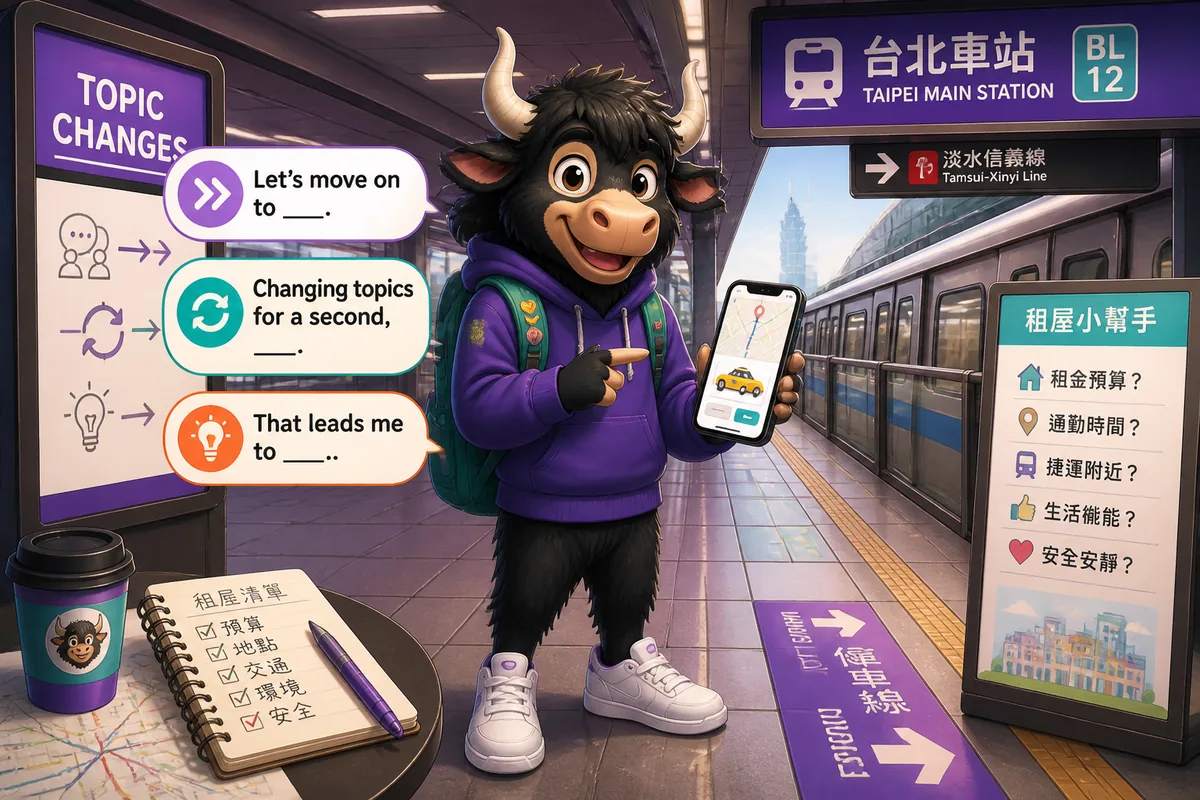
Let's move on to ___.

Meaning: Let's move on to ___.

When to use: Use when you want to move the conversation to a named next topic—common in meetings and group planning.

Tip: Don't leave out the specific topic after 接着说—listeners need to know WHAT to move to.

我们接着说下周活动吧。

Wǒmen jiēzhe shuō xià zhōu huódòng ba.

Let's move on to next week's event.
会议结束前,我们接着说预算问题吧。

Wǒmen jiēzhe shuō yùsuàn wèntí ba.

Before we finish, let's move on to the budget issue.

稍微换个话题,___。

Shāowēi huàn ge huàtí, ___.

Changing topics for a second, ___.

Meaning: Changing topics for a second, ___.

When to use: Use to make a short, light switch in topic—friendly and casual enough for group talk.

Tip: Avoid using this for long agenda items — it's best for short, temporary switches.

稍微换个话题,谈谈客户反馈。

Shāowēi huàn ge huàtí, tán tán kèhù fǎnkuì.

Changing topics for a moment, let's talk about customer feedback.
稍微换个话题,你周末有什么安排?

Shāowēi huàn ge huàtí, nǐ zhōumò yǒu shénme ānpái?

Quickly switching topics, what are your weekend plans?

这就说到___了。

Zhè jiù shuō dào ___ le.

That leads me to ___.

Meaning: That leads me to ___.

When to use: Use to link the current point to a related new point—natural for adding a related thought.

这就说到客户满意度了。

Zhè jiù shuō dào kèhù mǎnyìdù le.

That brings us to customer satisfaction.
这就说到时间管理的问题。

Zhè jiù shuō dào shíjiān guǎnlǐ de wèntí.

That brings up the issue of time management.

关于___,还有一点。

Guānyú ___, hái yǒu yì diǎn.

One more thing about ___.

Meaning: One more thing about ___.

When to use: Use to add a final point on a topic before ending it or switching away.
关于预算,还有一点,我们需要确认供应商名单。

Guānyú yùsuàn, hái yǒu yì diǎn, wǒmen xūyào quèrèn gōngyìngshāng míngdān.

One more thing about the budget: we need to confirm the vendor list.
关于下周活动,还有一点,地点可能要换。

Guānyú xià zhōu huódòng, hái yǒu yì diǎn, dìdiǎn kěnéng yào huàn.

One more thing about next week's event: the venue might change.

2. Conversational Listening Practice

Hear phrases in a real mini-conversation.

Planning a team event and checking the budget

Anna and David discuss next week's event, briefly shift subjects, and add a final budget point using Simplified Chinese topic-transition phrases.

What new topic do Anna and David decide to discuss?

Portrait of Anna in a Simplified Chinese lesson dialogue

Anna

我们接着说下周活动吧。

Wǒmen jiēzhe shuō xià zhōu huódòng ba.

Let's move on to next week's event.

Portrait of David in a Simplified Chinese lesson dialogue

David

好。稍微换个话题,我想问问场地的容量。

Hǎo. Shāowēi huàn ge huàtí, wǒ xiǎng wèn wèn chǎngdì de róngliàng.

Okay. Changing topics briefly, I'd like to ask about the venue capacity.

Portrait of Anna in a Simplified Chinese lesson dialogue

Anna

这就说到预算了,我们可能需要更多赞助。

Zhè jiù shuō dào yùsuàn le, wǒmen kěnéng xūyào gèng duō zànzhù.

That leads to the budget; we may need more sponsorship.

Portrait of David in a Simplified Chinese lesson dialogue

David

关于预算,还有一点,运输费用还没算进来。

Guānyú yùsuàn, hái yǒu yì diǎn, yùnshū fèiyòng hái méi suàn jìnlái.

One more thing about the budget: shipping costs haven't been included yet.

3. Guided Practice

Quizzes and matching to lock in meaning.

Which phrase fits best when you want to move on to the next agenda item?

You want to briefly ask about someone's weekend during a long meeting. Which is best?

Which phrase naturally connects the previous point to a related issue?

You're wrapping up a topic and want to add a last detail before moving on. Which fits?

Let's move on to next week's event.

讨论完用户反馈,Anna 想把话题移到下周活动,她会说:___

Changing topics briefly, let's talk about the weather.

会议中,David 想短暂提到天气,他会说:___

One more thing about scheduling.

总结快结束时,Anna 想补充最后一点关于时间安排,她会说:___

Match the core phrases

Match the extra phrases

4. Speaking Practice

Say phrases yourself (mic/recording).

Recording stays on your device only. Check speech uses your browser's speech tools when available.

Say this phrase out loud:

我们接着说___吧。

Wǒmen jiēzhe shuō ___ ba.

Let's move on to ___.

Say this phrase out loud:

稍微换个话题,___。

Shāowēi huàn ge huàtí, ___.

Changing topics for a second, ___.

Say this phrase out loud:

这就说到___了。

Zhè jiù shuō dào ___ le.

That leads me to ___.

Say this phrase out loud:

关于___,还有一点。

Guānyú ___, hái yǒu yì diǎn.

One more thing about ___.