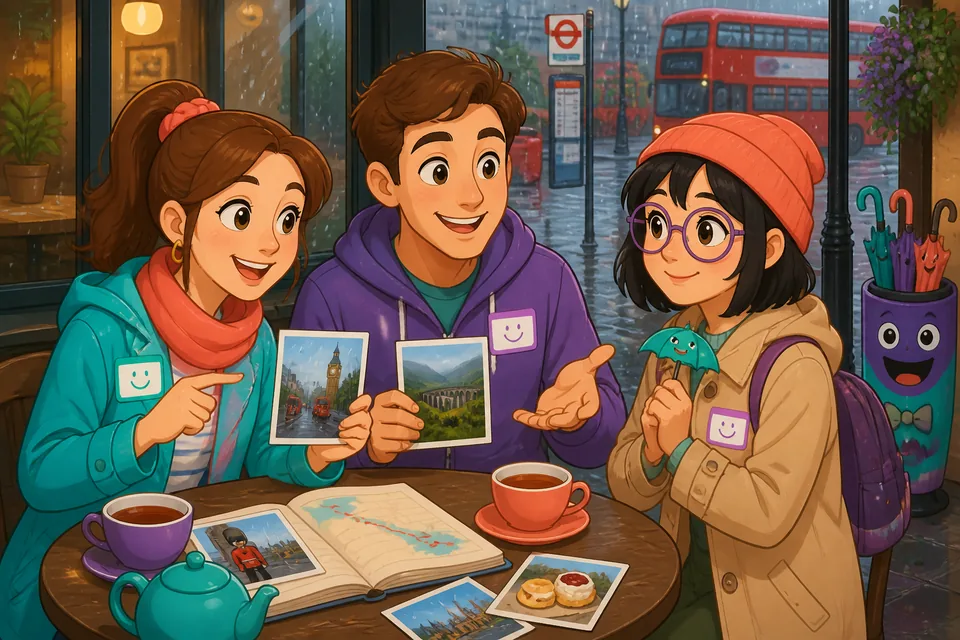
Ready to tell a travel story with confidence? In this short lesson we'll focus on useful B1 phrases to explain what went wrong, what surprised you, and what you'd change next time. Have fun—short, real phrases you can start saying today!
Level B1: Lesson 65 focuses on telling short travel stories and explaining unexpected events. You'll practice phrases to say that a trip didn't go as planned, describe things that happened on the way, mention meeting people, taking photos, and what you'd do next time. This CEFR-aligned set helps you make a convincing travel story in German.
After this lesson you'll be able to:
Describe problems and surprises during a trip (Level B1).
Use phrases to say you got lost, met people, and took photos.
Say what you would change next time and describe a memorable moment.
Ready? Let's go!
When you tap play on phrases, we track your progress through this lesson.
1. Reading + Listening Practice
Hear core phrases, repeat aloud.
Die Reise lief nicht wie geplant.
The trip didn't go as planned.
Meaning: The trip didn't go as planned.
When to use: Use this neutral sentence to summarize a trip that had unexpected problems or delays.
Die Reise lief nicht wie geplant, weil der Zug Verspätung hatte.
The trip didn't go as planned because the train was delayed.
Die Reise lief nicht wie geplant, aber am Ende war es trotzdem ein Erlebnis.
The trip didn't go as planned, but in the end it was still an experience.
Auf dem Weg dorthin ist ___ passiert.
On the way there, ___ happened.
Meaning: On the way there, ___ happened.
When to use: Start a sentence about an event that occurred while you were traveling (fill the blank with the event).
Auf dem Weg dorthin ist ein Reifen geplatzt.
On the way there, a tire burst.
Auf dem Weg dorthin ist etwas Komisches passiert: das GPS hat nicht mehr funktioniert.
On the way there, something strange happened: the GPS stopped working.
Ich habe mich verlaufen, aber ich habe den Weg zurückgefunden.
I got lost, but I found my way back.
Meaning: I got lost, but I found my way back.
When to use: Tell a brief story about being lost on foot and how you recovered.
Tip: Don’t use „verlaufen“ for cars; for driving say „Ich habe mich verfahren.“
Ich habe mich verlaufen, aber ich habe den Weg zurückgefunden, nachdem ich jemanden nach dem Weg gefragt habe.
I got lost, but I found my way back after asking someone for directions.
In der Altstadt habe ich mich verlaufen, aber ich habe den Weg zurückgefunden und bin wieder zum Hotel gekommen.
I got lost in the old town, but I found my way back and returned to the hotel.
Es war ___, als ich erwartet hatte.
It was more ___ than I expected.
Meaning: It was more ___ than I expected.
When to use: Compare how the experience actually felt versus your expectation; use a comparative adjective.
Tip: Remember to use the comparative form (e.g., schöner, teurer, anstrengender).
Es war anstrengender, als ich erwartet hatte.
It was more exhausting than I expected.
Es war schöner, als ich erwartet hatte.
It was more beautiful than I expected.
Ich habe ein paar Leute kennengelernt, die ___.
I met some people who ___ .
Meaning: I met some people who ___.
When to use: Mention people you met while traveling and add a relative clause to describe them.
Ich habe ein paar Leute kennengelernt, die aus verschiedenen Ländern kamen.
I met a few people who came from different countries.
Ich habe ein paar Leute kennengelernt, die mir viele Tipps gegeben haben.
I met a few people who gave me a lot of tips.
Ich habe viele Fotos von ___ gemacht.
I took a lot of photos of ___ .
Meaning: I took a lot of photos of ___.
When to use: Talk about what you photographed on the trip; follow ‚von‘ with the dative (e.g., von der Stadt).
Tip: After ‚von‘ remember the dative: e.g., ‚von der Stadt‘, not ‚von die Stadt‘.
Ich habe viele Fotos von den Bergen gemacht.
I took a lot of photos of the mountains.
Ich habe viele Fotos von der Stadt gemacht, besonders von den alten Häusern.
I took a lot of photos of the city, especially the old houses.
Nächstes Mal würde ich ___.
Next time, I would ___ .
Meaning: Next time, I would ___.
When to use: Say what you would change on a future trip; add an infinitive phrase at the end.
Nächstes Mal würde ich früher buchen, damit alles pünktlich ist.
Next time I would book earlier so everything is on time.
Nächstes Mal würde ich länger bleiben und mehr Orte besuchen.
Next time I would stay longer and visit more places.
Ich werde den Moment nie vergessen, als ___.
I'll never forget the moment when ___ .
Meaning: I'll never forget the moment when ___.
When to use: Describe a single memorable moment from the trip; use ‚als‘ for a one-time past event.
Ich werde den Moment nie vergessen, als wir den Sonnenuntergang vom Berg gesehen haben.
I'll never forget the moment when we saw the sunset from the mountain.
Ich werde den Moment nie vergessen, als das Boot plötzlich vor der Küste anhielt.
I'll never forget the moment when the boat suddenly stopped off the coast.
2. Conversational Listening Practice
Hear phrases in a real mini-conversation.
Anna and David compare travel stories after a trip.
Anna
Die Reise lief nicht wie geplant.
The trip didn't go as planned.
David
Oh nein — Auf dem Weg dorthin ist ein Unfall passiert?
Oh no — did an accident happen on the way there?
Anna
Ja, und ich habe mich verlaufen, aber ich habe den Weg zurückgefunden.
Yes, and I got lost, but I found my way back.
David
War es wenigstens schöner, als du erwartet hattest?
Was it at least more beautiful than you expected?
Anna
Es war schöner, als ich erwartet hatte. Ich habe ein paar Leute kennengelernt, die sehr nett waren.
It was more beautiful than I expected. I met some people who were very nice.
David
Nächstes Mal würde ich früher buchen.
Next time I would book earlier.
3. Guided Practice
Quizzes and matching to lock in meaning.
Which German sentence means "I got lost, but I found my way back."?
Which phrase best fits when you want to say 'On the way there, something happened'?
Which sentence expresses a plan for next time?
Which sentence specifically talks about taking photos?
The trip did not go as planned because the train was cancelled.
Die Reise ___ nicht wie geplant, weil der Zug ausgefallen ist.
On the way there an accident happened: the bus suddenly stopped.
Auf dem Weg dorthin ist ___ passiert: der Bus hielt plötzlich an.
I'll never forget the moment when we saw the sunset from the mountain.
Ich werde den Moment nie vergessen, als ___.
Match the core phrases
Match the extra phrases
4. Speaking Practice
Say phrases yourself (mic/recording).
Recording stays on your device only. Check speech uses your browser's speech tools when available.
Say this phrase out loud:
Die Reise lief nicht wie geplant.
The trip didn't go as planned.
Say this phrase out loud:
Auf dem Weg dorthin ist ___ passiert.
On the way there, ___ happened.
Say this phrase out loud:
Ich habe mich verlaufen, aber ich habe den Weg zurückgefunden.