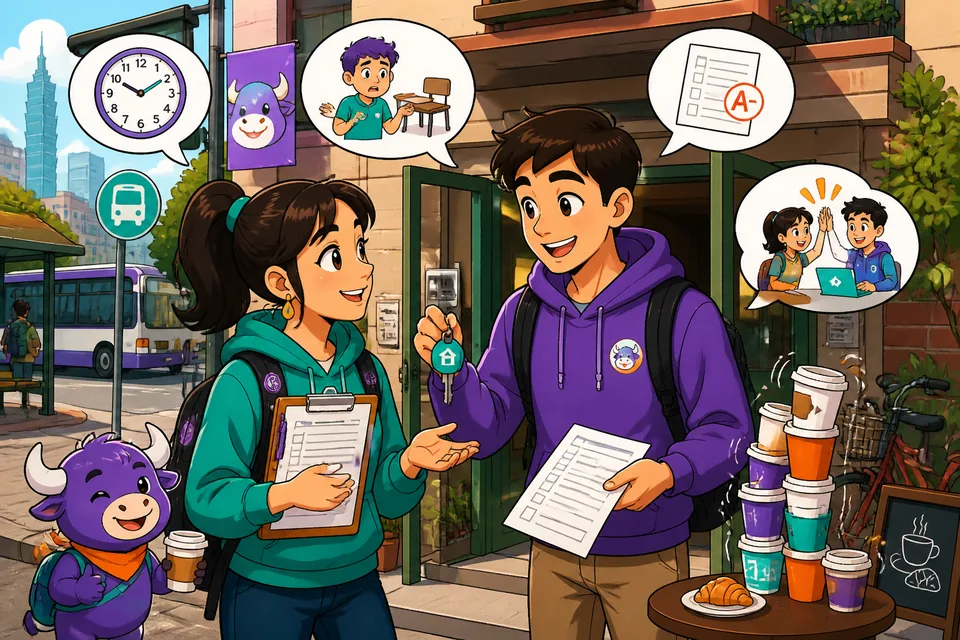
Welcome to Lesson 57 — a short, friendly set of school phrases you can use with classmates and teachers. Have fun practicing these useful lines for asking, reporting, and requesting help.
Level A2: In this lesson (Lesson 57) you'll practice common school phrases: asking to turn in work later, talking about test results, saying when school starts, describing that you missed class, saying you forgot something, asking someone to check your work, and talking about projects and current topics. This CEFR-aligned set focuses on practical classroom communication you can use right away.
After this lesson you'll be able to:
Use polite permissions and requests with teachers and classmates.
Report and ask about test results and project topics.
Say when school starts, explain missed classes, and report forgotten items.
Ready? Let's go!
When you tap play on phrases, we track your progress through this lesson.
1. Reading + Listening Practice
Hear core phrases, repeat aloud.
Kann ich das morgen abgeben?
Can I turn it in tomorrow?
Meaning: Can I turn it in tomorrow?
When to use: Ask a teacher or classmate for permission to submit work one day later.
Tip: Avoid moving 'morgen' in front of the object: 'Kann ich morgen das abgeben?' sounds less natural.
Entschuldigung, Frau Müller — kann ich das morgen abgeben?
Excuse me, Ms. Müller — can I turn it in tomorrow?
Ich bin krank heute. Kann ich das morgen abgeben?
I'm sick today. Can I turn it in tomorrow?
Ich habe im Test ___ bekommen.
I got ___ on the test.
Meaning: I got ___ on the test.
When to use: Report the grade, points or percentage you received on a test.
Ich habe im Test eine Zwei bekommen.
I got a 2 on the test.
Ich habe im Test 80 Prozent bekommen.
I got 80 percent on the test.
Was hast du im Test bekommen?
How did you do on the test?
Meaning: How did you do on the test?
When to use: Ask a classmate informally about their test result (use 'du').
Tip: Don't use 'Sie' with close classmates — this question is informal (du).
Was hast du im Mathetest bekommen?
What did you get on the math test?
Was hast du im Test bekommen? — Eine Drei.
How did you do on the test? — A three.
Wir lernen gerade etwas über ___.
We're learning about ___.
Meaning: We’re learning about ___.
When to use: Say what topic your class is currently studying.
Tip: After 'über' use the correct article (Akkusativ) if you include one; don't replace 'über' with 'von'.
Wir lernen gerade etwas über den Körper.
We’re learning about the body.
Wir lernen gerade etwas über Umweltverschmutzung.
We’re learning about environmental pollution.
Die Schule fängt um ___ an.
School starts at ___.
Meaning: School starts at ___.
When to use: Tell someone the time school or class begins.
Tip: Say 'um' + time: 'Die Schule fängt um acht an.' — word order matters; don't say 'Die Schule um acht fängt an.'
Die Schule fängt um acht an.
School starts at eight.
Die Schule fängt um halb neun an.
School starts at half past eight (8:30).
Ich war gestern nicht im Unterricht.
I missed class yesterday.
Meaning: I missed class yesterday.
When to use: Explain that you were not in class on the previous day.
Tip: Don't mix tenses like 'Ich habe gestern den Unterricht verpasst' is also OK, but avoid incorrect participle forms.
Ich war gestern nicht im Unterricht, weil ich krank war.
I wasn't in class yesterday because I was sick.
Ich war gestern nicht im Unterricht; hast du Notizen für mich?
I missed class yesterday; do you have notes for me?
Ich habe mein ___ zu Hause vergessen.
I forgot my ___ at home.
Meaning: I forgot my ___ at home.
When to use: Tell someone you left a school item at home; adjust 'mein' by gender and case.
Tip: Remember to change 'mein' for gender/case: 'meinen Stift' (Akkusativ masculine).
Ich habe mein Heft zu Hause vergessen.
I forgot my notebook at home.
Ich habe meinen Stift zu Hause vergessen.
I forgot my pen at home.
Wir haben ein Projekt über ___.
We have a project about ___.
Meaning: We have a project about ___.
When to use: Say the subject or topic of a group project at school.
Wir haben ein Projekt über Recycling.
We have a project about recycling.
Wir haben ein Projekt über die Stadtgeschichte.
We have a project about the city's history.
Kannst du mein ___ kurz durchsehen?
Can you check my ___?
Meaning: Can you check my ___?
When to use: Ask a friend to look over your work briefly; use informal 'du'.
Kannst du mein Heft kurz durchsehen?
Can you check my notebook quickly?
Kannst du meinen Text kurz durchsehen?
Can you check my text briefly?
2. Conversational Listening Practice
Hear phrases in a real mini-conversation.
Anna and David meet at school and mention start time, a missed class, a test, and a project.
Anna
Die Schule fängt um acht an, oder?
School starts at eight, right?
David
Ja. Ich war gestern nicht im Unterricht, aber heute bin ich da.
Yes. I missed class yesterday, but I'm here today.
Anna
Was hast du im Test bekommen?
How did you do on the test?
David
Ich habe im Test eine Drei bekommen.
I got a three on the test.
Anna
Wir haben ein Projekt über Recycling. Kannst du mein Teil kurz durchsehen?
We have a project about recycling. Can you check my part quickly?
David
Klar. Und kannst du das morgen abgeben?
Sure. And can you turn it in tomorrow?
3. Guided Practice
Quizzes and matching to lock in meaning.
Which sentence asks for permission to turn in something tomorrow?
Which sentence means 'I missed class yesterday'?
How do you ask a friend 'How did you do on the test?'
Which phrase asks someone to quickly check your work?
I forgot my pen at home.
If you left your pen at home, you can say: ___
Can you check my presentation quickly?
To ask a classmate to check your assignment quickly, choose: ___
I got 80 percent on the test.
When you report your score, you can say: ___
Match the core phrases
Match the extra phrases
4. Speaking Practice
Say phrases yourself (mic/recording).
Recording stays on your device only. Check speech uses your browser's speech tools when available.