
New here? This is lesson 226 of a free 240-lesson German course.
The noise next door in German
Music after ten is leaking through the wall on Fliederstraße. Priya knocks next door, stays on Sie, and names the quiet hours without picking a fight.
The neighbour opens on the landing. Priya wants a solution, not an enemy.
By the end, you'll name the noise, ask for quieter music, cite quiet hours, soften the ask, and thank them for listening.
You keep Sie with a neighbour you do not know well.
By the end of this lesson
Raise a neighbour problem about night noise and quiet hours without making an enemy.
- Es ist in letzter Zeit nachts ziemlich laut.It's been pretty loud at night lately.
- Könnten Sie die Musik etwas leiser stellen?Could you turn the music down a bit?
- Laut Hausordnung gilt nach 22 Uhr Ruhezeit.Under the house rules, quiet hours start at 10 p.m.
- Das soll kein Vorwurf sein.I don't mean that as a complaint about you.
- Können wir gemeinsam eine Lösung finden?Can we find a solution together?
- Danke, dass Sie sich das angehört haben.Thank you for hearing me out.
Scene — the landing
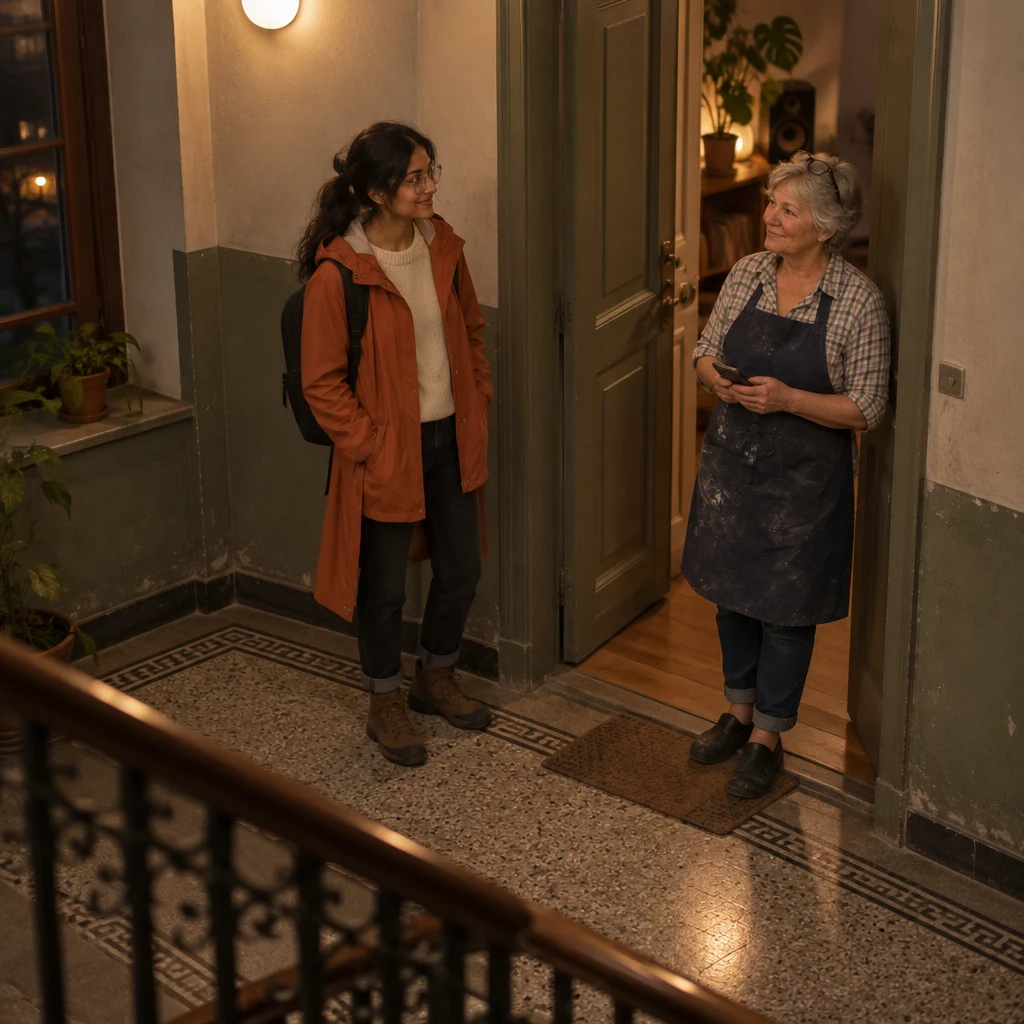
Priya is on the third-floor landing of her Hinterhaus. Music is still coming through the neighbour's door after ten.
She knocks. A neighbour she barely knows opens, still holding a phone. Priya will stay on Sie and keep the talk short.
Learn — noise and quiet hours
Six lines for a neighbour at the door: the noise, a polite ask, quiet hours, a softener, a shared solution, and thanks.
You stay on Sie the whole way.

Es ist in letzter Zeit nachts ziemlich laut.
It's been pretty loud at night lately.
When to use it: Use this when night noise has gone on for more than one evening.
In letzter Zeit comes before nachts, and the verb stays in second place.
Say it: The ch in nachts is the ach sound, not the ich sound.

Könnten Sie die Musik etwas leiser stellen?
Could you turn the music down a bit?
When to use it: Ask this of a neighbour when the music is too loud.
This neighbour is not a friend yet, so the ask stays on Sie.
Say it: Round your lips for the ö in Könnten.
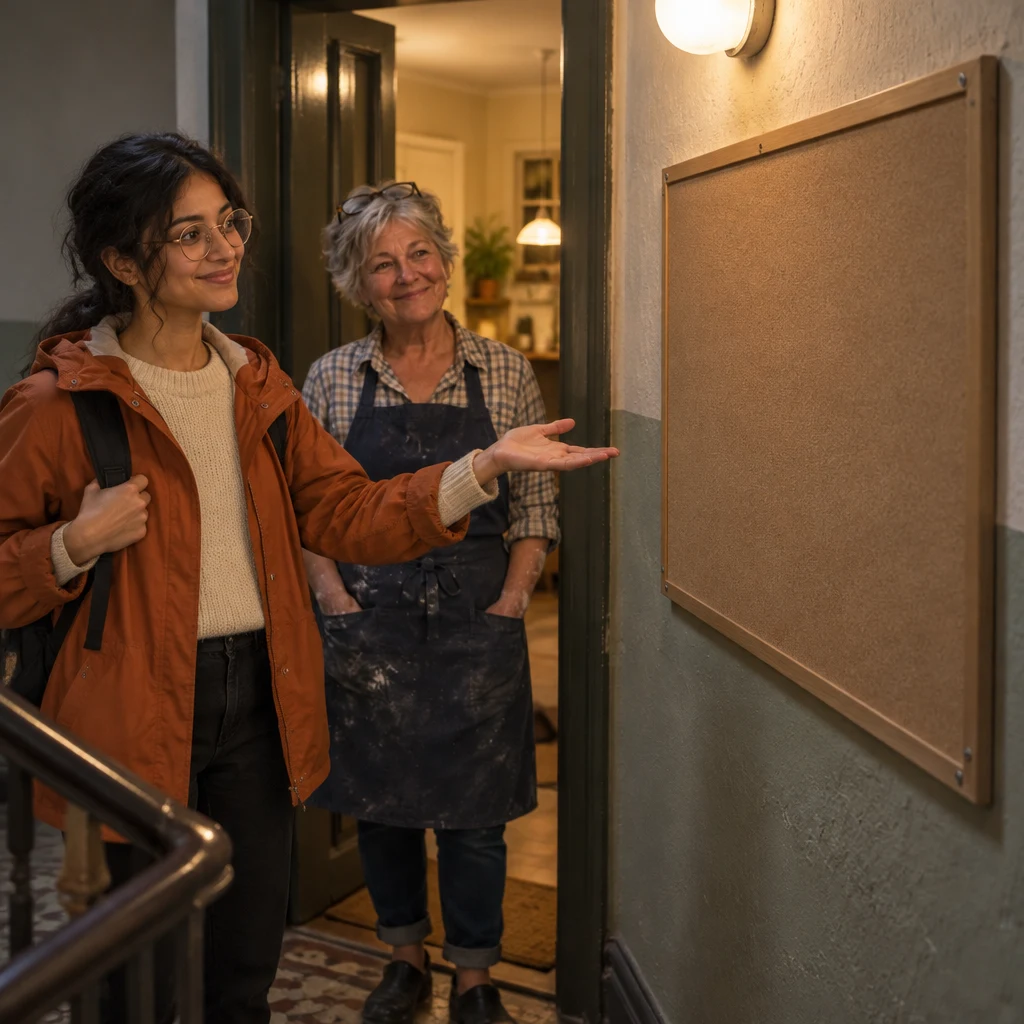
Laut Hausordnung gilt nach 22 Uhr Ruhezeit.
Under the house rules, quiet hours start at 10 p.m.
When to use it: Cite this when quiet hours should already have started.
Here Laut means according to the rules, not loud.
Say it: Hausordnung puts the stress on the first syllable.

Das soll kein Vorwurf sein.
I don't mean that as a complaint about you.
When to use it: Say this right after a request so it does not sound like blame.
This whole line softens the ask so the neighbour does not feel accused.

Können wir gemeinsam eine Lösung finden?
Can we find a solution together?
When to use it: Use this when you want a shared fix, not a fight.
Gemeinsam tells the neighbour you want a fix that works for both of you.
Say it: Round your lips for the ö in Lösung.

Danke, dass Sie sich das angehört haben.
Thank you for hearing me out.
When to use it: Say this when a neighbour has let you finish your point.
After dass, angehört haben come last in the clause.
Story — she knocks
Priya knocks next door after ten. Watch how she names the noise, cites quiet hours, and still leaves the door friendly.
The highlighted words are the lines you just learned. Turn on Show English if you need it.
- The landing light is dim. Bass still comes through the neighbour's door after ten.
- NeighbourJa? Wer ist da?Yes? Who is it?
- The door opens a little. The neighbour still has a phone in one hand.
 PriyaGuten Abend. Ich wohne nebenan.Good evening. I live next door.
- NeighbourAch so. Hallo.Ah. Hello.
- PriyaWie geht es Ihnen?How are you?
- NeighbourGut, danke.I'm good, thanks.
- She takes a breath. The bass is still going.
- PriyaEs ist in letzter Zeit nachts ziemlich laut.It's been pretty loud at night lately.
- NeighbourAch so. Die Musik.Ah. The music.
- PriyaKönnten Sie die Musik etwas leiser stellen?Could you turn the music down a bit?
- NeighbourOh. Ich habe die Uhr gar nicht gesehen.Oh. I didn't even look at the clock.
- PriyaNormalerweise bleibe ich nicht lange auf.I don't usually stay up late.
- NeighbourVerstehe.I see.
- PriyaLaut Hausordnung gilt nach 22 Uhr Ruhezeit.Under the house rules, quiet hours start at 10 p.m.
- NeighbourJa, das stimmt. Ich passe künftig besser auf.Yes, that's right. I'll be more careful from now on.
- PriyaDas soll kein Vorwurf sein.I don't mean that as a complaint about you.
- NeighbourSchon gut. Ich wollte Sie nicht stören.That's all right. I didn't want to disturb you.
- PriyaKönnen wir gemeinsam eine Lösung finden?Can we find a solution together?
- NeighbourJa, klar. Ich stelle sie jetzt leiser.Yes, of course. I'll turn it down now.
- PriyaDanke, dass Sie sich das angehört haben.Thank you for hearing me out.
- NeighbourGern. Entschuldigung nochmal.You're welcome. Sorry again.
- PriyaGute Nacht.Good night.
- NeighbourGute Nacht.Good night.
Practice — keep it calm
Eleven short items wait here. You'll listen, match, fill a gap, swap a word, and build a line.
They stay on the landing talk, so the round stays useful.
0 of 11 done
What did you hear?
What did you hear?
Match the pairs
German
Es ist in letzter Zeit nachts ziemlich laut.Drop the English hereLaut Hausordnung gilt nach 22 Uhr Ruhezeit.Drop the English hereDas soll kein Vorwurf sein.Drop the English hereEnglish
What does it mean?
What does it mean?
Es ist in letzter Zeit nachts ziemlich laut.
What do you say?
What do you say?
You are at a neighbour's door after ten. Cite the house rule on when quiet hours start.
Fill the gap
Fill the gap
I don't mean that as a complaint about you.
Das soll kein ____ sein.
Pick the reply
Neighbour says:
Pick the reply
Tut mir leid. Was sollen wir jetzt tun?
I'm sorry. What should we do now?
And you reply with:
Build the line
Build the line
Thank you for hearing me out.
, .
Tap the words in order.
Swap the word
Swap the word
The music is too loud after ten. You want it quieter.
Könnten Sie die Musik etwas ____ stellen?
True or false?
True or false?
This is the informal way to ask a close friend how they are.
Pick the reply
Neighbour says:
Pick the reply
Wie geht es Ihnen?
How are you?
And you reply with:
Fill the gap
Fill the gap
I don't usually stay up late.
Normalerweise ____ ich nicht lange auf.
Say it — say it at the door
Now you're Priya on the landing after ten. When it's your turn, tap the microphone and speak the line.
Tap ▶ first if you want to hear the line. Your recording stays on your device.
- NeighbourJa? Guten Abend.Yes? Good evening.
- Priya (you)Tell them nights have been pretty loud lately.
Tell them nights have been pretty loud lately.
Es ist in letzter Zeit nachts ziemlich laut.
It's been pretty loud at night lately.
0 of 6 said
Recap — what you can say now
| German | English | Play |
|---|---|---|
| Es ist in letzter Zeit nachts ziemlich laut. | It's been pretty loud at night lately. | |
| Könnten Sie die Musik etwas leiser stellen? | Could you turn the music down a bit? | |
| Laut Hausordnung gilt nach 22 Uhr Ruhezeit. | Under the house rules, quiet hours start at 10 p.m. | |
| Das soll kein Vorwurf sein. | I don't mean that as a complaint about you. | |
| Können wir gemeinsam eine Lösung finden? | Can we find a solution together? | |
| Danke, dass Sie sich das angehört haben. | Thank you for hearing me out. |
Save your progress — it’s free
Keep your place in the course and see which lines you’ve learned.
Want the next lesson in your inbox?
Get the next lesson by email, one a day.
Join the newsletterDaily lesson emails are coming soon. Newsletter subscribers get them first.
Keep practicing with Yak Cards
Want to keep these neighbour lines handy? Grab the Yak Cards for this lesson and review them anywhere.
A short Yak Cards round keeps the quiet-hours lines ready for the landing.
Open Yak Cards