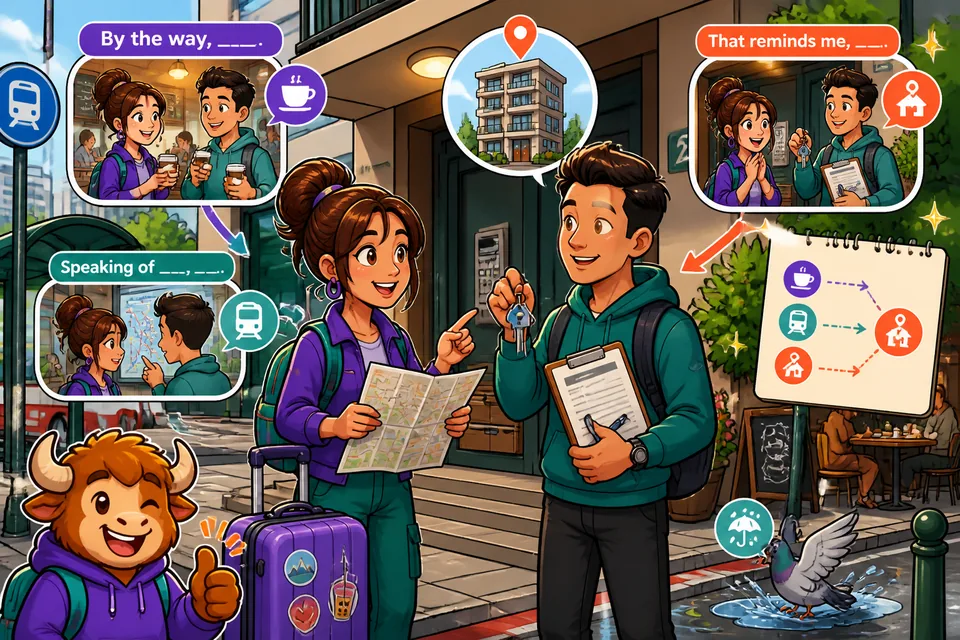
Ready to steer conversations like a pro? This short lesson helps you nudge, change, and return to topics naturally in German. Have fun — think of these phrases as conversational glue.
Level B1: In Lesson 86 you'll practice common German topic-change phrases like “Übrigens,” “Da fällt mir ein,” and “Um noch mal auf ... zurückzukommen.” We'll listen, repeat, and use them in a short dialogue so you can introduce new points, ask to change the topic, or get back to the main thread. CEFR-aligned and focused on practical social glue.
After this lesson you'll be able to:
Recognize and use common B1 phrases for shifting topics politely.
Practice asking permission to change topics and bringing up things you almost forgot.
Hear the phrases in a short dialogue and repeat them aloud.
Ready? Let's go!
When you tap play on phrases, we track your progress through this lesson.
1. Reading + Listening Practice
Hear core phrases, repeat aloud.
Übrigens, ___.
By the way, ___.
Meaning: By the way, ___.
When to use: Use to add a related point casually or introduce something that just came to mind.
Übrigens, hast du die E‑Mail schon gelesen?
By the way, have you read the email yet?
Übrigens, die Party ist am Samstag.
By the way, the party is on Saturday.
Wo wir gerade bei ___ sind: ___.
Speaking of ___, ___.
Meaning: Speaking of ___, ___.
When to use: Move from something just mentioned to a related point; after 'bei' the following noun gets dative.
Tip: Remember that 'bei' requires dative when used with a noun (e.g., 'bei deinem Projekt').
Wo wir gerade bei deinem Projekt sind: Brauchst du noch Hilfe?
Speaking of your project: do you need more help?
Wo wir gerade bei Reisen sind: Bist du schon in Spanien gewesen?
Speaking of travel: have you been to Spain yet?
Da fällt mir ein, ___.
That reminds me, ___.
Meaning: That reminds me, ___.
When to use: Introduce a new topic that suddenly came to mind because of something in the conversation.
Da fällt mir ein, ich muss noch den Arzt anrufen.
That reminds me, I still have to call the doctor.
Da fällt mir ein, hattest du das Buch schon zurückgegeben?
That reminds me, did you already return the book?
Mal was anderes: ___.
On another note, ___.
Meaning: On another note, ___.
When to use: Use to intentionally shift to a different but still polite topic in conversation.
Mal was anderes: Wie läuft dein neuer Kurs?
On another note: how's your new course going?
Mal was anderes: Hast du Zeit nächste Woche?
On another note: do you have time next week?
Bevor ich’s vergesse, ___.
Before I forget, ___.
Meaning: Before I forget, ___.
When to use: Bring up something important you might forget later; common in spoken German.
Tip: The contraction 'ich’s' is common in speech; for formal clarity use 'Bevor ich es vergesse.'
Bevor ich’s vergesse, die Rechnung liegt auf deinem Schreibtisch.
Before I forget, the bill is on your desk.
Bevor ich’s vergesse, ich habe deine Einladung bekommen.
Before I forget, I received your invitation.
Können wir kurz über ___ sprechen?
Can we talk about ___ for a minute?
Meaning: Can we talk about ___ for a minute?
When to use: Ask permission to bring up or move to a new topic politely.
Tip: Remember that 'über' takes the accusative when followed by a noun (e.g., 'über das Budget').
Können wir kurz über das Budget sprechen?
Can we talk about the budget for a minute?
Können wir kurz über deinen Zeitplan sprechen?
Can we talk about your schedule for a minute?
Ich wollte dich zu ___ etwas fragen.
I wanted to ask you about ___.
Meaning: I wanted to ask you about ___.
When to use: Use to gently introduce a question about a new topic; informal 'dich' vs. formal 'Sie'.
Ich wollte dich zu dem neuen Projekt etwas fragen.
I wanted to ask you something about the new project.
Ich wollte dich zu deinen Plänen für den Urlaub etwas fragen.
I wanted to ask you about your holiday plans.
Lass uns das Thema wechseln.
Let's change the subject.
Meaning: Let's change the subject.
When to use: Use when you want to make a clear, friendly shift away from the current topic.
Lass uns das Thema wechseln, wir reden schon lange darüber.
Let's change the subject; we've been talking about it for a long time.
Lass uns das Thema wechseln und über etwas Positives sprechen.
Let's change the subject and talk about something positive.
Na ja, zurück zu ___.
Anyway, back to ___.
Meaning: Anyway, back to ___.
When to use: Return the conversation to the main topic after a side discussion.
Na ja, zurück zu unserem Plan: Wann starten wir?
Anyway, back to our plan: when do we start?
Na ja, zurück zu dir: Wie war das Meeting?
Anyway, back to you: how was the meeting?
Um noch mal auf ___ zurückzukommen: ___.
Going back to ___, ___.
Meaning: Going back to ___, ___.
When to use: Reconnect to an earlier point or question in the conversation when you want to revisit it.
Um noch mal auf gestern zurückzukommen: Hast du die Unterlagen?
Going back to yesterday: do you have the documents?
Um noch mal auf den Zeitplan zurückzukommen: Können wir ihn ändern?
Going back to the schedule: can we change it?
Das gehört jetzt nicht ganz zum Thema, aber ___.
This is a bit off topic, but ___
Meaning: This is a bit off topic, but ___.
When to use: Signal a small move away from the current topic to add a related comment or question.
Das gehört jetzt nicht ganz zum Thema, aber hast du Fotos vom Event?
This is a bit off topic, but do you have photos from the event?
Das gehört jetzt nicht ganz zum Thema, aber ich habe eine Idee.
This is a bit off topic, but I have an idea.
Kann ich kurz etwas anderes ansprechen?
Can I bring up something else?
Meaning: Can I bring up something else?
When to use: Politely ask to introduce a different topic; use 'etwas' for neutral tone.
Kann ich kurz etwas anderes ansprechen? Es geht um die Pausenregelung.
Can I bring up something else quickly? It's about the break policy.
Kann ich kurz etwas anderes ansprechen? Ich habe eine Frage zur Technik.
Can I bring up something else? I have a question about the tech.
Ich wollte noch etwas anderes erwähnen.
There's something else I wanted to mention.
Meaning: There's something else I wanted to mention.
When to use: Add another point or a closing remark before ending the topic.
Ich wollte noch etwas anderes erwähnen: Die Tür bleibt morgen offen.
There's something else I wanted to mention: the door will be open tomorrow.
Ich wollte noch etwas anderes erwähnen: Danke für deine Hilfe.
There's something else I wanted to mention: thanks for your help.
2. Conversational Listening Practice
Hear phrases in a real mini-conversation.
Quick office chat where Anna and David move between a side-topic and the main agenda.
Anna
Übrigens, hast du den Bericht fertig?
By the way, have you finished the report?
David
Noch nicht ganz. Da fällt mir ein: Können wir kurz über den Zeitplan sprechen?
Not yet. That reminds me: can we talk about the schedule for a minute?
Anna
Bevor ich’s vergesse, die Grafik braucht ein Update.
Before I forget, the chart needs an update.
David
Na ja, zurück zu dem Meeting: Wollen wir das heute klären?
Anyway, back to the meeting: shall we sort that today?
3. Guided Practice
Quizzes and matching to lock in meaning.
Which German phrase means 'By the way, ...'?
Which phrase politely asks to introduce a different topic?
If you want to return to an earlier point, which phrase fits?
Which phrase warns you're about to add something you might forget later?
Before I forget, we need more coffee in the kitchen.
I'm worried I'll forget to tell you later. ___ we need more coffee in the kitchen.
Anyway, back to the budget: shall we discuss next quarter's hiring?
We've talked for a while about budgets. ___ shall we discuss next quarter's hiring?
Can we talk about the new software for a minute?
Before starting, I want to ask: ___ about the new software?
Match the core phrases
Match the extra phrases
4. Speaking Practice
Say phrases yourself (mic/recording).
Recording stays on your device only. Check speech uses your browser's speech tools when available.