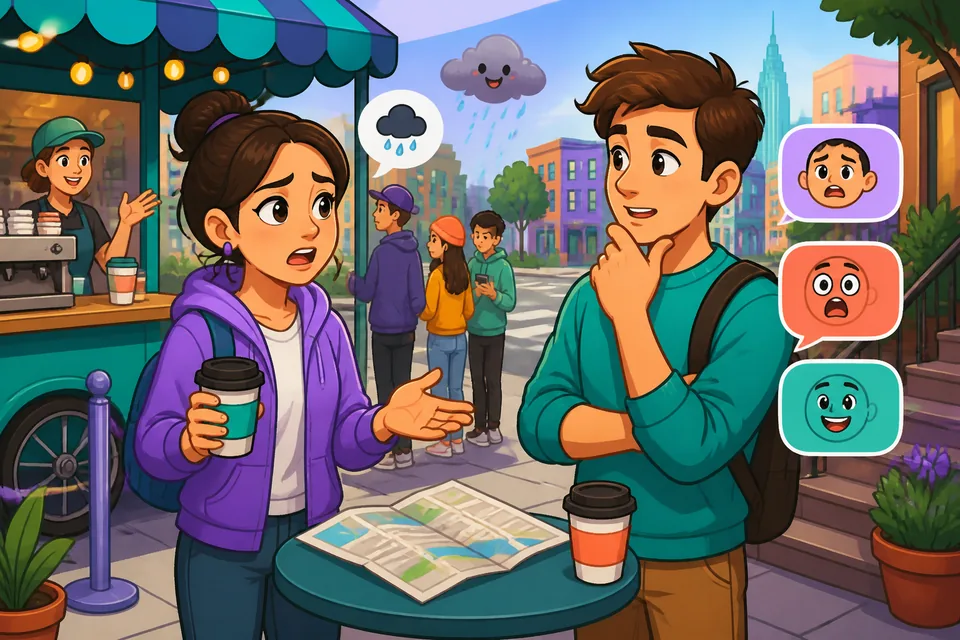
Ready for Lesson 77? We'll learn short German reactions you can use right away in conversations. Have fun — these small phrases are big social glue.
Level A2: In this lesson you'll practice four natural reactions in German: showing empathy, a strong upset reaction, a neutral acknowledgement of useful info, and a simple expression of interest. We'll listen, repeat, and use them in a short dialogue and quick quizzes — CEFR-aligned and friendly.
After this lesson you'll be able to:
Recognize and use four common German reaction phrases in everyday talk.
Respond with empathy and appropriate short reactions in simple conversations.
Practice speaking each phrase aloud to build natural timing.
Ready? Let's go!
When you tap play on phrases, we track your progress through this lesson.
1. Reading + Listening Practice
Hear core phrases, repeat aloud.
Das ist bestimmt schwer.
That must be hard.
Meaning: That must be hard.
When to use: Use this to show empathy when someone describes a difficult or stressful situation.
Mein Freund hat seine Arbeit verloren. Das ist bestimmt schwer.
My friend lost his job. That must be hard.
Du hast zwei kleine Kinder und viel Arbeit — das ist bestimmt schwer.
You have two small children and a lot of work — that must be hard.
Das ist ja schrecklich.
That's awful.
Meaning: That's awful.
When to use: Use this for very bad or upsetting news when you want a stronger reaction.
Tip: Beginners sometimes drop 'ja' and lose the stronger emphasis; 'Das ist schrecklich' is okay but 'Das ist ja schrecklich' feels more natural here.
Dein Haus ist überschwemmt worden? Das ist ja schrecklich!
Your house was flooded? That's awful!
Er hat den Unfall gesehen — das ist ja schrecklich.
He saw the accident — that's awful.
Gut zu wissen.
Good to know.
Meaning: Good to know.
When to use: Use this to acknowledge useful or relevant information in a neutral way.
Tip: Don't use this for sad news — it's neutral, not empathetic or emotional.
Das Meeting beginnt um 15 Uhr — gut zu wissen.
The meeting starts at 3 pm — good to know.
Die Prüfungen sind online? Gut zu wissen.
The exams are online? Good to know.
Das ist interessant.
That's interesting.
Meaning: That's interesting.
When to use: Use this to show curiosity or mild interest in information someone shares.
Du arbeitest als Grafikdesigner? Das ist interessant.
You work as a graphic designer? That's interesting.
Die Geschichte über die Stadt ist wirklich spannend. Das ist interessant.
The story about the city is really exciting. That's interesting.
2. Conversational Listening Practice
Hear phrases in a real mini-conversation.
Anna tells David some bad news and some practical details; David uses short reactions.
Anna
David, mein Fahrrad wurde letzte Nacht gestohlen.
David, my bike was stolen last night.
David
Das ist ja schrecklich.
That's awful.
Anna
Außerdem habe ich jetzt wenig Zeit, weil ich die Polizei kontaktieren muss.
Also I have little time now because I need to contact the police.
David
Das ist bestimmt schwer.
That must be hard.
Anna
Ich habe ihnen gesagt, wo ich das Fahrrad zuletzt gesehen habe.
I told them where I last saw the bike.
David
Gut zu wissen. Vielleicht findet die Polizei etwas.
Good to know. Maybe the police will find something.
Anna
Ja — und der Laden hat Fotos. Das ist interessant.
Yes — and the store has photos. That's interesting.
3. Guided Practice
Quizzes and matching to lock in meaning.
Someone says their house was badly damaged in a storm. Which phrase is the strongest, most appropriate reaction?
A friend explains a difficult schedule and how stressed they are. Which phrase shows empathy?
If someone tells you the meeting time changed and you want to acknowledge the useful info, what do you say?
You hear a curious fact and want to show mild interest. Which phrase fits best?
My bike was stolen last night. That's awful.
My bike was stolen last night. ___
She told me the exam is next Monday. I said, 'Good to know.'
She told me the exam is next Monday. I said, '___'.
My colleague moved to a new city; I replied, 'That's interesting.'
My colleague moved to a new city; I replied, '___'.
Match the core phrases
Match the extra phrases
4. Speaking Practice
Say phrases yourself (mic/recording).
Recording stays on your device only. Check speech uses your browser's speech tools when available.