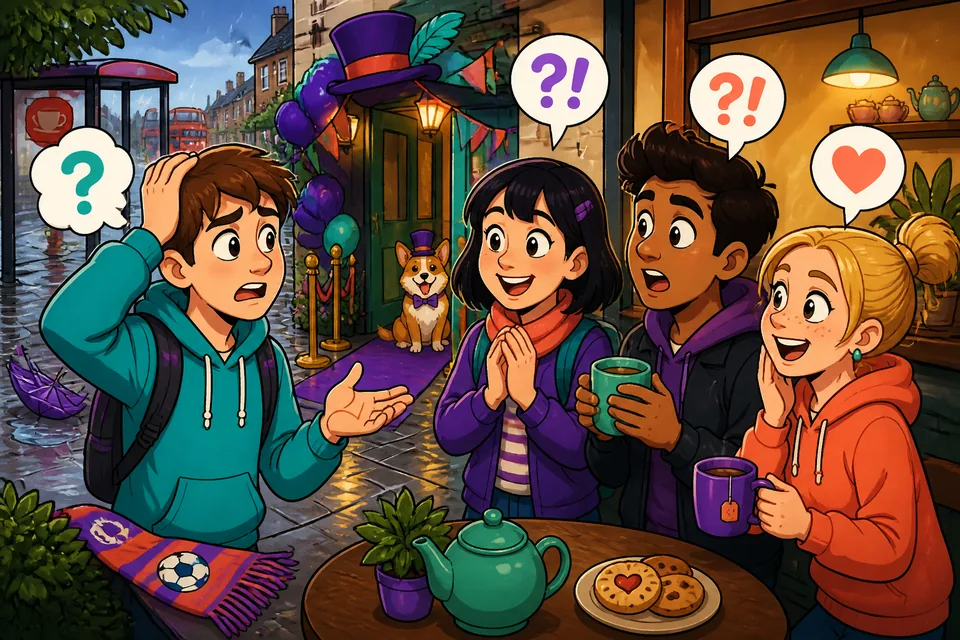
Welcome back! This short lesson gives you ready phrases to react naturally when people share good or bad news. Try listening, repeating, and using them in small conversations.
Level A2: In this lesson you'll practice common German reaction phrases — surprise, sympathy, relief, and excitement (CEFR-aligned). You'll hear and repeat short chunks like "Echt?", "Das tut mir leid." and "Das sind tolle Nachrichten.", then use them in a tiny dialogue and quick quizzes to lock them in.
After this lesson you'll be able to:
Understand and use common German reactions to good and bad news.
Ask for more information and check how someone is doing after hearing news.
Practice saying short, natural phrases aloud (A2 level).
Ready? Let's go!
When you tap play on phrases, we track your progress through this lesson.
1. Reading + Listening Practice
Hear core phrases, repeat aloud.
Echt?
Really?
Meaning: Really?
When to use: Use this short question when you hear surprising or new information and want to show interest or mild disbelief.
Tip: Don't overuse in very formal contexts; in formal speech say "Wirklich?"
Echt? Du hast das alleine gemacht?
Really? You did that by yourself?
Echt? Das wusste ich nicht.
Really? I didn't know that.
Oh nein
Oh no!
Meaning: Oh no!
When to use: A quick natural reaction to bad news or a sudden problem — use it to show concern or surprise.
Oh nein! Dein Computer ist kaputt?
Oh no! Your computer is broken?
Oh nein! Das ist wirklich schlecht.
Oh no! That's really bad.
Das sind tolle Nachrichten.
That's great news.
Meaning: That's great news.
When to use: Use this to react positively when someone tells you good news, like a success or a win.
Das sind tolle Nachrichten — herzlichen Glückwunsch!
That's great news — congratulations!
Du hast bestanden? Das sind tolle Nachrichten.
You passed? That's great news.
Das tut mir leid.
I'm sorry to hear that.
Meaning: I'm sorry to hear that.
When to use: A standard, polite phrase to express sympathy after hearing bad news; it doesn't necessarily mean you're apologizing yourself.
Oh nein — das tut mir leid, das zu hören.
Oh no — I'm sorry to hear that.
Das tut mir leid. Wenn du reden willst, ich höre zu.
I'm sorry to hear that. If you want to talk, I'm here.
Das ist schade.
That's too bad.
Meaning: That's too bad.
When to use: Use for mild disappointment or regret; it's less strong than full sympathy phrases.
Du kannst nicht kommen? Das ist schade.
You can't come? That's too bad.
Das ist schade — wir hätten dich gern dabei gehabt.
That's too bad — we'd have liked you to be there.
Was ist passiert?
What happened?
Meaning: What happened?
When to use: Ask this direct question when you want more information after hearing about an event or problem.
Du siehst besorgt aus. Was ist passiert?
You look worried. What happened?
Er hat geweint — also habe ich gefragt: Was ist passiert?
He was crying — so I asked: What happened?
Geht’s dir gut?
Are you okay?
Meaning: Are you okay?
When to use: A friendly, informal way to check someone's condition after troubling news. Use formal "Geht es Ihnen gut?" if needed.
Tip: Remember this is informal — replace with "Geht es Ihnen gut?" in formal situations.
Geht’s dir gut? Du wirkst sehr müde.
Are you okay? You seem very tired.
Aua — Geht’s dir gut? Soll ich helfen?
Ouch — Are you okay? Should I help?
Ich kann’s nicht glauben.
I can't believe it.
Meaning: I can't believe it.
When to use: Use to express strong surprise at unexpected news. The contraction "kann’s" is common in speech.
Ich kann’s nicht glauben — du hast gewonnen!
I can't believe it — you won!
Er hat das machen sollen? Ich kann’s nicht glauben.
He was supposed to do that? I can't believe it.
Das klingt ___.
That sounds ___.
Meaning: That sounds ___.
When to use: Give a quick opinion about someone's situation using an adjective: e.g., "Das klingt gut/schwierig/spannend."
Das klingt spannend — erzähl mir mehr!
That sounds exciting — tell me more!
Oh, das klingt schwierig. Brauchst du Hilfe?
Oh, that sounds difficult. Do you need help?
Das freut mich zu hören.
I'm glad to hear that.
Meaning: I'm glad to hear that.
When to use: A natural reaction when you hear good news or something that brings relief.
Du bist gesund? Das freut mich zu hören.
You're healthy? I'm glad to hear that.
Die Operation war erfolgreich — das freut mich zu hören.
The surgery was successful — I'm glad to hear that.
Wie spannend!
How exciting!
Meaning: How exciting!
When to use: Use this to react positively to exciting news or plans.
Du reist nach Japan? Wie spannend!
You're traveling to Japan? How exciting!
Neue Ideen für das Projekt — wie spannend!
New ideas for the project — how exciting!
Da bin ich erleichtert.
That's a relief.
Meaning: That's a relief.
When to use: Say this after worry or uncertainty when you learn things turned out well.
Die Prüfung ist verschoben? Da bin ich erleichtert.
The exam is postponed? That's a relief.
Der Hund ist wieder da — da bin ich erleichtert.
The dog is back — that's a relief.
Ich freue mich für dich.
I'm happy for you.
Meaning: I'm happy for you.
When to use: Use to show warm, personal support for someone's good personal news (informal 'du' form).
Du hast die Stelle bekommen — ich freue mich für dich!
You got the position — I'm happy for you!
Ihr habt ein Baby? Ich freue mich für dich.
You have a baby? I'm happy for you.
2. Conversational Listening Practice
Hear phrases in a real mini-conversation.
Anna tells David about a bad moment followed by very good news.
Anna
Oh nein! Ich habe den Zug verpasst.
Oh no! I missed the train.
David
Geht’s dir gut? Was ist passiert?
Are you okay? What happened?
Anna
Zuerst war alles ärgerlich, aber dann bekam ich eine E-Mail: Ich habe die Stelle!
First everything was annoying, but then I got an email: I got the job!
David
Echt? Das sind tolle Nachrichten!
Really? That's great news!
Anna
Ich kann’s nicht glauben — wie spannend!
I can't believe it — how exciting!
David
Ich freue mich für dich. Da bin ich erleichtert.
I'm happy for you. That's a relief.
3. Guided Practice
Quizzes and matching to lock in meaning.
Which German phrase means "I'm sorry to hear that."?
Which phrase would you say when you are surprised and want confirmation?
Which phrase asks someone for more details about an event?
Which phrase best expresses relief after worrying?
Anna expresses sympathy: "I'm sorry to hear that."
David: My flight was canceled and I missed the meeting. Anna: ___
David responds: "That's great news."
Anna: I got the job! David: ___
David shows personal happiness: "I'm happy for you."
Anna: My brother won the competition! David: ___
Match the core phrases
Match the extra phrases
4. Speaking Practice
Say phrases yourself (mic/recording).
Recording stays on your device only. Check speech uses your browser's speech tools when available.