Ready to ride? This lesson gives you the polite phrases you need for taxi pick-ups, asking for stops, payment and receipts. Short, practical, and useful on the go.
Level A2: In Lesson 110 you'll practice polite requests and questions for taxi rides — giving destinations, asking about cost and time, asking the driver to wait or stop, and confirming bookings. This CEFR-aligned lesson focuses on ready-to-use phrases to use with drivers in Germany and other German-speaking areas.
After this lesson you'll be able to:
Use polite forms (Sie) to tell a driver your destination and request stops.
Ask about price and estimated travel time.
Confirm a booked ride and request a receipt or card payment.
Ready? Let's go!
When you tap play on phrases, we track your progress through this lesson.
1. Reading + Listening Practice
Hear core phrases, repeat aloud.
Können Sie mich bitte zu ___ bringen?
Can you take me to ___?
Meaning: Can you take me to ___, please?
When to use: Use this polite request to tell a taxi driver where you want to go. For many places use 'zu' (zum/zur); for cities use 'nach'.
Tip: Don't use 'du' with the driver; use 'Sie'.
Können Sie mich bitte zum Hauptbahnhof bringen?
Can you take me to the main train station, please?
Können Sie mich bitte zur Adresse Schillerstraße 10 bringen?
Can you bring me to Schillerstraße 10, please?
Ich möchte zu ___, bitte.
I'm going to ___.
Meaning: I'm going to ___, please.
When to use: Give your destination politely. Use 'zu' for many local places (zum Bahnhof), 'nach' for cities (nach Berlin), or 'ins' for buildings (ins Hotel).
Tip: Be careful which preposition is correct: 'nach' for cities, 'zu' or 'zum' for places.
Ich möchte zum Hotel, bitte.
I'd like to go to the hotel, please.
Ich möchte nach Stuttgart, bitte.
I'm going to Stuttgart, please.
Wie viel wird das ungefähr kosten?
How much will it cost?
Meaning: How much will it cost?
When to use: Ask this politely before or during the ride if you want an estimated fare.
Wie viel wird das ungefähr kosten?
How much will that cost roughly?
Können Sie sagen, wie viel das ungefähr kostet?
Can you say how much it will cost roughly?
Wie lange dauert das ungefähr?
How long will it take?
Meaning: How long will it take?
When to use: Ask for an estimated travel time, for planning or if you're in a hurry.
Wie lange dauert das ungefähr?
How long will that take approximately?
Ist die Fahrt lang? Wie lange dauert das ungefähr?
Is the trip long? How long will it take roughly?
Können Sie bitte hier anhalten?
Can you stop here, please?
Meaning: Can you stop here, please?
When to use: Ask the driver to stop at a specific spot, e.g. in front of a building or at a corner.
Können Sie bitte hier anhalten? Das ist mein Haus.
Can you stop here, please? This is my house.
Können Sie bitte hier anhalten? Ich steige aus.
Can you stop here, please? I'm getting off.
Können Sie bitte kurz warten?
Can you wait a minute, please?
Meaning: Can you wait a minute, please?
When to use: Use this when you need the driver to wait briefly — for luggage, a quick errand, or someone returning.
Können Sie bitte kurz warten? Ich bin gleich zurück.
Can you wait a moment, please? I'll be right back.
Warten Sie bitte kurz, ich hole nur mein Ticket.
Please wait a short while, I just get my ticket.
Kann ich mit Karte zahlen?
Can I pay by card?
Meaning: Can I pay by card?
When to use: Ask this to check whether the driver accepts card payment instead of cash.
Kann ich mit Karte zahlen? Ich habe kein Bargeld.
Can I pay by card? I don't have cash.
Akzeptieren Sie Karten? Kann ich mit Karte zahlen?
Do you accept cards? Can I pay by card?
Kann ich bitte eine Quittung bekommen?
Can I have a receipt, please?
Meaning: Can I have a receipt, please?
When to use: Ask for a receipt at the end of the ride if you need it for expense claims or proof of payment.
Kann ich bitte eine Quittung bekommen? Für die Firma.
Can I get a receipt, please? For the company.
Brauche ich eine Quittung — kann ich bitte eine bekommen?
I need a receipt — can I get one, please?
Sind Sie für ___ da?
Are you here for ___?
Meaning: Are you here for ___?
When to use: Confirm the driver's booking or whether they are waiting for a named passenger or appointment.
Sind Sie für Herrn Schmidt da?
Are you here for Mr. Schmidt?
Sind Sie für Anna Müller da? Ich habe eine Buchung.
Are you here for Anna Müller? I have a booking.
Nehmen Sie bitte die schnellste Route.
Please take the fastest route.
Meaning: Please take the fastest route.
When to use: Request the quickest route, useful if you're short on time. Polite and direct.
Nehmen Sie bitte die schnellste Route, ich habe wenig Zeit.
Please take the fastest route, I have little time.
Wenn möglich, nehmen Sie bitte die schnellste Route.
If possible, please take the fastest route.
Ich habe eine Fahrt auf den Namen ___ gebucht.
I booked a ride under the name ___.
Meaning: I booked a ride under the name ___.
When to use: Use this at pick-up to identify your reservation with the driver or ride service.
Tip: Don't forget 'auf den Namen' — it's the natural phrase for reservations.
Ich habe eine Fahrt auf den Namen Becker gebucht.
I booked a ride under the name Becker.
Entschuldigung, ich habe eine Fahrt auf den Namen Anna Köhler gebucht.
Excuse me, I booked a ride under the name Anna Köhler.
Der Abholort ist ___.
The pickup point is ___.
Meaning: The pickup point is ___.
When to use: Tell the driver the pickup location from your app or booking information.
Der Abholort ist Eingang C am Terminal 2.
The pickup point is entrance C at Terminal 2.
Der Abholort ist vor dem Haupteingang des Museums.
The pickup point is in front of the museum main entrance.
Ich bin am ___-Eingang.
I'm at the ___ entrance.
Meaning: I’m at the ___ entrance.
When to use: Say this to describe exactly where you are waiting (e.g. Nord-, Süd-, Haupteingang).
Ich bin am Nord-Eingang. Sehen Sie mich?
I'm at the north entrance. Do you see me?
Ich bin am Haupt-Eingang, gleich vor dem Taxistand.
I'm at the main entrance, right in front of the taxi stand.
2. Conversational Listening Practice
Hear phrases in a real mini-conversation.
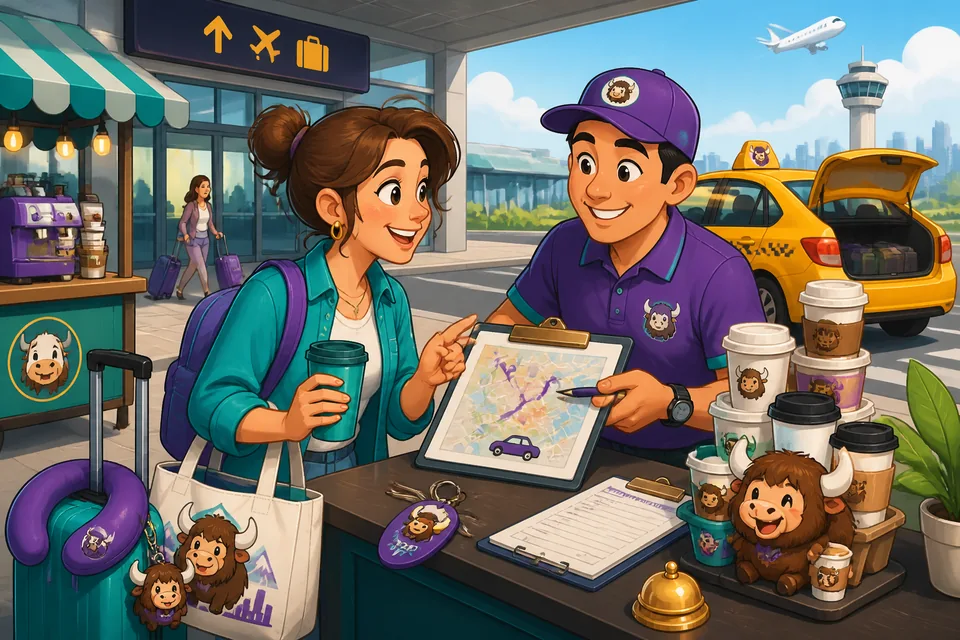
Anna meets the driver at an airport entrance.
Anna
Ich habe eine Fahrt auf den Namen Anna Müller gebucht.
I booked a ride under the name Anna Müller.
David
Sind Sie für Anna Müller da?
Are you here for Anna Müller?
Anna
Ja. Der Abholort ist Eingang B. Ich bin am Nord-Eingang.
Yes. The pickup point is Entrance B. I'm at the north entrance.
Anna
Können Sie mich bitte zum Hotel König bringen? Wie lange dauert das ungefähr?
Can you take me to Hotel König, please? How long will it take roughly?
David
Ungefähr 20 Minuten. Möchten Sie die schnellste Route?
About 20 minutes. Would you like the fastest route?
Anna
Ja bitte. Und kann ich mit Karte zahlen?
Yes please. And can I pay by card?
3. Guided Practice
Quizzes and matching to lock in meaning.
Which German phrase asks if you can pay by card?
Which phrase would you use to ask the driver to stop right away?
How do you ask 'How long will it take?' in German?
Which phrase politely asks the driver to use the fastest route?
Before I pay, I ask the driver: Can I pay by card?
Bevor ich bezahle, frage ich den Fahrer: ___
When I am in front of my hotel, I say: Can you stop here, please?
Wenn ich vor meinem Hotel bin, sage ich: ___
At the airport I'm at the north entrance. I tell the driver: I'm at the ___ entrance.
Am Flughafen stehe ich am Nord-Eingang. Ich sage dem Fahrer: ___
Match the core phrases
Match the extra phrases
4. Speaking Practice
Say phrases yourself (mic/recording).
Recording stays on your device only. Check speech uses your browser's speech tools when available.