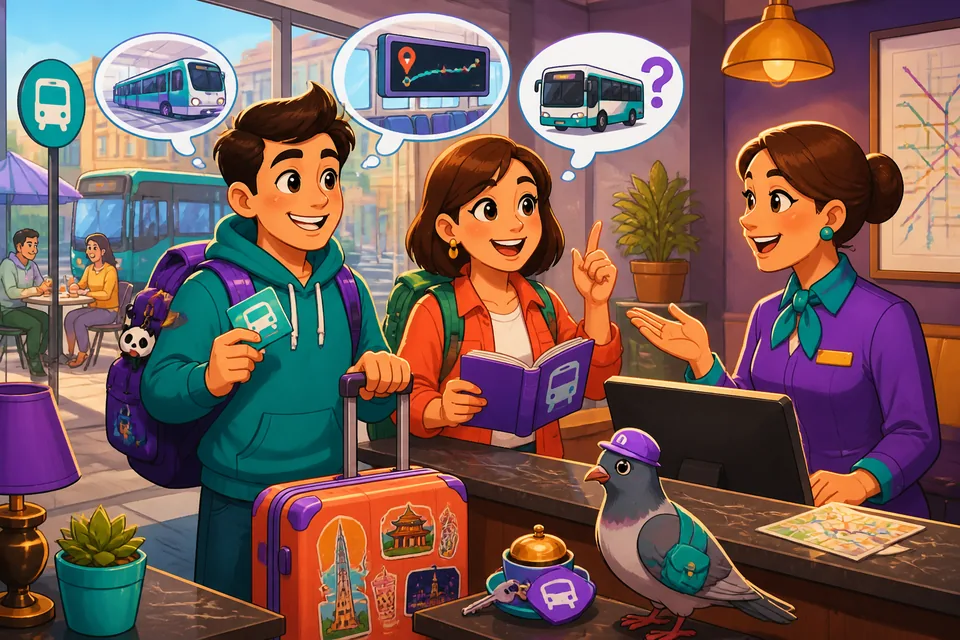
Welcome! This lesson helps you handle short conversations on buses, trams and local trains. You'll listen, repeat, and practice useful requests and questions when traveling around town.
Level A2: In this short lesson you'll practice common transit phrases: asking to be let off, buying tickets on board, checking whether seats are free, reporting a missed stop, and asking about frequency or direct routes. It's CEFR-aligned and practical — we keep it focused and travel-ready.
After this lesson you'll be able to:
Understand and use polite requests with drivers (A2).
Ask where and how to buy tickets and whether you must tap in and out.
Report a missed stop and ask if a seat is free.
Ready? Let's go!
When you tap play on phrases, we track your progress through this lesson.
1. Reading + Listening Practice
Hear core phrases, repeat aloud.
Ich muss bei ___ aussteigen.
I need to get off at ___.
Meaning: I need to get off at ___.
When to use: Use „bei ___“ for many stop or station names. With a city or district, „in ___“ may be more natural.
Tip: Beginners sometimes say „in“ with small stop names; use „bei“ for many stops.
Ich muss bei Hauptbahnhof aussteigen.
I need to get off at Central Station.
Entschuldigung, ich muss bei der nächsten Haltestelle aussteigen.
Excuse me, I need to get off at the next stop.
Können Sie mich bitte an der nächsten Haltestelle rauslassen?
Please let me off at the next stop.
Meaning: Please let me off at the next stop.
When to use: Use this polite request when speaking to a driver. „rauslassen“ is natural in spoken German.
Können Sie mich bitte an der nächsten Haltestelle rauslassen?
Please let me off at the next stop.
Fahrer, können Sie mich bitte an der nächsten Haltestelle rauslassen?
Driver, could you please let me off at the next stop?
Kann ich im Bus ein Ticket kaufen?
Can I buy a ticket on the bus?
Meaning: Can I buy a ticket on the bus?
When to use: Ask this after boarding if you still need a ticket. Also common: „Kann man im Bus ein Ticket kaufen?“
Entschuldigung, kann ich im Bus ein Ticket kaufen?
Excuse me, can I buy a ticket on the bus?
Ich habe kein Ticket. Kann ich im Bus ein Ticket kaufen?
I don't have a ticket. Can I buy one on the bus?
Muss ich ein- und auschecken?
Do I have to tap in and out?
Meaning: Do I have to tap in and out?
When to use: Use this when your transit system requires card or app check-in/out. Ask to confirm the correct procedure.
Tip: Learners sometimes confuse this with hotel 'check-in'; emphasize 'ein- und auschecken' for transit.
Muss ich ein- und auschecken?
Do I have to tap in and out?
Muss ich mich beim Ein- und Aussteigen ein- und auschecken?
Do I have to check in and out when boarding and leaving?
Ist hier noch frei?
Is this seat taken?
Meaning: Is this seat free?
When to use: Ask this politely when you want to sit down on a bus or tram.
Entschuldigung, ist hier noch frei?
Excuse me, is this seat free?
Ist hier noch frei, oder ist der Platz besetzt?
Is this seat free, or is it taken?
Ich habe meine Haltestelle verpasst.
I missed my stop.
Meaning: I missed my stop.
When to use: Use this to tell someone you missed your stop on a bus, tram or local train.
Oh nein, ich habe meine Haltestelle verpasst.
Oh no, I missed my stop.
Ich habe meine Haltestelle verpasst. Können Sie mir helfen?
I missed my stop. Can you help me?
Der Fahrkartenautomat funktioniert nicht.
The ticket machine isn't working.
Meaning: The ticket machine isn’t working.
When to use: Say this when the machine for buying tickets is broken or not responding.
Der Fahrkartenautomat funktioniert nicht.
The ticket machine isn't working.
Tut mir leid, der Fahrkartenautomat funktioniert nicht heute.
Sorry, the ticket machine isn't working today.
Wo kann ich ein Ticket kaufen?
Where can I buy a ticket?
Meaning: Where can I buy a ticket?
When to use: Use this to ask where tickets are sold if the machine is broken or you prefer a shop or kiosk.
Wo kann ich ein Ticket kaufen?
Where can I buy a ticket?
Wo kann ich ein Ticket kaufen — am Schalter oder im Kiosk?
Where can I buy a ticket — at the counter or at the kiosk?
Wie oft fährt der/die ___?
How often does the ___ come?
Meaning: How often does the ___ come?
When to use: Use this to ask about service frequency. Choose the correct article: „der“ for Bus/Zug, „die" for Bahn/U-Bahn/S-Bahn.
Wie oft fährt der Bus?
How often does the bus come?
Wie oft fährt die U-Bahn zur Hauptstraße?
How often does the subway go to Main Street?
Fährt der/die ___ direkt nach ___?
Is there a direct ___ to ___?
Meaning: Is there a direct ___ to ___?
When to use: Ask whether a bus, train, or subway goes directly to your destination without changes. Use the correct article for the vehicle.
Tip: Learners sometimes use 'zu' instead of 'nach' for cities; use 'nach' for city destinations.
Fährt der Zug direkt nach Köln?
Does the train go directly to Cologne?
Fährt die S-Bahn direkt nach Innenstadt?
Does the S-Bahn go directly to the city center?
2. Conversational Listening Practice
Hear phrases in a real mini-conversation.
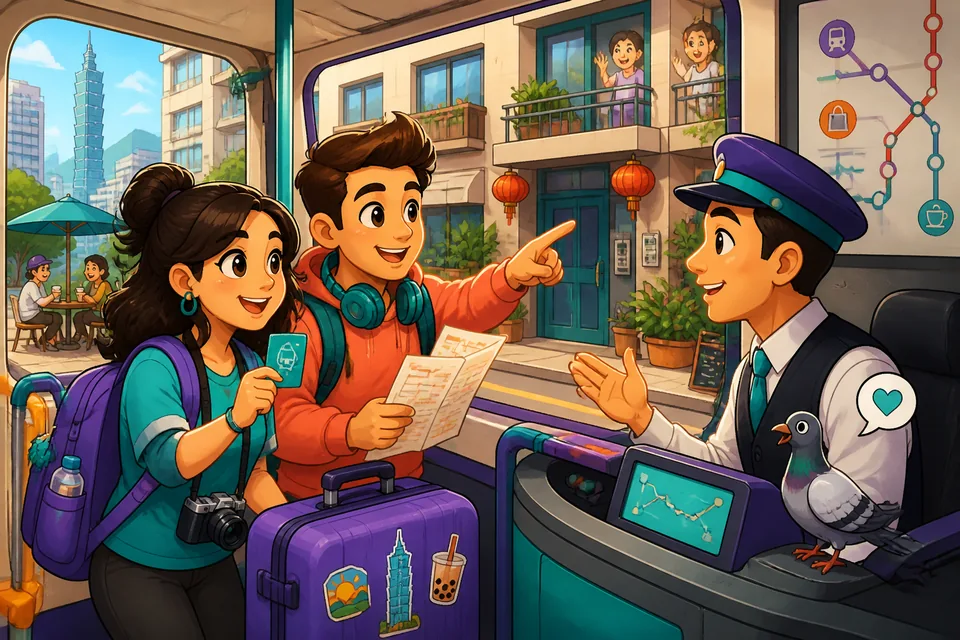
On a tram, two passengers talk and ask the driver for help.
Anna
Entschuldigung, ist hier noch frei?
Excuse me, is this seat free?
David
Ja, setz dich bitte.
Yes, please sit down.
Anna
Ich habe meine Haltestelle verpasst.
I missed my stop.
David
Frag doch den Fahrer.
Ask the driver, then.
Anna
Können Sie mich bitte an der nächsten Haltestelle rauslassen?
Could you please let me off at the next stop?
Fahrer
Natürlich. Muss ich ein- und auschecken?
Of course. Do I have to tap in and out?
Anna
Nein, danke. Ich muss bei Bahnhofstraße aussteigen.
No, thanks. I need to get off at Bahnhofstraße.
3. Guided Practice
Quizzes and matching to lock in meaning.
How do you say 'I need to get off at Central Station.'?
Which phrase asks 'Can I buy a ticket on the bus?'
Which phrase means 'Is this seat free?'
Which phrase asks about tapping in and out?
On the tram you realize you missed your stop. You say: I missed my stop.
On the tram you realize you missed your stop. You say: ___
At the station the ticket machine is broken. You tell the attendant: The ticket machine isn't working.
At the station the ticket machine is broken. You tell the attendant: ___
You are on the bus without a ticket and want to ask the driver: Can I buy a ticket on the bus?
You are on the bus without a ticket and want to ask the driver: ___
Match the core phrases
Match the extra phrases
4. Speaking Practice
Say phrases yourself (mic/recording).
Recording stays on your device only. Check speech uses your browser's speech tools when available.
Say this phrase out loud:
Ich muss bei ___ aussteigen.
I need to get off at ___.
Say this phrase out loud:
Können Sie mich bitte an der nächsten Haltestelle rauslassen?