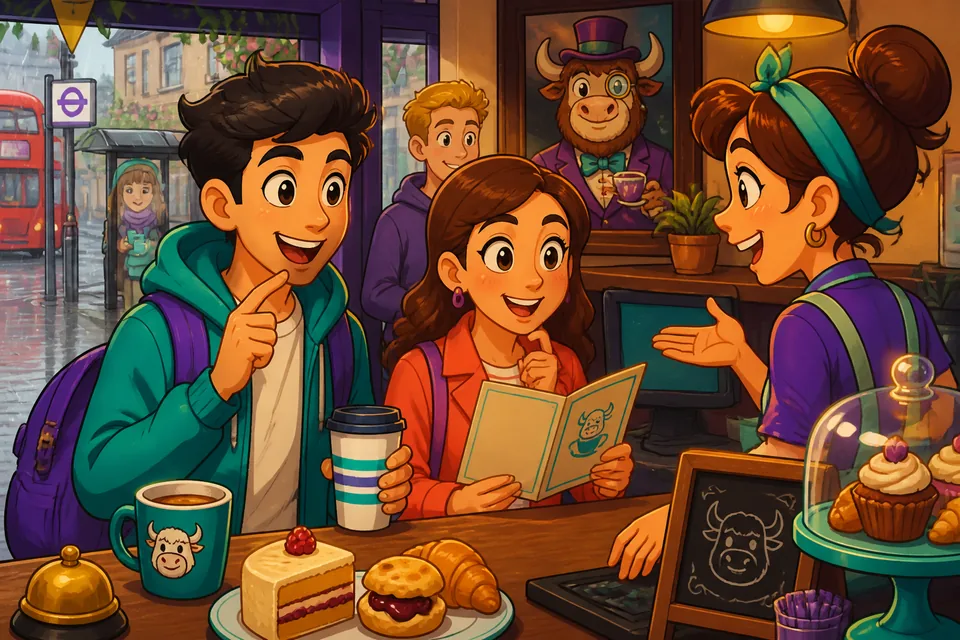
Welcome! This short lesson helps you handle common café and restaurant moments in German. Have fun — ordering coffee can be an excellent excuse to practice your German.
Level A2: In this lesson you'll practice polite, practical phrases for cafés and restaurants — asking for a table, requesting the menu, ordering or changing dishes, asking about spice, asking for water, and how to pay. CEFR-aligned and focused on useful frames you can repeat aloud right away.
After this lesson you'll be able to:
Ask if a table is available and request a table for your group.
Ask for the menu, order politely, and request changes (e.g., without something).
Ask about a dish, request water, and ask to pay separately (Level A2).
Ready? Let's go!
When you tap play on phrases, we track your progress through this lesson.
1. Reading + Listening Practice
Hear core phrases, repeat aloud.
Einen Tisch für ___, bitte.
A table for ___, please.
Meaning: A table for ___, please.
When to use: Say this when you arrive and want to tell staff how many people will sit. Fill the blank with a number or phrase like "zwei Personen."
Tip: Don't use nominative 'Ein Tisch ...' — use the accusative 'Einen Tisch'.
Einen Tisch für zwei Personen, bitte.
A table for two, please.
Einen Tisch für vier, bitte.
A table for four, please.
Haben Sie noch einen Tisch frei?
Do you have a table available?
Meaning: Do you have a table available?
When to use: Ask this politely when entering a busy café or restaurant if you don't have a reservation.
Haben Sie noch einen Tisch frei?
Do you have a table available?
Haben Sie für zwei Personen noch einen Tisch frei?
Do you still have a table available for two?
Kann ich bitte die Karte haben?
Can I see the menu, please?
Meaning: Can I see the menu, please?
When to use: Use this to ask for the menu (often called 'die Karte') when you sit down or before ordering.
Kann ich bitte die Karte haben?
Can I have the menu, please?
Kann ich noch einmal die Karte haben?
Can I have the menu once more?
Ich hätte gern ___, bitte.
I'd like ___, please.
Meaning: I'd like ___, please.
When to use: A very common polite frame for ordering a specific drink or dish. Insert the item after the phrase.
Tip: Learners sometimes say 'Ich will ...' which sounds blunt; use 'Ich hätte gern ...' to stay polite.
Ich hätte gern einen Kaffee, bitte.
I'd like a coffee, please.
Ich hätte gern die Suppe des Tages, bitte.
I'd like the soup of the day, please.
Kann ich ___ ohne ___ bekommen?
Can I get ___ without ___?
Meaning: Can I get ___ without ___?
When to use: Use this to ask for a dish with a modification, for example without an ingredient or sauce.
Tip: Remember that after 'ohne' the object is accusative. For example: 'ohne den Käse', not dative.
Kann ich den Salat ohne Käse bekommen?
Can I get the salad without cheese?
Kann ich den Burger ohne Zwiebeln bekommen?
Can I get the burger without onions?
Ist das Gericht scharf?
Is this dish spicy?
Meaning: Is this dish spicy?
When to use: Point to a menu item and ask this to check the spice level before ordering.
Ist das Gericht scharf?
Is this dish spicy?
Ist das Curry sehr scharf?
Is the curry very spicy?
Könnten wir bitte etwas Wasser bekommen?
Could we have some water, please?
Meaning: Could we have some water, please?
When to use: Ask this when you want water for the table. For tap water, say 'Leitungswasser'.
Könnten wir bitte etwas Wasser bekommen?
Could we have some water, please?
Könnten wir noch eine Flasche Wasser bekommen?
Could we have another bottle of water?
Wir würden gern bestellen.
We're ready to order.
Meaning: We're ready to order.
When to use: Tell the server this when you and your group are ready to place the order.
Wir würden gern bestellen.
We would like to order.
Entschuldigung, wir würden gern bestellen.
Excuse me, we'd like to order.
Können wir getrennt zahlen?
Can we pay separately?
Meaning: Can we pay separately?
When to use: Use this when you want each person to pay for their part of the bill.
Können wir getrennt zahlen?
Can we pay separately?
Können wir die Rechnung getrennt bekommen?
Can we get the bill separately?
Wir haben eine Reservierung auf ___.
We have a reservation under ___.
Meaning: We have a reservation under ___.
When to use: Say this when you arrive and want staff to look up your reservation name. You can say 'auf Müller' or 'unter dem Namen Müller'.
Wir haben eine Reservierung auf Schmidt.
We have a reservation under Schmidt.
Wir haben eine Reservierung auf den Namen Meier.
We have a reservation under the name Meier.
Wie lange müssen wir warten?
How long is the wait?
Meaning: How long is the wait?
When to use: Ask this when there is a line or waiting list and you want an estimate of waiting time.
Wie lange müssen wir warten?
How long do we have to wait?
Entschuldigung, wie lange dauert die Wartezeit?
Excuse me, how long is the wait?
Können wir draußen sitzen?
Can we sit outside?
Meaning: Can we sit outside?
When to use: Use this to ask if outdoor seating is available or if you prefer a table on the terrace.
Können wir draußen sitzen?
Can we sit outside?
Ist ein Tisch draußen frei? Können wir draußen sitzen?
Is a table outside free? Can we sit outside?
Ich hätte gern ___.
I'll have the ___.
Meaning: I'll have the ___.
When to use: Use this short frame to order a particular dish naturally and politely.
Tip: Avoid dropping politeness words; 'Ich hätte gern ...' is softer than 'Ich nehme ...'.
Ich hätte gern den Caesar-Salat.
I'll have the Caesar salad.
Ich hätte gern das vegetarische Menü, bitte.
I'll have the vegetarian menu, please.
2. Conversational Listening Practice
Hear phrases in a real mini-conversation.
At the café entrance, asking for seating and ordering
Anna
Haben Sie noch einen Tisch frei?
Do you have a table available?
David
Ja, wir haben einen Tisch. Möchten Sie draußen sitzen?
Yes, we have a table. Would you like to sit outside?
Anna
Können wir draußen sitzen? Und könnten wir bitte etwas Wasser bekommen?
Can we sit outside? And could we get some water, please?
David
Natürlich. Hier ist die Karte.
Of course. Here is the menu.
Anna
Ist das Gericht scharf?
Is this dish spicy?
David
Nur ein wenig. Wir würden gern bestellen, wenn Sie bereit sind.
Only a little. We would like to order when you're ready.
3. Guided Practice
Quizzes and matching to lock in meaning.
Which German phrase asks if a table is available?
How do you say 'I'd like a coffee, please' politely?
Which phrase asks for a menu?
Which phrase asks to split the bill?
At the door you say: 'A table for two, please.'
At the door you say: '___ für zwei Personen, bitte.'
Before ordering you ask the server: 'Can I have the menu, please?'
Before ordering you ask the server: '___ die Karte haben?'
To change an order you say: 'Can I get the salad without cheese?'
To change an order you say: 'Kann ich den Salat ___ bekommen?'
Match the core phrases
Match the extra phrases
4. Speaking Practice
Say phrases yourself (mic/recording).
Recording stays on your device only. Check speech uses your browser's speech tools when available.