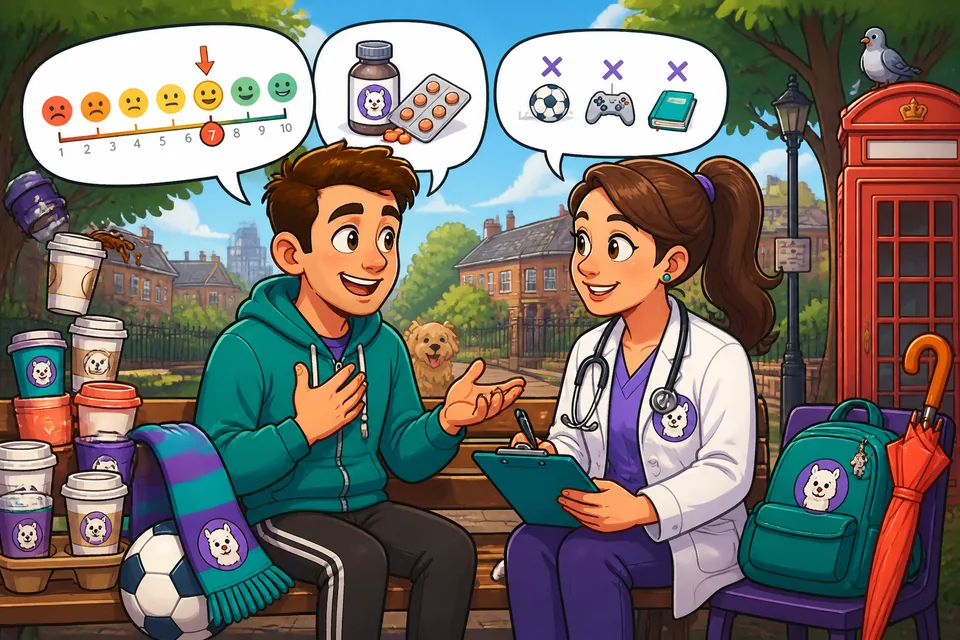
Quick and practical: this lesson helps you describe pain, say what you've tried, and ask the doctor the right questions. Keep it natural — you’ll practice phrases a doctor will actually understand.
Level B1: Lesson 115 focuses on common doctor-visit phrases for describing symptoms and asking about tests, side effects, restrictions, and follow-up. You will hear core lines, repeat them, and use them in a short dialogue so you can say them confidently during a real appointment. (CEFR-aligned vocabulary and useful for role-play.)
After this lesson you'll be able to:
Practice B1-level phrases to describe pain, past treatments, and how symptoms affect daily life.
Ask and understand questions about tests, side effects, restrictions, and follow-up.
Use key phrases in a short doctor–patient dialogue and say them aloud.
Ready? Let's go!
When you tap play on phrases, we track your progress through this lesson.
1. Reading + Listening Practice
Hear core phrases, repeat aloud.
Auf einer Skala von 1 bis 10 ist es ungefähr ___.
On a scale from 1 to 10, it's about ___ .
Meaning: On a scale from 1 to 10, it's about ___.
When to use: Use this to tell the doctor how bad your pain is when asked to rate it numerically.
Tip: Don't forget to give a number or say 'eine Sieben' rather than a vague word like 'sehr'.
Auf einer Skala von 1 bis 10 ist es ungefähr 7.
On a scale from 1 to 10, it's about a 7.
Auf einer Skala von 1 bis 10 ist es ungefähr drei.
On a scale from 1 to 10, it's about a 3.
Ich habe ___ genommen, aber es hat nicht geholfen.
I took ___, but it didn't help.
Meaning: I took ___, but it didn't help.
When to use: Say this when you already tried a medicine or remedy and it had no effect.
Tip: Remember the verb 'genommen' with 'haben'—beginner mistakes sometimes change the verb form or forget the helping verb.
Ich habe Ibuprofen genommen, aber es hat nicht geholfen.
I took ibuprofen, but it didn't help.
Ich habe eine Tablette genommen, aber es hat nicht geholfen.
I took a tablet, but it didn't help.
Ich konnte deswegen nicht ___.
I haven't been able to ___ because of it.
Meaning: I haven't been able to ___ because of it.
When to use: Use this to explain how symptoms affect daily activities (work, sleep, walking).
Ich konnte deswegen nicht schlafen.
I haven't been able to sleep because of it.
Ich konnte deswegen nicht arbeiten.
I haven't been able to work because of it.
Sind Untersuchungen nötig?
Do I need any tests?
Meaning: Do I need any tests?
When to use: Ask this when you want to know whether examinations or investigations are necessary.
Sind Untersuchungen nötig, um die Ursache zu finden?
Are tests necessary to find the cause?
Sind Untersuchungen nötig oder reicht die Behandlung?
Are tests necessary, or is treatment enough?
Sollte ich ___ vermeiden?
Should I avoid ___ ?
Meaning: Should I avoid ___?
When to use: Use this to ask about activities, foods, or substances you should stay away from during recovery.
Sollte ich Sport vermeiden?
Should I avoid sports?
Sollte ich Alkohol vermeiden?
Should I avoid alcohol?
Wann soll ich wiederkommen?
When should I come back?
Meaning: When should I come back?
When to use: Ask about the timing for a follow-up appointment or when to return if symptoms persist.
Wann soll ich wiederkommen, wenn es nicht besser wird?
When should I come back if it doesn't get better?
Wann soll ich wiederkommen zur Nachkontrolle?
When should I come back for a check-up?
In letzter Zeit habe ich ___ bemerkt.
I've noticed ___ recently.
Meaning: I’ve noticed ___ recently.
When to use: Use this to describe a change or new symptom you've observed recently.
In letzter Zeit habe ich mehr Husten bemerkt.
I've noticed more coughing recently.
In letzter Zeit habe ich ein Taubheitsgefühl bemerkt.
I've noticed a numbness recently.
Der Schmerz strahlt bis in ___ aus.
The pain spreads to my ___.
Meaning: The pain spreads to my ___.
When to use: Describe that pain is moving from one area to another (for example, to an arm or shoulder).
Tip: Remember: with 'in' + movement here, use the accusative (e.g. 'in meinen Arm'), not dative.
Der Schmerz strahlt bis in meinen Arm aus.
The pain spreads to my arm.
Der Schmerz strahlt bis in die Schulter aus.
The pain spreads to the shoulder.
Könnte das eine Nebenwirkung von ___ sein?
Could this be a side effect of ___?
Meaning: Could this be a side effect of ___?
When to use: Ask this when you suspect a medicine or treatment may be causing new symptoms.
Könnte das eine Nebenwirkung von Ibuprofen sein?
Could this be a side effect of ibuprofen?
Könnte das eine Nebenwirkung von meiner neuen Medikation sein?
Could this be a side effect of my new medication?
Ist das ansteckend?
Is it contagious?
Meaning: Is it contagious?
When to use: Ask whether an illness or symptom can spread to other people.
Ist das ansteckend für andere Familienmitglieder?
Is this contagious for other family members?
Ist das ansteckend oder nur lokal?
Is this contagious or only local?
2. Conversational Listening Practice
Hear phrases in a real mini-conversation.
Short doctor–patient check-in at a clinic
Anna
In letzter Zeit habe ich starke Kopfschmerzen bemerkt.
I've noticed strong headaches recently.
David
Auf einer Skala von 1 bis 10 ist es ungefähr 7?
On a scale from 1 to 10, is it about a 7?
Anna
Ja, es ist ungefähr eine Sieben.
Yes, it's about a seven.
David
Haben Sie etwas genommen?
Have you taken anything?
Anna
Ich habe Ibuprofen genommen, aber es hat nicht geholfen.
I took ibuprofen, but it didn't help.
David
Sind Untersuchungen nötig?
Do we need any tests?
3. Guided Practice
Quizzes and matching to lock in meaning.
Which German phrase asks whether medical tests are necessary?
Which phrase asks about a follow-up appointment?
Which German sentence means: 'I took ibuprofen, but it didn't help.'?
Which phrase asks whether an illness can spread to other people?
Use 'Sind Untersuchungen nötig?' to ask if tests are needed.
Doctor: Do I need any tests? — German: ___
Say 'Ich habe Ibuprofen genommen, aber es hat nicht geholfen.' to report that medicine didn't help.
Patient: I took ibuprofen, but it didn't help. — German: ___
Use 'Der Schmerz strahlt bis in meinen Arm aus.' to say the pain spreads into the arm.
You want to explain: 'The pain spreads to my arm.' — German: ___
Match the core phrases
Match the extra phrases
4. Speaking Practice
Say phrases yourself (mic/recording).
Recording stays on your device only. Check speech uses your browser's speech tools when available.
Say this phrase out loud:
Auf einer Skala von 1 bis 10 ist es ungefähr ___.
On a scale from 1 to 10, it's about ___.
Say this phrase out loud:
Ich habe ___ genommen, aber es hat nicht geholfen.