
New here? This is lesson 234 of a free 240-lesson German course.
News and opinions in German
Priya sits down with Anton and an untouched Milchkaffee. The Kiez is arguing about a new BVG timetable, and she wants to talk about it without picking a team.
You'll report what you read, say the street is talking, and give both sides a fair hearing.
Then you'll note who it affects, say it is not that simple, and choose to watch first.
By the end of this lesson
Talk about a local news item and give a balanced view.
- Ich habe gelesen, dass ___.I read that ___.
- Im Kiez sprechen gerade alle darüber.Everyone in the neighbourhood is talking about it.
- Ich finde, beide Seiten haben nachvollziehbare Argumente.I think both sides have understandable arguments.
- Das betrifft hier wirklich eine Menge Leute.This really affects a lot of people here.
- So einfach, wie es klingt, ist es nicht.It's not as simple as it sounds.
- Ich würde das Ganze erst mal beobachten.I'd watch the whole thing for a bit first.
Scene — the corner table
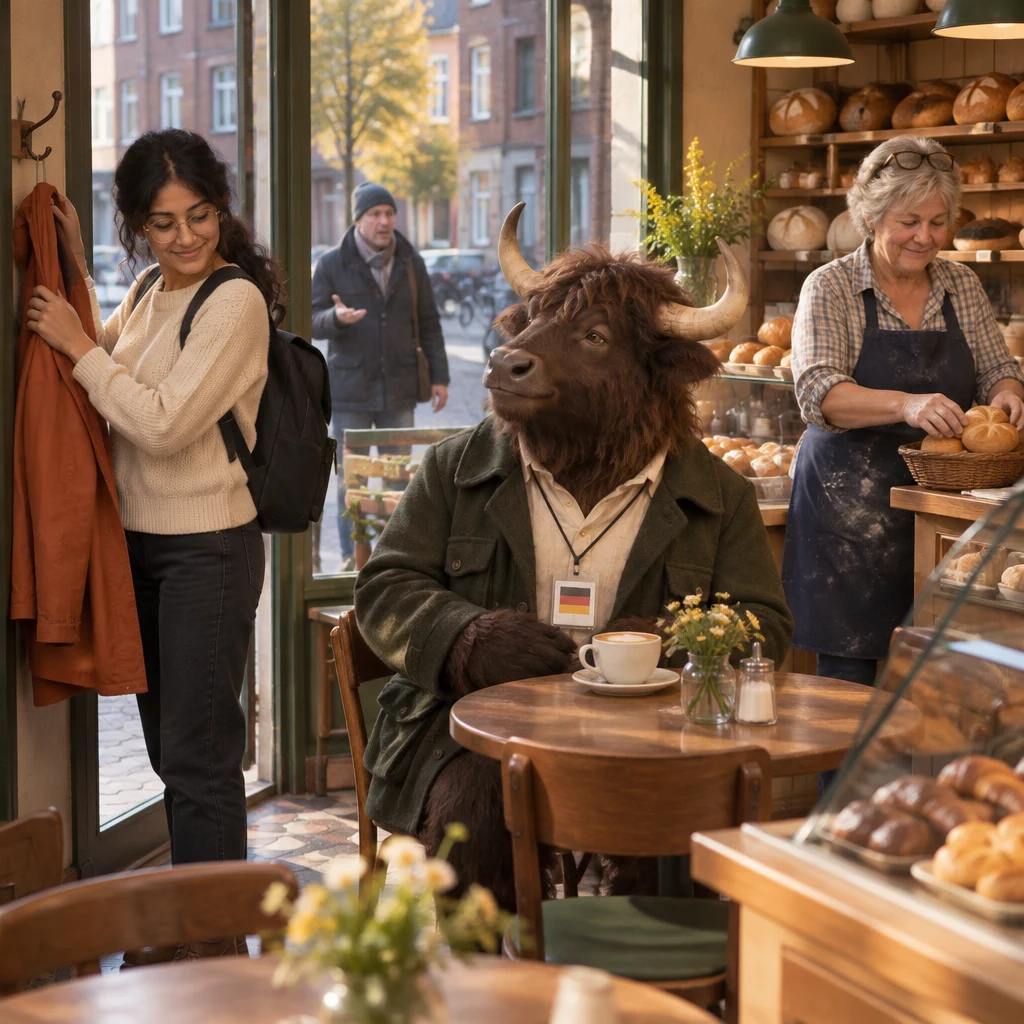
Tuesday morning at Bäckerei Krause. Priya hangs her coat and sits across from Anton at the corner table. His Milchkaffee is still full.
Renate is restacking Schrippen. Outside, someone on the pavement is complaining about the new BVG timetable.
Learn — news and a fair take
Six lines help you bring up local news and keep a balanced view.
You report, name the buzz, and refuse a simple take.

Ich habe gelesen, dass ___.
I read that ___.
When to use it: Use this to report a news item you saw in writing.
After dass, the verb of that clause goes last.

Im Kiez sprechen gerade alle darüber.
Everyone in the neighbourhood is talking about it.
When to use it: Use this when a local topic is already buzzing on your street.
Gerade here means right now, not in a straight line.

Ich finde, beide Seiten haben nachvollziehbare Argumente.
I think both sides have understandable arguments.
When to use it: Use this to show you see sense on both sides.
You are not picking a winner, only crediting both sides.

Das betrifft hier wirklich eine Menge Leute.
This really affects a lot of people here.
When to use it: Use this when a local change hits many people around you.
Eine Menge is a quantity, and Leute stays plural after it.

So einfach, wie es klingt, ist es nicht.
It's not as simple as it sounds.
When to use it: Use this when a neat take hides a messier reality.
Put nicht at the end to flip the whole simple claim.
Say it: The ch in einfach is the ach sound, not the soft ich sound.

Ich würde das Ganze erst mal beobachten.
I'd watch the whole thing for a bit first.
When to use it: Use this when you want to wait before you take a side.
Würde stays second; beobachten waits at the end of the clause.
Say it: Würde uses a tight rounded ü, not a plain u.
Story — both sides
Watch Priya give both sides of the new timetable without picking a winner.
The highlighted words are the lines you just learned. Turn on Show English if you need it.
- Anton has not touched his Milchkaffee. He looks at Priya over the cup.
 AntonHast du das mit dem neuen Fahrplan schon gelesen?Have you already read about the new timetable?
 PriyaIch habe gelesen, dass die U1 morgens seltener fährt.I read that the U1 runs less often in the morning.
- AntonIm Kiez sprechen gerade alle darüber.Everyone in the neighbourhood is talking about it.
- Renate comes over with a basket of Schrippen and stays to listen.
 RenateWatt, die einen schimpfen, die anderen sind froh.Well, some complain, the others are glad.
- PriyaIch finde, beide Seiten haben nachvollziehbare Argumente.I think both sides have understandable arguments.
- AntonWen betrifft das hier?Who does this affect here?
- PriyaDas betrifft hier wirklich eine Menge Leute.This really affects a lot of people here.
- RenateMeine Lieferungen kommen später, die Schüler auch.My deliveries come later, and the school kids too.
- AntonSagen wir mal so. Wer später fährt, hat endlich Sitzplätze.Let's put it this way. People who leave later finally get seats.
- PriyaSo einfach, wie es klingt, ist es nicht.It's not as simple as it sounds.
- AntonDie erste Bahn bleibt voll, die zweite leer.The first train stays packed, the second one empty.
- PriyaIch frage mich, ob das immer stimmt.I wonder if that's always true.
- AntonNa ja, vielleicht.Well, maybe.
- PriyaIch würde das Ganze erst mal beobachten.I'd watch the whole thing for a bit first.
- AntonDas stand nicht auf dem Zettel.That wasn't on the tag.
- He does not explain. The Milchkaffee stays full.
- PriyaWelcher Zettel denn, Anton?What tag, Anton?
- AntonJedenfalls nicht der Fahrplan.Not the timetable, anyway.
Practice — the timetable
Eleven short tasks wait here. You'll listen, match, fill a gap, swap a word, and pick a line.
They stay on the timetable, so you practise a fair take.
0 of 11 done
What did you hear?
What did you hear?
Swap the word
Swap the word
You saw the news in writing, not by hearsay.
Ich habe ____, dass ___.
What does it mean?
What does it mean?
Ich finde, beide Seiten haben nachvollziehbare Argumente.
Match the pairs
German
Ich finde, beide Seiten haben nachvollziehbare Argumente.Drop the English hereDas betrifft hier wirklich eine Menge Leute.Drop the English hereSo einfach, wie es klingt, ist es nicht.Drop the English hereEnglish
Pick the reply
Anton says:
Pick the reply
Der neue Fahrplan ist doch eindeutig besser.
The new timetable is clearly better.
And you reply with:
Fill the gap
Fill the gap
This really affects a lot of people here.
Das ____ hier wirklich eine Menge Leute.
What do you say?
What do you say?
You want to credit both camps with a real point.
Swap the word
Swap the word
A neat take is going around. Say the reality is messier.
So ____, wie es klingt, ist es nicht.
Fill the gap
Fill the gap
I'd watch the whole thing for a bit first.
Ich würde das Ganze erst mal ____.
True or false?
True or false?
You use this when you are sure the claim is always true.
Which one doesn’t belong?
Which one doesn’t belong?
Say it — say it back
Now you're Priya at the corner table. When it's your turn, tap the microphone and speak the line.
Tap ▶ first if you want to hear the line. Your recording stays on your device.
- AntonHast du schon was zum neuen Fahrplan gelesen?Have you already read something about the new timetable?
- Priya (you)Tell him you read that the morning trains run less often.
Tell him you read that the morning trains run less often.
Ich habe gelesen, dass ___.
I read that ___.
0 of 5 said
Recap — what you can say now
| German | English | Play |
|---|---|---|
| Ich habe gelesen, dass ___. | I read that ___. | |
| Im Kiez sprechen gerade alle darüber. | Everyone in the neighbourhood is talking about it. | |
| Ich finde, beide Seiten haben nachvollziehbare Argumente. | I think both sides have understandable arguments. | |
| Das betrifft hier wirklich eine Menge Leute. | This really affects a lot of people here. | |
| So einfach, wie es klingt, ist es nicht. | It's not as simple as it sounds. | |
| Ich würde das Ganze erst mal beobachten. | I'd watch the whole thing for a bit first. |
Save your progress — it’s free
Keep your place in the course and see which lines you’ve learned.
Want the next lesson in your inbox?
Get the next lesson by email, one a day.
Join the newsletterDaily lesson emails are coming soon. Newsletter subscribers get them first.
Keep practicing with Yak Cards
Want to keep these news lines handy? Grab the Yak Cards for this lesson and review them anywhere.
A quick round with the Yak Cards each day keeps your fair takes ready for the bakery table.
Open Yak Cards