German - Basic Questions

Lesson 25 of 158

A friendly learner practicing German question phrases at Level A1; lesson about basic questions and asking for time.

Goal: Ask what, when, what time, and ask someone to do something (Level A1)

Free German lessons with guided practice, audio, and speaking support.

Welcome — ready to ask useful questions in German? In this short lesson you'll hear common question frames, practice them, and say them out loud.

Level A1: In this lesson you'll learn five core question frames: asking "What is...?", "When is...?", "What time is...?", the informal request "Can you...?", and "How do you say...?" We'll practice hearing them in a short conversation and use quizzes to lock them in. A small, friendly step toward asking for information — no heavy grammar today.

After this lesson you'll be able to:
  • Recognize and use simple question frames for identity, time, and requests.
  • Ask and answer "Was ist ___?", "Wann ist ___?", and "Um wie viel Uhr ist ___?" in everyday situations.
  • Use the informal request "Kannst du ___?" and ask "Wie sagt man ___?" with confidence.
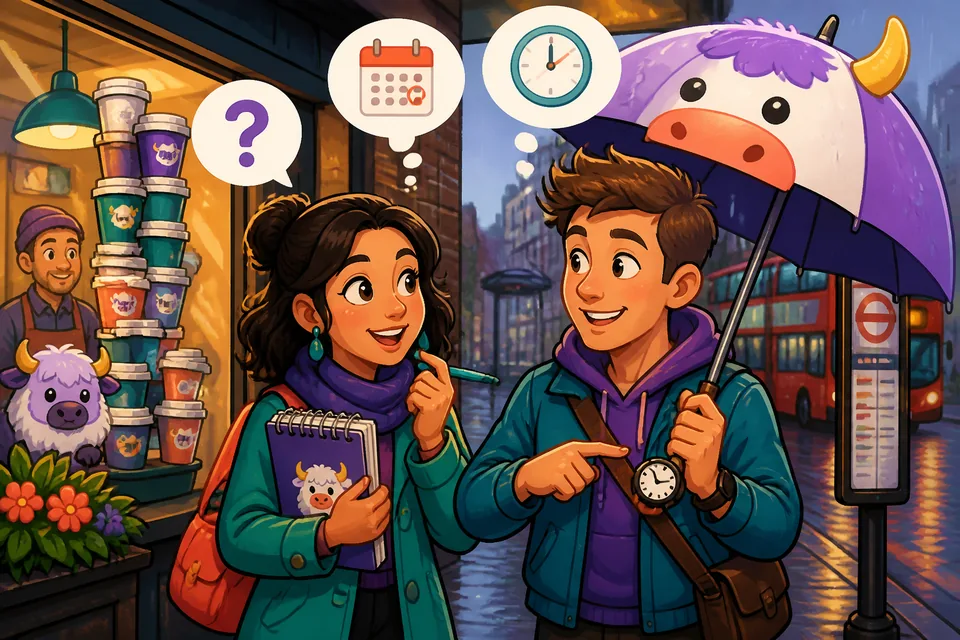
Two people planning an event and using German question frames to ask what, when and what time.

Ready? Let's go!

When you tap play on phrases, we track your progress through this lesson.

1. Reading + Listening Practice

Hear core phrases, repeat aloud.

Was ist ___?

What is ___?

Meaning: What is ___?

When to use: Ask for the identity or explanation of a thing (name, object, event).

Was ist das?
What is that?
Was ist dieses Treffen?
What is this meeting?

Wann ist ___?

When is ___?

Meaning: When is ___?

When to use: Ask about dates or general time (day or date) for events and appointments.

Wann ist die Prüfung?
When is the exam?
Wann ist dein Geburtstag?
When is your birthday?

Um wie viel Uhr ist ___?

What time is ___?

Meaning: What time is ___?

When to use: Ask for the exact clock time of an event (use with Uhr or a clock-time answer).

Tip: Beginners sometimes say "Wann ist...?" for exact clock times; use "Um wie viel Uhr...?" for a specific hour.

Um wie viel Uhr ist das Konzert?
What time is the concert?
Um wie viel Uhr ist das Treffen morgen?
What time is the meeting tomorrow?

Kannst du ___?

Can you ___?

Meaning: Can you ___?

When to use: Make an informal request or ask if someone can do something (use with an infinitive).

Tip: Remember this is informal. For formal situations use "Können Sie ___?"

Kannst du mir helfen?
Can you help me?
Kannst du das Buch bringen?
Can you bring the book?

Wie sagt man ___?

How do you say ___?

Meaning: How do you say ___?

When to use: Ask how to express a word or phrase (often: "Wie sagt man ___ auf Deutsch?").

Wie sagt man 'schedule' auf Deutsch?
How do you say 'schedule' in German?
Wie sagt man das Wort auf Deutsch?
How do you say that word in German?

2. Conversational Listening Practice

Hear phrases in a real mini-conversation.

Anna and David plan and ask about a German course.

Anna and David talking about a German course, asking when it is and if someone can come.

What do Anna and David ask about the course?

Portrait of Anna in a German lesson dialogue

Anna

Was ist dieses Treffen?

What is this meeting?

Portrait of David in a German lesson dialogue

David

Es ist ein Deutschkurs.

It's a German course.

Portrait of Anna in a German lesson dialogue

Anna

Wann ist der Kurs?

When is the course?

Portrait of David in a German lesson dialogue

David

Um wie viel Uhr ist er? — Um 18 Uhr.

What time is it? — At 6 p.m.

Portrait of Anna in a German lesson dialogue

Anna

Kannst du morgen kommen?

Can you come tomorrow?

Portrait of David in a German lesson dialogue

David

Wie sagt man 'course' auf Deutsch?

How do you say 'course' in German?

3. Guided Practice

Quizzes and matching to lock in meaning.

How do you ask 'What is ___?' in German?

Which phrase asks for a specific clock time?

Which phrase is an informal request form 'Can you...?'

How do you ask 'How do you say ___?' in German?

A: When is the movie? B: It starts at 8 p.m.

A: ___ der Film? B: Er beginnt um 20 Uhr.

A: What time is the concert? B: It starts at 7:30 p.m.

A: ___ das Konzert? B: Es beginnt um 19:30.

A: Can you help me please? B: Yes, gladly.

A: ___ mir bitte helfen? B: Ja, gern.

Match the core phrases

Match the extra phrases

4. Speaking Practice

Say phrases yourself (mic/recording).

Recording stays on your device only. Check speech uses your browser's speech tools when available.

Say this phrase out loud:

Was ist ___?

What is ___?

Say this phrase out loud:

Wann ist ___?

When is ___?

Say this phrase out loud:

Um wie viel Uhr ist ___?

What time is ___?

Say this phrase out loud:

Kannst du ___?

Can you ___?

Say this phrase out loud:

Wie sagt man ___?

How do you say ___?