German - Basic Problem Statements

Lesson 24 of 158

Learner practicing German problem statements like 'Ich bin zu spät' and 'Es ist zu teuer' — beginner A1 vocabulary.

Goal: Say what's wrong — simple problems and solutions

Free German lessons with guided practice, audio, and speaking support.

Welcome! In this short lesson you'll practice common ways to say small problems in German. Listen, repeat, and use the phrases in tiny role-plays — it's how Yak Yackers learn fast.

Level A1: In Lesson 24 you'll learn and practice everyday problem statements: saying you hurt yourself, something is broken, you forgot or missed something, you're late, can't pay, or that something is 'too' something (zu ...). This CEFR-aligned practice focuses on clear phrases you can repeat and use right away.

After this lesson you'll be able to:

  • Recognize and say short problem statements in German (A1).
  • Use accusative or simple structures correctly with these chunks.
  • Be able to tell someone: I forgot, I missed, I'm late, it's broken, I can't pay, and more.
A friendly street scene showing someone explaining a problem in German: a broken phone, a missed bus, and a late person.

Ready? Let's go!

When you tap play on phrases, we track your progress through this lesson.

1. Reading + Listening Practice

Hear core phrases, repeat aloud.

Ich habe mir ___ verletzt.

I hurt my ___.

Meaning: I hurt my ___.

When to use: Say this when you injured a body part (use accusative article: den, die, das).

Tip: Beginner error: using 'mich' instead of 'mir + den/die/das' (Ich habe mir den Arm verletzt is natural).

Ich habe mir den Arm verletzt.
I hurt my arm.
Oh nein, ich habe mir die Hand verletzt.
Oh no, I hurt my hand.

___ ist kaputt.

The ___ is broken.

Meaning: The ___ is broken.

When to use: Use this to say that an object is not working (include correct article: der/die/das).

Der Drucker ist kaputt.
The printer is broken.
Mein Handy ist kaputt.
My phone is broken.

Ich habe ___ vergessen.

I forgot ___.

Meaning: I forgot ___.

When to use: Say this when you left or forgot an object; the object is accusative (den, die, das / mein, deine...).

Ich habe den Schlüssel vergessen.
I forgot the key.
Ich habe mein Ticket vergessen.
I forgot my ticket.

Ich habe ___ verpasst.

I missed ___.

Meaning: I missed ___.

When to use: Use for transport, appointments or events (den Bus, die Bahn, den Termin).

Ich habe den Bus verpasst.
I missed the bus.
Ich habe den Termin verpasst.
I missed the appointment.

Ich bin zu spät.

I'm late.

Meaning: I'm late.

When to use: A short natural phrase for being late to work, class, or a meeting.

Tut mir leid, ich bin zu spät.
Sorry, I'm late.
Er sagt: Ich bin zu spät.
He says: I'm late.

Ich kann nicht bezahlen.

I can't pay.

Meaning: I can't pay.

When to use: Use when you cannot pay now or have a payment problem at a shop or machine.

Tip: Some learners say 'Ich habe kein Geld' (I have no money) — correct but different meaning.

Entschuldigung, ich kann nicht bezahlen.
Sorry, I can't pay.
Die Karte funktioniert nicht — ich kann nicht bezahlen.
The card doesn't work — I can't pay.

Es ist zu ___.

It's too ___.

Meaning: It's too ___.

When to use: Use with adjectives (kalt, teuer, weit). The adjective after 'zu' stays unchanged.

Tip: Don't change the adjective ending after 'zu' (say 'Es ist zu teuer', not 'Es ist zu teurer').

Es ist zu kalt.
It's too cold.
Das Auto ist zu teuer.
The car is too expensive.

2. Conversational Listening Practice

Hear phrases in a real mini-conversation.

Anna missed the bus and has a broken phone; David asks and helps.
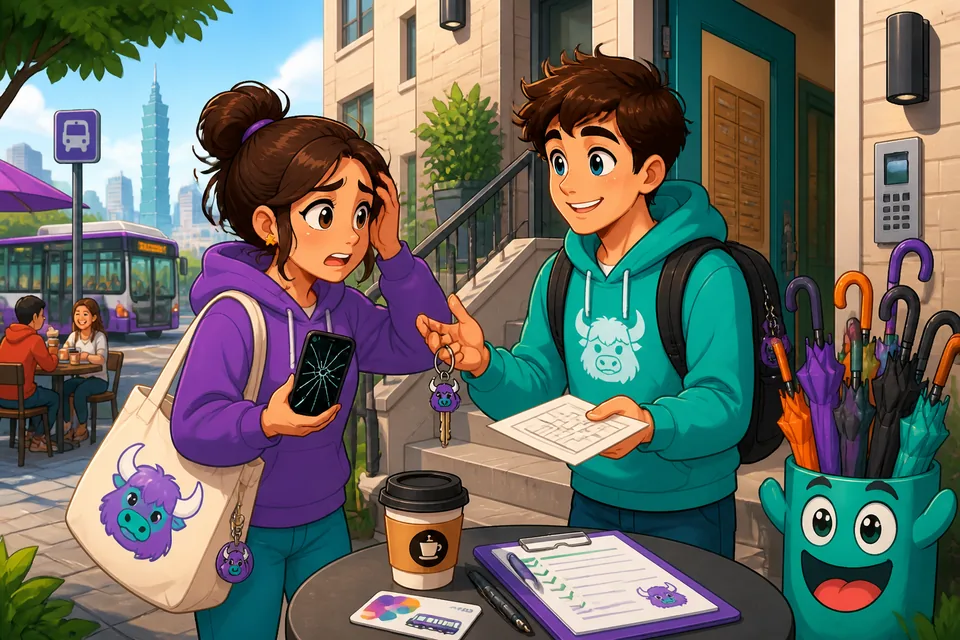
Two people in German using simple problem phrases: 'Ich habe den Bus verpasst' and 'Es ist kaputt.'

Who missed the bus?

Portrait of Anna in a German lesson dialogue

Anna

Ich bin zu spät.

I'm late.

Portrait of David in a German lesson dialogue

David

Warum? Was ist los?

Why? What's wrong?

Portrait of Anna in a German lesson dialogue

Anna

Ich habe den Bus verpasst und mein Handy ist kaputt.

I missed the bus and my phone is broken.

Portrait of David in a German lesson dialogue

David

Oh nein. Kannst du bezahlen?

Oh no. Can you pay?

Portrait of Anna in a German lesson dialogue

Anna

Nein, ich kann nicht bezahlen. Und ich habe mein Portemonnaie vergessen.

No, I can't pay. And I forgot my wallet.

Portrait of David in a German lesson dialogue

David

Ich gebe dir Geld. Ist alles sonst okay? Hast du dich verletzt?

I'll give you money. Is everything else okay? Did you get hurt?

3. Guided Practice

Quizzes and matching to lock in meaning.

How do you say 'I'm late.' in German?

Which German phrase says 'I missed the bus'?

Choose the phrase meaning 'The phone is broken.'

Which sentence means 'It's too cold'?

I missed the train.

At the station I say: '___' when I missed my train.

I can't pay.

When my card doesn't work at the shop I say: '___'.

I forgot the key.

If you forgot your keys you tell someone: '___'.

Match the core phrases

Match the extra phrases

4. Speaking Practice

Say phrases yourself (mic/recording).

Recording stays on your device only. Check speech uses your browser's speech tools when available.

Say this phrase out loud:

Ich habe mir ___ verletzt.

I hurt my ___.

Say this phrase out loud:

___ ist kaputt.

The ___ is broken.

Say this phrase out loud:

Ich habe ___ vergessen.

I forgot ___.

Say this phrase out loud:

Ich habe ___ verpasst.

I missed ___.

Say this phrase out loud:

Ich bin zu spät.

I'm late.

Say this phrase out loud:

Ich kann nicht bezahlen.

I can't pay.

Say this phrase out loud:

Es ist zu ___.

It's too ___.