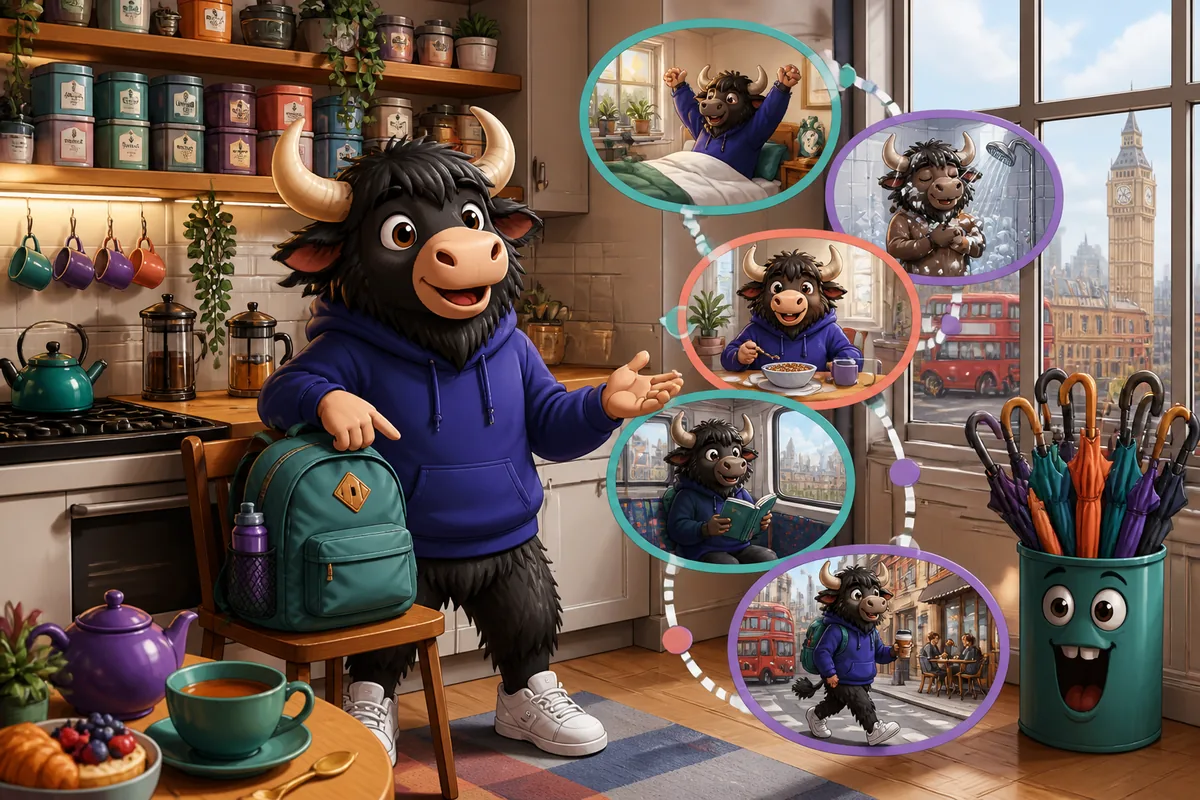
Welcome to Lesson 60! Ready to map out a typical day in German? We'll listen, practice, and say these handy routine phrases aloud.
Level A2: In this short lesson you'll practice common phrases to talk about daily routines — saying when you do things (um/am), what happens before or after, how long tasks take, and which days you do (or don't do) activities. This CEFR-aligned practice focuses on useful sentence frames you can use every day.
After this lesson you'll be able to:
Practice A2-level phrases for times and routines (um, am, vor, nach).
Ask and answer "When?" questions about daily activities.
Say how long tasks take and describe what you usually do each day.
Ready? Let's go!
When you tap play on phrases, we track your progress through this lesson.
1. Reading + Listening Practice
Hear core phrases, repeat aloud.
Ich ___ normalerweise um ___.
I usually ___ at ___.
Meaning: I usually ___ at ___.
When to use: Use this frame to say what you normally do at a specific clock time (use um + time).
Tip: Don't put the time before 'um' — say 'um sieben Uhr', not 'sieben Uhr um'.
Ich frühstücke normalerweise um sieben Uhr.
I usually have breakfast at 7:00.
Ich gehe normalerweise um halb acht zur Arbeit.
I usually go to work at 7:30.
Um wie viel Uhr machst du normalerweise ___?
What time do you usually ___?
Meaning: What time do you usually ___?
When to use: Ask someone the usual time for an activity. Works well with activities like 'Hausaufgaben machen' or 'zur Arbeit gehen'.
Um wie viel Uhr machst du normalerweise Sport?
What time do you usually exercise?
Um wie viel Uhr machst du normalerweise Hausaufgaben?
What time do you usually do homework?
Ich ___ vor ___.
I ___ before ___.
Meaning: I ___ before ___.
When to use: Say what happens earlier than another event or time (use 'vor' + noun/time).
Tip: Remember 'vor' often needs the dative for events (e.g. 'vor der Schule').
Ich esse frühstück vor der Arbeit.
I eat breakfast before work.
Ich jogge vor der Schule.
I jog before school.
Nach ___ mache ich normalerweise ___.
After ___, I usually ___.
Meaning: After ___, I usually ___.
When to use: Use this to describe what you normally do after a given part of the day or event (use 'nach' + noun).
Nach der Arbeit mache ich normalerweise Sport.
After work, I usually exercise.
Nach dem Frühstück lese ich normalerweise die Nachrichten.
After breakfast, I usually read the news.
Am ___ mache ich normalerweise ___.
On ___, I usually ___.
Meaning: On ___, I usually ___.
When to use: Talk about routine activities on a weekday or weekend using 'am' (e.g. am Montag, am Wochenende).
Am Samstag mache ich normalerweise Einkäufe.
On Saturday I usually do shopping.
Am Morgen mache ich normalerweise Yoga.
In the morning I usually do yoga.
Ich habe von ___ bis ___ keine Zeit.
I'm busy from ___ to ___.
Meaning: I’m busy from ___ to ___.
When to use: Say you have no free time during a time range (use 'von ... bis ...').
Tip: Watch the order: 'von neun bis elf' (from 9 to 11), not 'bis neun von elf'.
Ich habe von neun bis zwölf keine Zeit.
I'm busy from nine to twelve.
Am Nachmittag habe ich von vier bis sechs keine Zeit.
In the afternoon I'm busy from four to six.
Ich brauche ___, um zu ___.
It takes me ___ to ___.
Meaning: It takes me ___ to ___.
When to use: Describe how long an activity takes; start with a duration (e.g. zehn Minuten) followed by 'um zu' + infinitive.
Tip: Put the duration first and use 'um zu' before the infinitive; for separable verbs keep 'zu' inside (e.g. 'um aufzustehen').
Ich brauche zehn Minuten, um mich fertig zu machen.
I need ten minutes to get ready.
Ich brauche halb Stunde, um zur Arbeit zu gehen.
I need half an hour to walk to work.
Ich versuche, jeden Tag zu ___.
I try to ___ every day.
Meaning: I try to ___ every day.
When to use: Talk about daily goals or habits; finish with an infinitive (e.g. 'jeden Tag zu laufen').
Ich versuche, jeden Tag zu joggen.
I try to jog every day.
Ich versuche, jeden Tag Deutsch zu lernen.
I try to learn German every day.
Ich ___ am ___ normalerweise nicht.
I don't usually ___ on ___.
Meaning: I don’t usually ___ on ___.
When to use: Say that an activity is not part of your usual routine on a certain day (use 'am' with weekday or weekend).
Ich arbeite am Sonntag normalerweise nicht.
I don't usually work on Sunday.
Ich esse am Wochenende normalerweise nicht im Büro zu Mittag.
I don't usually eat lunch at the office on weekends.
Was machst du normalerweise am ___?
What do you usually do in the ___?
Meaning: What do you usually do in the ___?
When to use: Ask about someone's usual activity during parts of the day (am Morgen, am Nachmittag, am Abend).
Was machst du normalerweise am Abend?
What do you usually do in the evening?
Was machst du normalerweise am Morgen?
What do you usually do in the morning?
Mein Wecker klingelt um ___.
My alarm goes off at ___.
Meaning: My alarm goes off at ___.
When to use: Use this to say the time your alarm rings (use 'um' + clock time).
Mein Wecker klingelt um sechs Uhr.
My alarm goes off at 6:00.
Mein Wecker klingelt um halb sieben.
My alarm goes off at 6:30.
Ich mache mich für ___ fertig.
I get ready for ___.
Meaning: I get ready for ___.
When to use: Say what you're preparing for in your routine (use 'für' + event or activity).
Ich mache mich für die Arbeit fertig.
I get ready for work.
Ich mache mich für die Schule fertig.
I get ready for school.
Ich gehe so gegen ___ von zu Hause los.
I leave home at about ___.
Meaning: I leave home at about ___.
When to use: Use 'so gegen' with an approximate time to say when you leave home.
Ich gehe so gegen sieben von zu Hause los.
I leave home at about 7:00.
Ich gehe so gegen halb acht von zu Hause los.
I leave home at about 7:30.
2. Conversational Listening Practice
Hear phrases in a real mini-conversation.
Anna and David compare morning routines and times they leave home.
Anna
Mein Wecker klingelt um sechs Uhr.
My alarm goes off at 6:00.
David
Um wie viel Uhr gehst du so von zu Hause los?
About what time do you leave home?
Anna
Ich gehe so gegen halb sieben von zu Hause los.
I leave home at about 6:30.
David
Nach dem Frühstück mache ich normalerweise Sport.
After breakfast, I usually exercise.
Anna
Ich brauche zehn Minuten, um mich fertig zu machen.
It takes me ten minutes to get ready.
3. Guided Practice
Quizzes and matching to lock in meaning.
Which German sentence says "My alarm goes off at 6"?
How do you say in German: "I'm busy from 9 to 11"?
Which option best answers: 'Um wie viel Uhr machst du normalerweise Sport?'
How to say: 'I leave home at about eight' in German?
I don't usually work on Sundays: Ich arbeite am Sonntag normalerweise nicht.
I don't usually work on Sundays: ___.
I leave home at about 7:30 every morning: Ich gehe so gegen halb acht von zu Hause los.
I leave home at about 7:30 every morning: ___.
After school, I usually do homework: Nach der Schule mache ich normalerweise Hausaufgaben.
After school, I usually do homework: ___.
Match the core phrases
Match the extra phrases
4. Speaking Practice
Say phrases yourself (mic/recording).
Recording stays on your device only. Check speech uses your browser's speech tools when available.