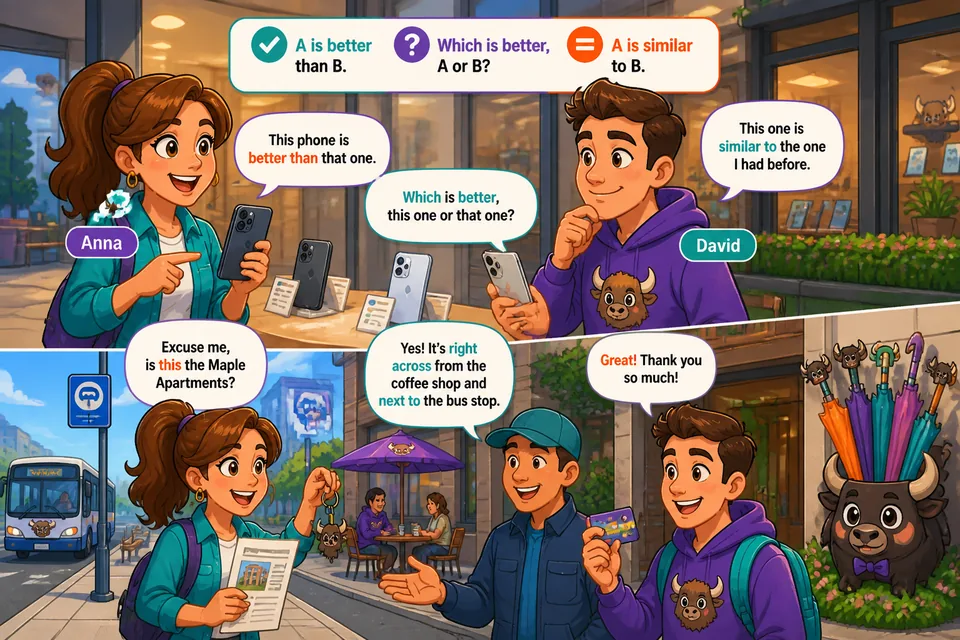
Ready to compare things and say what’s better? In this B1 lesson we’ll practice natural German comparison phrases you can use right away. Have fun — a little friendly debate makes learning stick!
Level B1: This lesson focuses on common comparison phrases like „___ ist besser als ___“, „Was ist besser: ___ oder ___?“, and questions like „Wie ist ___ im Vergleich zu ___?“. You’ll listen, repeat, and practice with short quizzes and speaking prompts to compare objects, qualities, and quantities. (CEFR-aligned — lesson 42 keeps it practical and a bit lively.)
After this lesson you'll be able to:
Use basic German comparison frames to say one thing is better, more, less, or the same.
Ask and answer simple comparison questions (e.g., Was ist besser: ___ oder ___?; Was ist der Unterschied zwischen ___ und ___?).
Describe quantities and similarities (e.g., ___ hat mehr ___ als ___; ___ ist ähnlich wie ___).
Ready? Let's go!
When you tap play on phrases, we track your progress through this lesson.
1. Reading + Listening Practice
Hear core phrases, repeat aloud.
___ ist besser als ___.
___ is better than ___.
Meaning: ___ is better than ___.
When to use: Use this to say plainly that one option is better than another; good for tastes, features, or choices.
Tip: Beginner learners sometimes say „besser von“ instead of „besser als“.
Dieses Modell ist besser als das alte.
This model is better than the old one.
Für mich ist Tee besser als Kaffee.
For me, tea is better than coffee.
Was ist besser: ___ oder ___?
Which is better, ___ or ___?
Meaning: Which is better, ___ or ___?
When to use: Ask this when you want someone's opinion about two clear options.
Was ist besser: Zug oder Auto?
Which is better: train or car?
Was ist besser: Sofa A oder Sofa B?
Which is better: sofa A or sofa B?
___ ist ähnlich wie ___.
___ is similar to ___.
Meaning: ___ is similar to ___.
When to use: Use this to say two things are alike in some ways — can describe appearance, function, or feeling.
Diese Jacke ist ähnlich wie die andere.
This jacket is similar to the other one.
Der Film ist ähnlich wie das Buch.
The movie is similar to the book.
___ ist anders als ___.
___ is different from ___.
Meaning: ___ is different from ___.
When to use: Say this to point out a clear difference between two items or ideas.
Mein Geschmack ist anders als deins.
My taste is different from yours.
Dieses Modell ist anders als das Vorgängermodell.
This model is different from the previous one.
Was ist der Unterschied zwischen ___ und ___?
What's the difference between ___ and ___?
Meaning: What's the difference between ___ and ___?
When to use: Ask this when you want a short explanation of how two things are not the same.
Tip: Remember: native speakers often put articles (dem/einem) after ‚zwischen‘ when specific nouns are used.
Was ist der Unterschied zwischen einem Tablet und einem Laptop?
What's the difference between a tablet and a laptop?
Was ist der Unterschied zwischen Premium und Standard?
What's the difference between premium and standard?
___ ist ___ als ___.
___ is more ___ than ___.
Meaning: ___ is more ___ than ___.
When to use: Use this to compare the degree of an adjective (e.g., faster, bigger, more interesting).
Tip: Don’t use ‚mehr‘ with adjectives that form a proper comparative (say ‚größer‘, not ‚mehr groß‘).
Dieses Auto ist schneller als das andere.
This car is faster than the other.
Das Buch ist interessanter als der Film.
The book is more interesting than the film.
___ ist weniger ___ als ___.
___ is less ___ than ___.
Meaning: ___ is less ___ than ___.
When to use: Say this to show a smaller degree: less expensive, less noisy, less difficult.
Das Zimmer ist weniger teuer als gedacht.
The room is less expensive than expected.
Das neue Modell ist weniger kompliziert als das alte.
The new model is less complicated than the old one.
___ ist genauso ___ wie ___.
___ is as ___ as ___.
Meaning: ___ is as ___ as ___.
When to use: Use this to say two things are equal in a quality or degree (same speed, same price).
Dieses Fahrrad ist genauso schnell wie das andere.
This bike is just as fast as the other.
Das Hotel ist genauso teuer wie das in der Stadt.
The hotel is as expensive as the one in the city.
Die sind ungefähr gleich.
They're about the same.
Meaning: They're about the same.
When to use: Use this short phrase for a casual, spoken comment when differences are small or unimportant.
Die beiden Telefone? Die sind ungefähr gleich.
The two phones? They're about the same.
Preislich sind die Optionen ungefähr gleich.
Price-wise the options are about the same.
Wie ist ___ im Vergleich zu ___?
How does ___ compare with ___?
Meaning: How does ___ compare with ___?
When to use: Ask this for a general comparison, often when wanting pros/cons or overall differences.
Wie ist das neue Modell im Vergleich zu dem alten?
How does the new model compare with the old one?
Wie ist Berlin im Vergleich zu Hamburg?
How does Berlin compare with Hamburg?
Im Vergleich zu ___ ist ___ ___.
Compared with ___, ___ is ___.
Meaning: Compared with ___, ___ is ___.
When to use: Use this to present one item as the reference and describe the other in relation to it.
Im Vergleich zu letztem Jahr ist dieses Jahr billiger.
Compared with last year, this year is cheaper.
Im Vergleich zu dem Vorgänger ist das neue Modell praktischer.
Compared with the predecessor, the new model is more practical.
___ hat mehr ___ als ___.
___ has more ___ than ___.
Meaning: ___ has more ___ than ___.
When to use: Compare countable features or quantities (more rooms, more features, more people).
Das Haus hat mehr Zimmer als die Wohnung.
The house has more rooms than the flat.
Mein Computer hat mehr Funktionen als dein Laptop.
My computer has more features than your laptop.
___ hat weniger ___ als ___.
___ has fewer ___ than ___.
Meaning: ___ has fewer ___ than ___.
When to use: Use this to say one thing has a smaller count or amount (fewer people, less time, fewer errors).
Tip: Some learners incorrectly use ‚weniger‘ only with uncountable nouns; ‚weniger‘ can be used with countable plural nouns in German.
Die kleine Wohnung hat weniger Fenster als das Haus.
The small flat has fewer windows than the house.
Dieses Paket hat weniger Seiten als das andere.
This package has fewer pages than the other.
2. Conversational Listening Practice
Hear phrases in a real mini-conversation.
Anna and David compare two smartphones in a store, using short B1 comparison phrases.
Anna
Was ist besser: Smartphone A oder Smartphone B?
Which is better: smartphone A or smartphone B?
David
Smartphone A ist besser als Smartphone B für Fotos.
Smartphone A is better than smartphone B for photos.
Anna
Smartphone B ist schneller als Smartphone A, oder?
Smartphone B is faster than smartphone A, right?
David
Ja, Smartphone B ist schneller als Smartphone A.
Yes, smartphone B is faster than smartphone A.
Anna
Was ist der Unterschied zwischen Smartphone A und Smartphone B?
What's the difference between smartphone A and smartphone B?
David
Smartphone A hat mehr Speicher; Smartphone B hat weniger Akku.
Smartphone A has more storage; smartphone B has less battery.
3. Guided Practice
Quizzes and matching to lock in meaning.
Which German sentence asks 'Which is better: A or B?'
Which sentence means 'They're about the same.'?
Which sentence correctly uses a comparative adjective for 'X is more interesting than Y'?
How do you say 'A has fewer rooms than B' in German?
After trying both phones, I say 'Smartphone A ist besser als Smartphone B.'
After trying both phones, I say ___.
To ask that question use 'Wie ist der Akku im Vergleich zu dem alten Modell?'
To ask 'How does the battery compare with the old model?' you would say ___.
If nearly equal, say 'Die sind ungefähr gleich.'
If two options seem nearly equal, you can say ___.
Match the core phrases
Match the extra phrases
4. Speaking Practice
Say phrases yourself (mic/recording).
Recording stays on your device only. Check speech uses your browser's speech tools when available.