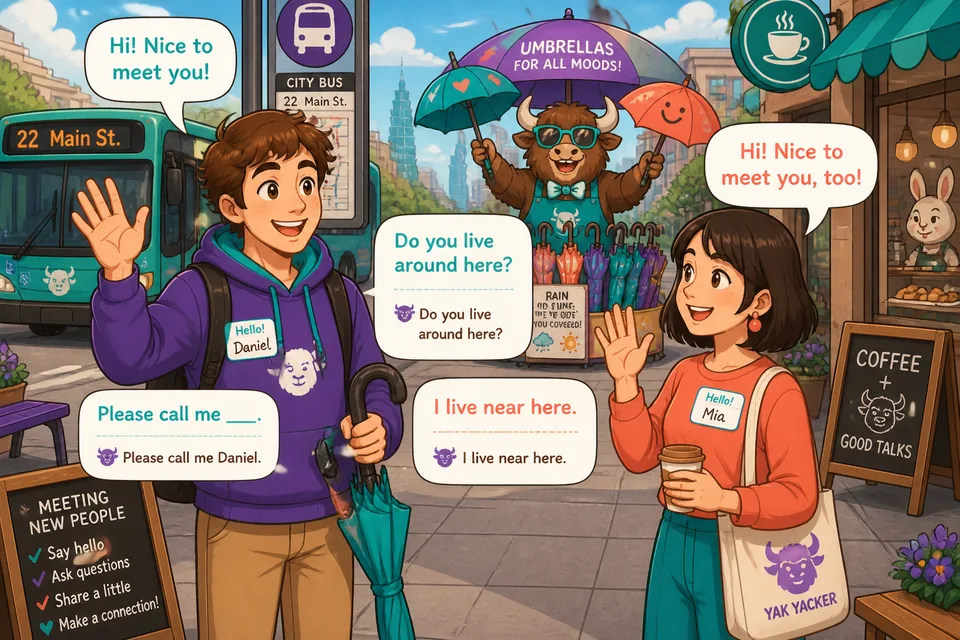
Nice to meet you — and welcome! This short lesson will help you start conversations and make connections at events or in your neighborhood. Have fun practicing — small talk is practice for big friendships!
Level A2: In this lesson you'll practice useful German phrases for meeting new people: saying what to call yourself, asking why someone is here, where they live, and how to stay in touch. We'll listen, repeat, and use these phrases in a short dialogue so you can try them right away. (CEFR-aligned, friendly practice.)
After this lesson you'll be able to:
Use simple phrases to introduce yourself and tell someone what they should call you.
Ask and answer questions about why someone is at an event and whether they live nearby.
Practice asking about jobs and suggesting you stay in contact (A2 level).
Ready? Let's go!
When you tap play on phrases, we track your progress through this lesson.
1. Reading + Listening Practice
Hear core phrases, repeat aloud.
Nenn mich bitte ___.
Please call me ___.
Meaning: Please call me ___.
When to use: Use this informal phrase to tell someone which name you prefer. Good when you want a casual, friendly vibe.
Tip: Beginners sometimes use the formal 'Nennen Sie mich' in casual settings; use 'Nenn mich bitte...' with friends or peers.
Nenn mich bitte Anna.
Please call me Anna.
Wenn du willst, nenn mich bitte Tom.
If you like, please call me Tom.
Wohnst du hier in der Nähe?
Do you live around here?
Meaning: Do you live around here?
When to use: Ask this to find out if someone lives nearby. Use 'du' for informal conversations.
Wohnst du hier in der Nähe oder bist du zu Besuch?
Do you live nearby or are you visiting?
Wohnst du hier in der Nähe? Ich suche nach einem Café.
Do you live around here? I'm looking for a café.
Ich wohne hier in der Nähe.
I live near here.
Meaning: I live near here.
When to use: Say this when someone asks if you live nearby. It's a simple, direct answer.
Ja, ich wohne hier in der Nähe, seit zwei Jahren.
Yes, I live near here, for two years.
Ich wohne hier in der Nähe, nur fünf Minuten entfernt.
I live nearby, just five minutes away.
Ich bin wegen ___ hier.
I'm here for ___.
Meaning: I'm here for ___.
When to use: Use this to explain why you are at a place or event (e.g., a concert, meeting, or to see a friend).
Tip: Learners sometimes avoid 'wegen' because of case questions. In conversation 'Ich bin wegen...' is common and natural.
Ich bin wegen der Konferenz hier.
I'm here for the conference.
Ich bin wegen eines Freundes hier.
I'm here because of a friend.
Was machst du beruflich?
What do you do?
Meaning: What do you do?
When to use: Ask this to inquire about someone's job or main activity. It's neutral and common in small talk.
Was machst du beruflich? Ich arbeite im Marketing.
What do you do for work? I work in marketing.
Was machst du beruflich, wenn ich fragen darf?
What do you do for a living, if I may ask?
Bist du zum ersten Mal hier?
Is this your first time here?
Meaning: Is this your first time here?
When to use: Ask this when you wonder if someone has been to an event or place before.
Bist du zum ersten Mal hier? Das Programm ist sehr freundlich.
Is this your first time here? The program is very friendly.
Bist du zum ersten Mal hier oder kennst du den Ort schon?
Is this your first time here or do you know this place already?
Lass uns in Kontakt bleiben.
Let's keep in touch.
Meaning: Let's keep in touch.
When to use: Use this after meeting someone to suggest staying connected, exchanging contacts or following up.
Es war schön, dich kennenzulernen. Lass uns in Kontakt bleiben.
It was nice to meet you. Let's keep in touch.
Wenn du willst, lass uns in Kontakt bleiben und Kaffeetrinken planen.
If you want, let's keep in touch and plan a coffee.
Was führt dich hierher?
What brings you here?
Meaning: What brings you here?
When to use: A friendly question to ask why someone is at an event; slightly more formal than 'Warum bist du hier?'.
Was führt dich hierher? Bist du beruflich da?
What brings you here? Are you here for work?
Was führt dich hierher — das Treffen oder ein Freund?
What brings you here — the meeting or a friend?
Ich bin ein Freund von ___.
I'm a friend of ___.
Meaning: I'm a friend of ___.
When to use: Use this to explain how you know someone at the event; change gender if needed (eine Freundin).
Tip: Female speakers should use 'eine Freundin von ...' — beginners sometimes forget the gender form.
Ich bin ein Freund von Lukas, wir arbeiten zusammen.
I'm a friend of Lukas; we work together.
Ich bin ein Freund von Maria — sie hat mich eingeladen.
I'm a friend of Maria — she invited me.
2. Conversational Listening Practice
Hear phrases in a real mini-conversation.
At a community event, two people meet and chat briefly.
Anna
Nenn mich bitte Anna.
Please call me Anna.
David
Freut mich, Anna. Wohnst du hier in der Nähe?
Nice to meet you, Anna. Do you live around here?
Anna
Ja, ich wohne hier in der Nähe. Und du?
Yes, I live nearby. And you?
David
Ich bin wegen der Konferenz hier. Was machst du beruflich?
I'm here for the conference. What do you do for work?
Anna
Ich bin ein Freund von Lisa und arbeite im Design.
I'm a friend of Lisa and I work in design.
David
Lass uns in Kontakt bleiben.
Let's keep in touch.
3. Guided Practice
Quizzes and matching to lock in meaning.
Which German phrase means 'Let's keep in touch.'?
Which question asks whether someone lives nearby?
Which phrase would you use to say you met someone through a mutual friend?
Which question asks about someone's job?
You're meeting a new neighbor and want to ask if they live nearby: Do you live around here?
You're meeting a new neighbor and want to ask if they live nearby: ___
You want to explain you are here for a conference: I'm here for the conference.
You want to explain you are here for a conference: ___
After a good chat you suggest staying connected: Let's keep in touch.
After a good chat you suggest staying connected: ___
Match the core phrases
Match the extra phrases
4. Speaking Practice
Say phrases yourself (mic/recording).
Recording stays on your device only. Check speech uses your browser's speech tools when available.