
New here? This is lesson 177 of a free 240-lesson German course.
The warehouse district in German
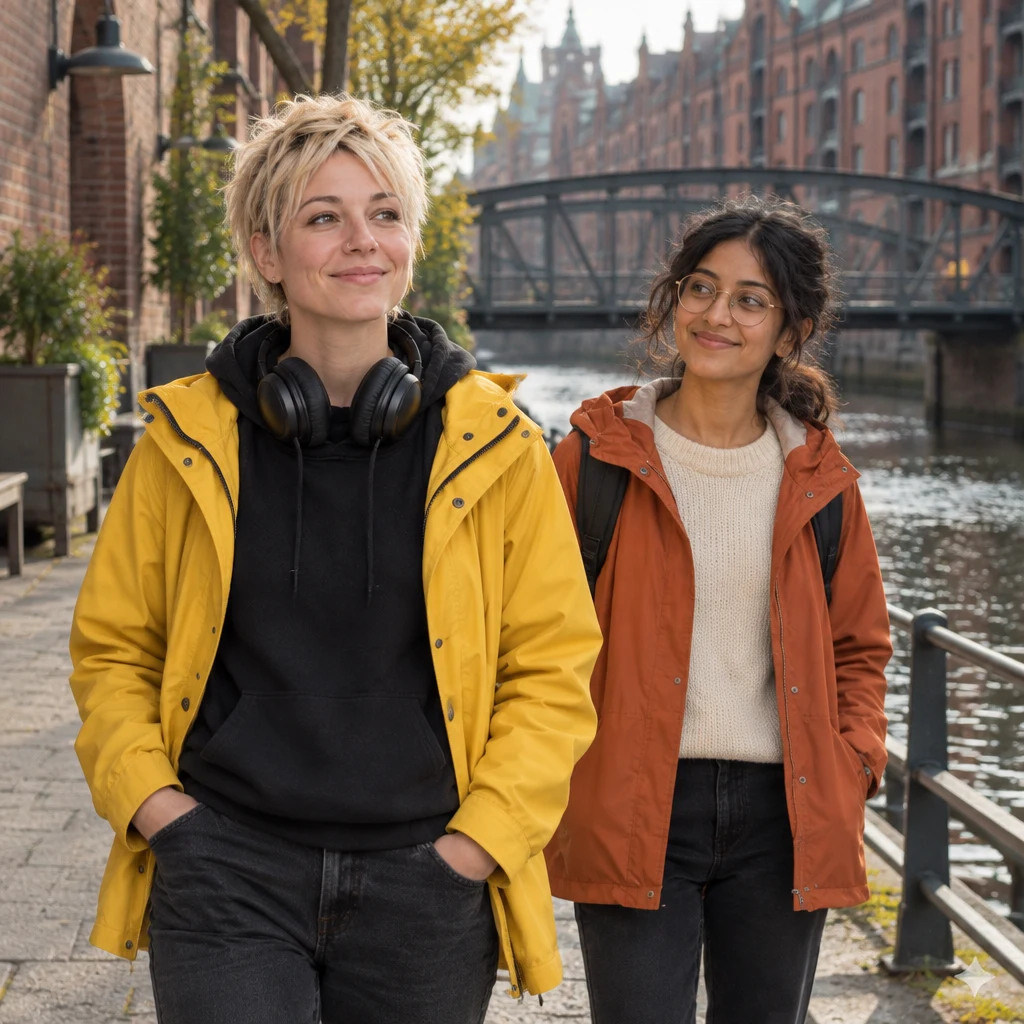
Priya and Jule walk the Speicherstadt after the delayed train.
Dark brick warehouses sit over dark water, older than they look.
Jule grew up in Hamburg, so she knows this stretch. She does not give a lecture.
She just says what the place used to do, and how it feels now.
By the end, you'll describe an old neighbourhood, say how it was used, and suggest walking through slowly.
Keep it everyday: bricks, water, and what people stored here.
By the end of this lesson
Describe an old neighbourhood, how it used to be used, and suggest walking through it slowly.
- Das Viertel ist schon über hundert Jahre alt.This neighbourhood is already more than a hundred years old.
- Die Speicher stehen direkt am Wasser.The warehouses stand right on the water.
- Früher haben die hier Waren gelagert.They used to store goods here.
- Heute sieht es fast aus wie ein Museum.Today it almost looks like a museum.
- Hier ist es ganz anders als in Berlin.It's very different here from Berlin.
- Lass uns da langsam durchlaufen.Let's walk through slowly.
Scene — over the canals
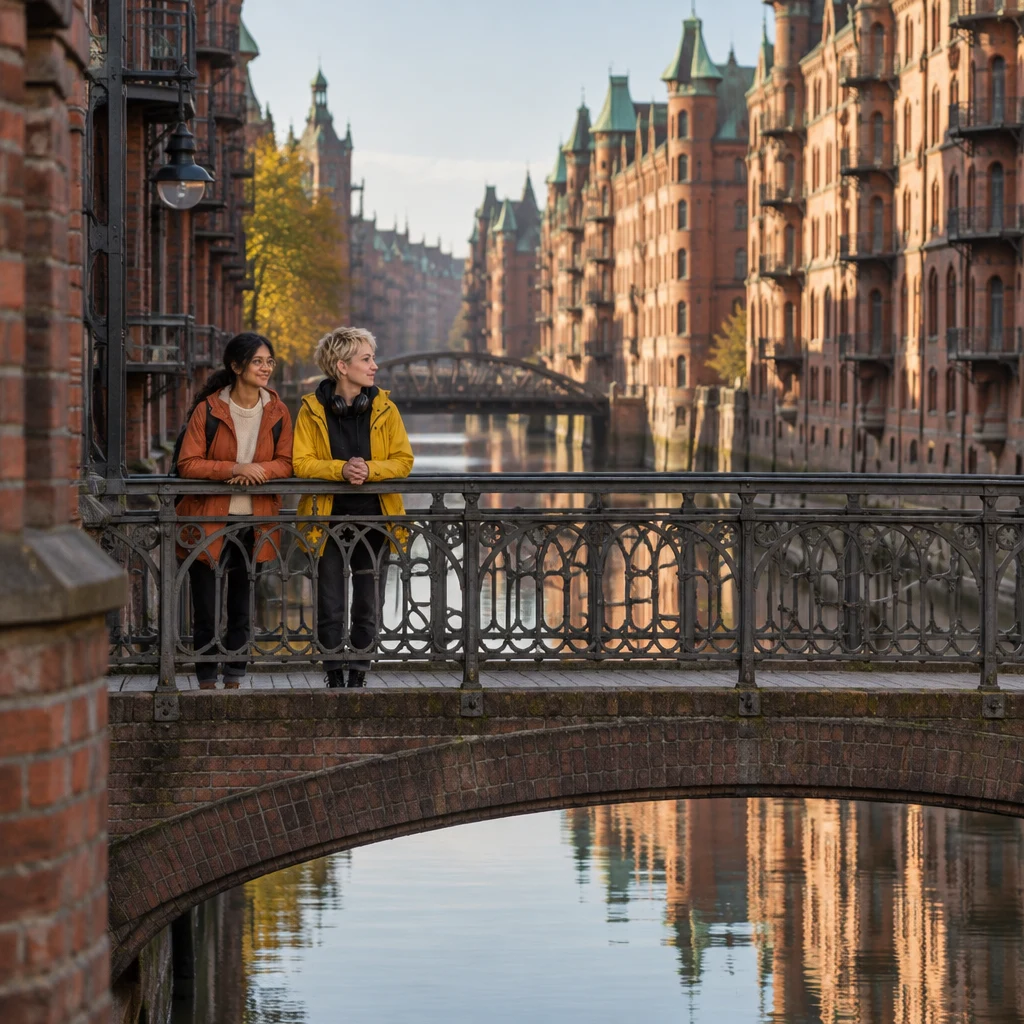
The ICE ran late, then a replacement bus. Now they stand on a bridge in the Speicherstadt.
Dark-brick warehouses rise over canals. The water is still.
Jule has her yellow rain jacket on. Priya holds the rail and looks down.
Learn — old bricks and water
Six lines help you talk about an old place: how old it is, what it sits on, and what people used it for.
You'll also say it looks like a museum now, and suggest walking through slowly.
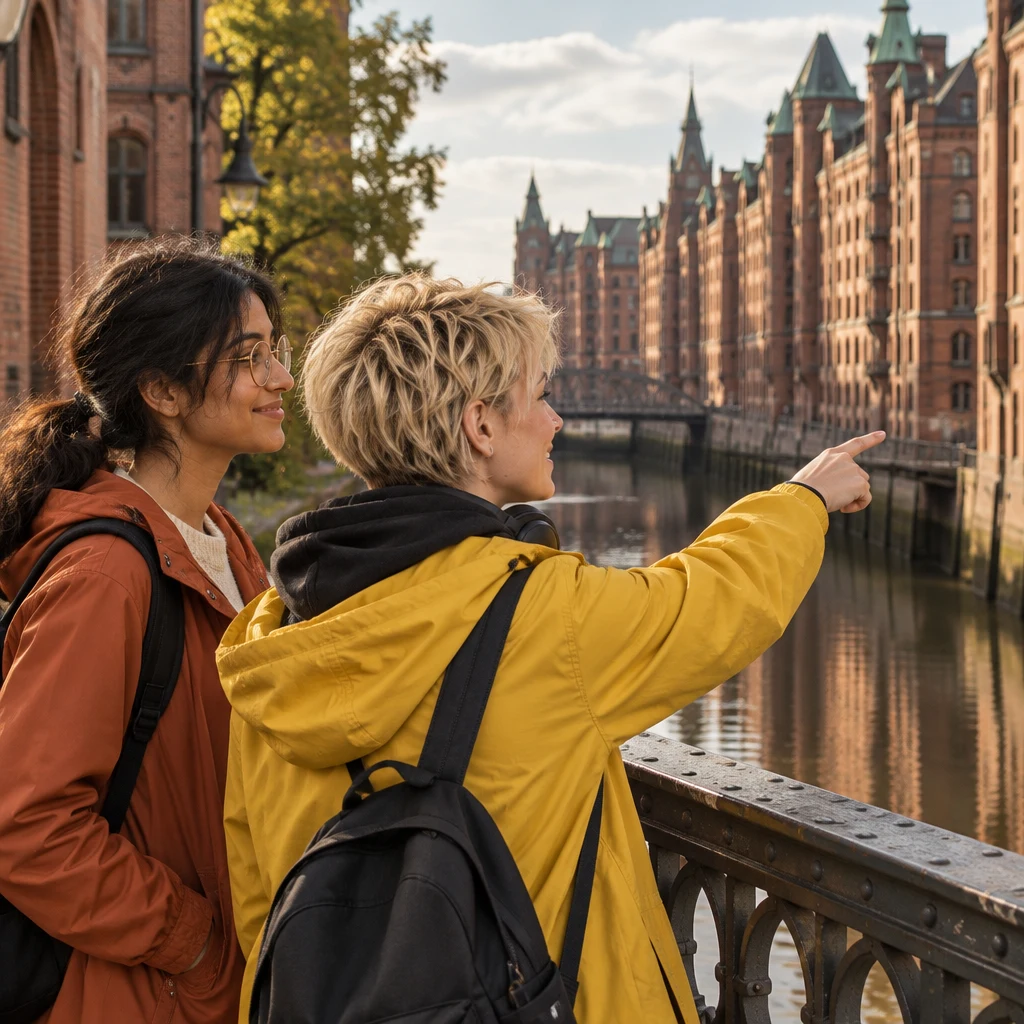
Das Viertel ist schon über hundert Jahre alt.
This neighbourhood is already more than a hundred years old.
When to use it: Say this when a neighbourhood is already very old.
The verb sits second: ist comes right after Viertel.
Say it: Viertel puts the stress on the first syllable.
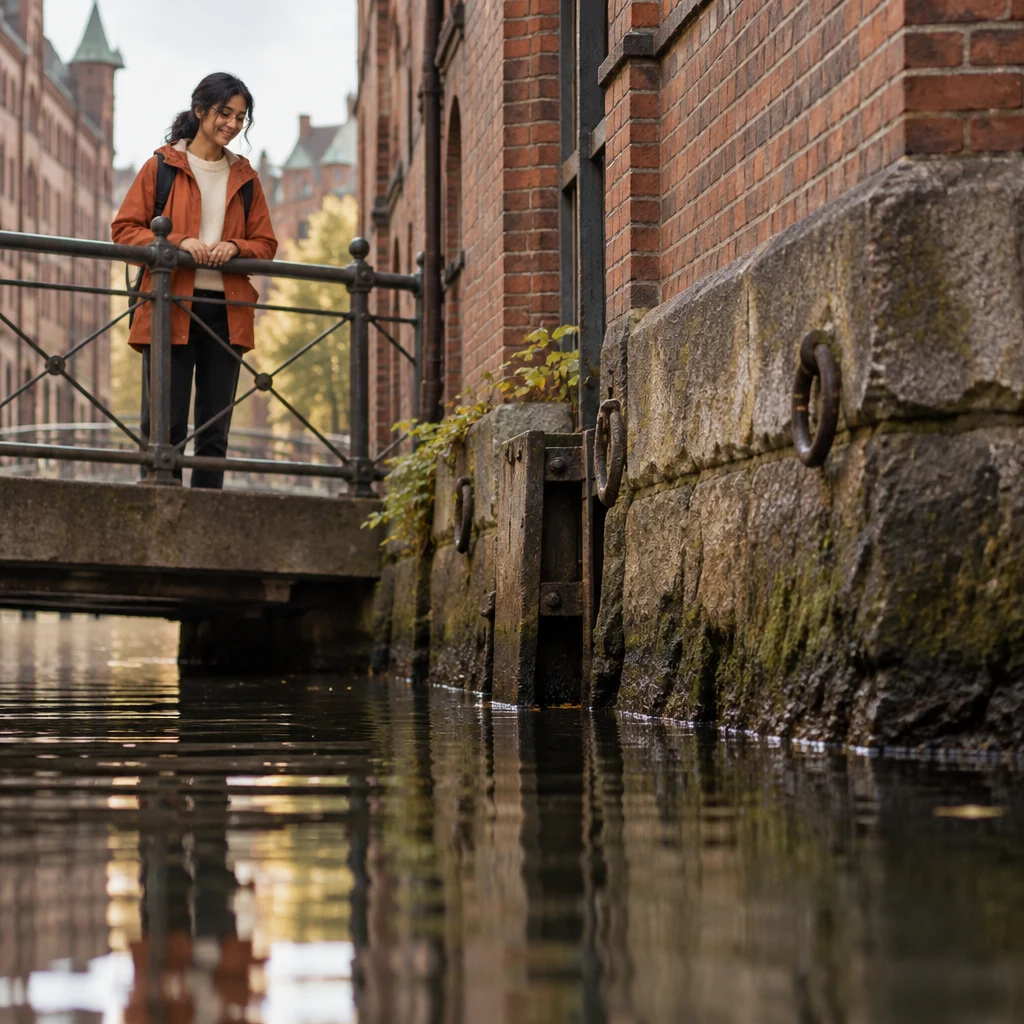
Die Speicher stehen direkt am Wasser.
The warehouses stand right on the water.
When to use it: Use this when warehouses sit right on a canal.
Learn die Speicher with the noun for the warehouses.
Say it: Speicher starts with sp, like Spiel.

Früher haben die hier Waren gelagert.
They used to store goods here.
When to use it: Say this when people used to store goods in a place.
Here die means they, the people who stored goods.
Say it: Früher has the ü sound, like a tight u.
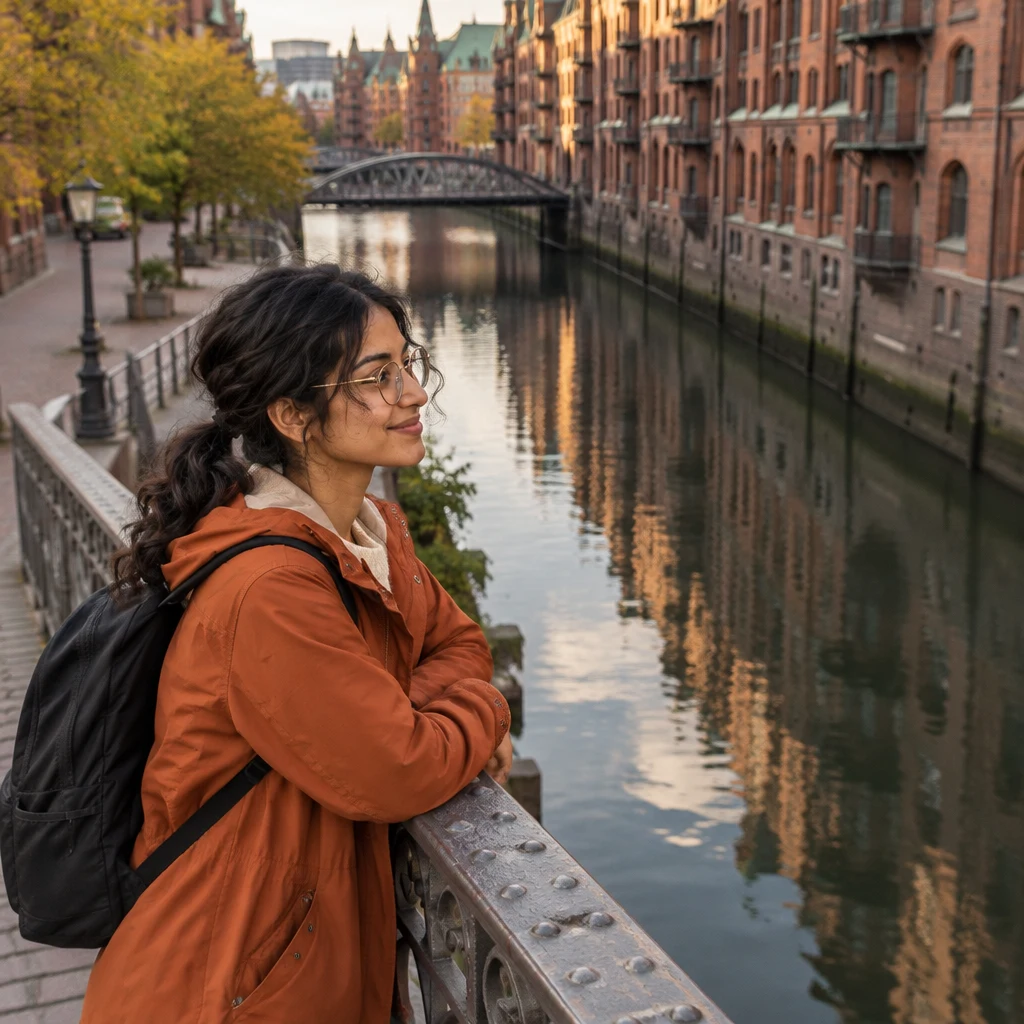
Heute sieht es fast aus wie ein Museum.
Today it almost looks like a museum.
When to use it: Use this when an old place now looks like a museum.
With aussehen, the prefix aus stands after sieht in this clause.

Hier ist es ganz anders als in Berlin.
It's very different here from Berlin.
When to use it: Say this when a place feels very different from Berlin.
Anders als is the pair you need for different from.
Say it: anders puts the stress on the first syllable.
Lass uns da langsam durchlaufen.
Let's walk through slowly.
When to use it: Use this to suggest walking through a place slowly.
Lass uns is the friendly way to say let's with a friend.
Say it: durchlaufen has the ach-ch, as in Bach.
Story — they walk the warehouses
Watch Priya and Jule walk the old warehouses over the water. Jule knows the place, but she keeps it short.
The highlighted words are the lines you just learned. Turn on Show English if you need it.
- They stop on a brick bridge. Dark water sits between the warehouses.
 JuleSchau mal da rüber.Take a look over there.
 PriyaDie Speicher stehen direkt am Wasser.The warehouses stand right on the water.
- JuleDas Viertel ist schon über hundert Jahre alt.This neighbourhood is already more than a hundred years old.
- PriyaEcht? Sieht so frisch aus.Really? It looks so fresh.
- JuleFrüher haben die hier Waren gelagert.They used to store goods here.
- A low boat passes. Jule does not start a history talk.
- PriyaHeute sieht es fast aus wie ein Museum.Today it almost looks like a museum.
- JuleNa ja. Das sieht gut aus, oder?Well. That looks good, doesn't it?
- PriyaHier ist es ganz anders als in Berlin.It's very different here from Berlin.
- JuleJa. In Kreuzberg ist weniger Wasser.Yes. In Kreuzberg there is less water.
- PriyaUnd ruhiger. Kein Lärm von der Bahn.And quieter. No noise from the train.
- JuleLass uns da langsam durchlaufen.Let's walk through slowly.
- PriyaJa, gerne. Ich schaue in Ruhe.Yes, gladly. I'll look in peace.
- JuleLass dir Zeit. Wir haben den Nachmittag.Take your time. We've got the afternoon.
Practice — age, use, and a slow walk
Ten short exercises wait here. You'll listen, fill a gap, swap a word, and build a line.
They stay on the warehouses, the water, and the slow walk.
0 of 10 done
What did you hear?
What did you hear?
What does it mean?
What does it mean?
Das Viertel ist schon über hundert Jahre alt.
Fill the gap
Fill the gap
They used to store goods here.
Früher haben die hier ____ gelagert.
Swap the word
Swap the word
The old warehouses now look like a place to visit, not a station.
Heute sieht es fast aus wie ein ____.
What do you say?
What do you say?
You want to walk through the warehouses slowly, not rush.
Pick the reply
Jule says:
Pick the reply
Fühlt sich das wie Berlin an?
Does this feel like Berlin?
And you reply with:
Fill the gap
Fill the gap
This neighbourhood is already more than a hundred years old.
Das Viertel ist schon über hundert Jahre ____.
Match the pairs
German
Die Speicher stehen direkt am Wasser.Drop the English hereFrüher haben die hier Waren gelagert.Drop the English hereHeute sieht es fast aus wie ein Museum.Drop the English hereEnglish
True or false?
True or false?
You say this when something looks good.
Fill the gap
Fill the gap
Take your time.
Lass dir ____.
Say it — say it on the bridge
Now you're Priya on a bridge in the Speicherstadt with Jule. When it's your turn, tap the microphone and speak the line.
Tap ▶ first if you want to hear the line. Your recording stays on your device.
- JuleSchau mal da runter.Take a look down there.
- Priya (you)Say the warehouses stand right on the water.
Say the warehouses stand right on the water.
Die Speicher stehen direkt am Wasser.
The warehouses stand right on the water.
0 of 6 said
Recap — what you can say now
| German | English | Play |
|---|---|---|
| Das Viertel ist schon über hundert Jahre alt. | This neighbourhood is already more than a hundred years old. | |
| Die Speicher stehen direkt am Wasser. | The warehouses stand right on the water. | |
| Früher haben die hier Waren gelagert. | They used to store goods here. | |
| Heute sieht es fast aus wie ein Museum. | Today it almost looks like a museum. | |
| Hier ist es ganz anders als in Berlin. | It's very different here from Berlin. | |
| Lass uns da langsam durchlaufen. | Let's walk through slowly. |
Save your progress — it’s free
Keep your place in the course and see which lines you’ve learned.
Want the next lesson in your inbox?
Get the next lesson by email, one a day.
Join the newsletterDaily lesson emails are coming soon. Newsletter subscribers get them first.
Keep practicing with Yak Cards
Want to keep these warehouse lines handy? Grab the Yak Cards for this lesson and review them anywhere.
A quick round with the Yak Cards keeps the old-place lines ready for the next canal walk.
Open Yak Cards