
New here? This is lesson 228 of a free 240-lesson German course.
Helping a newcomer in German
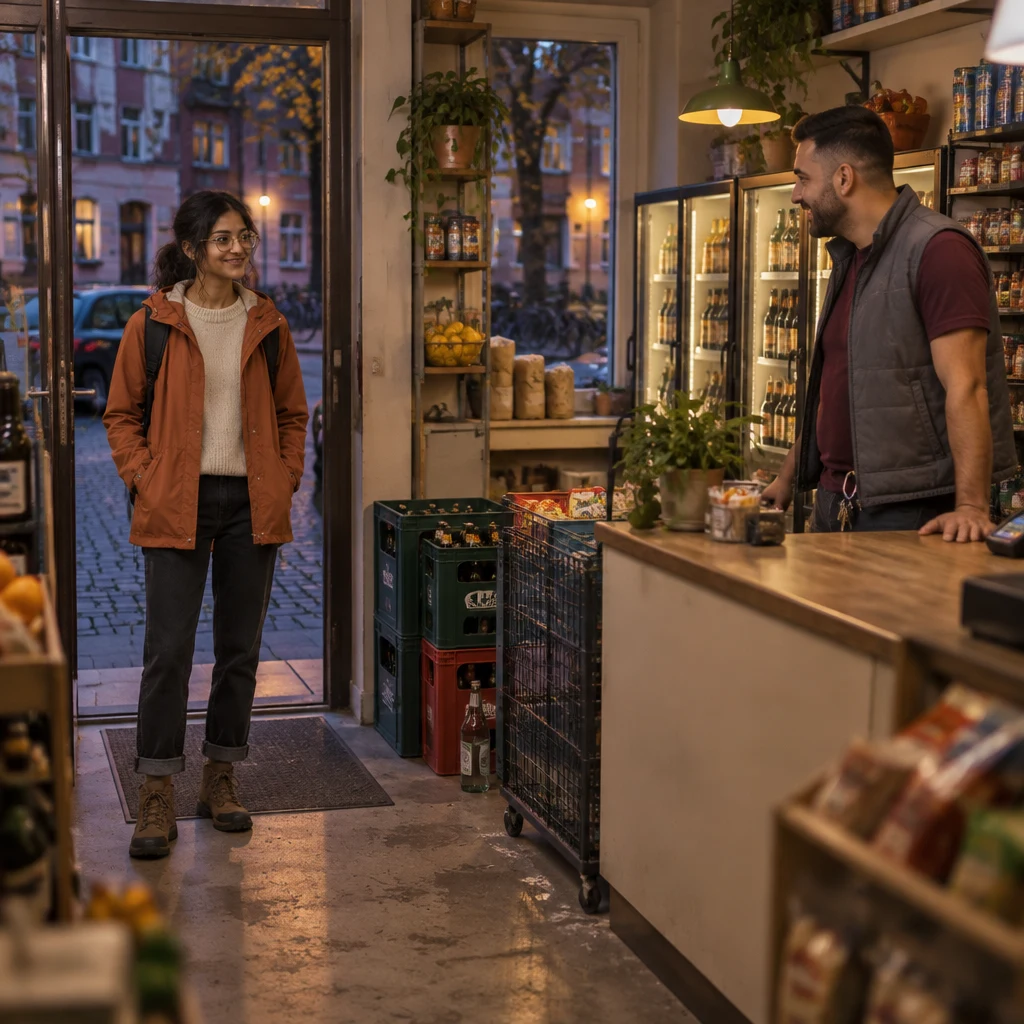
Priya is at Deniz's Späti when a newer customer stalls at the crates, unsure about bottles, cash, and how to leave.
She offers a short tour of the habits: Pfand back on the bottle, cash at the counter, and Tschüss on the way out.
You'll help a peer the same way, with du, and you'll leave the door open if they get stuck.
Deniz still swears the key is treasure. Nobody tests it. The help stays ordinary.
By the end of this lesson
Help a newer visitor with Pfand, cash, and Tschüss, then leave the door open if they get stuck.
- Soll ich dir kurz erklären, wie das hier läuft?Want me to quickly explain how things work here?
- Für die Flasche bekommst du Pfand zurück.You get the bottle deposit back.
- Bar zahlen ist am Schalter oft einfacher.Paying cash at the counter is often easier.
- Beim Rausgehen sagt man hier einfach Tschüss.On the way out people here just say Tschüss.
- Am Anfang war ich genauso unsicher.I was just as unsure at the start.
- Komm einfach auf mich zu, wenn du nicht weiterweißt.Just come to me if you're stuck.
Scene — the Späti counter
Evening on Fliederstraße. Priya stops at Deniz's Späti for a bottle of water. A newer customer stands at the crates with a glass bottle, looking lost.
Deniz is behind the counter. He still talks about the key as treasure, but the bottles come first.
Learn — Pfand, cash, and Tschüss
Six lines for peer help: offer a short explanation, name Pfand, cash, and Tschüss, then say you were unsure too.
The last line leaves the door open if they get stuck.
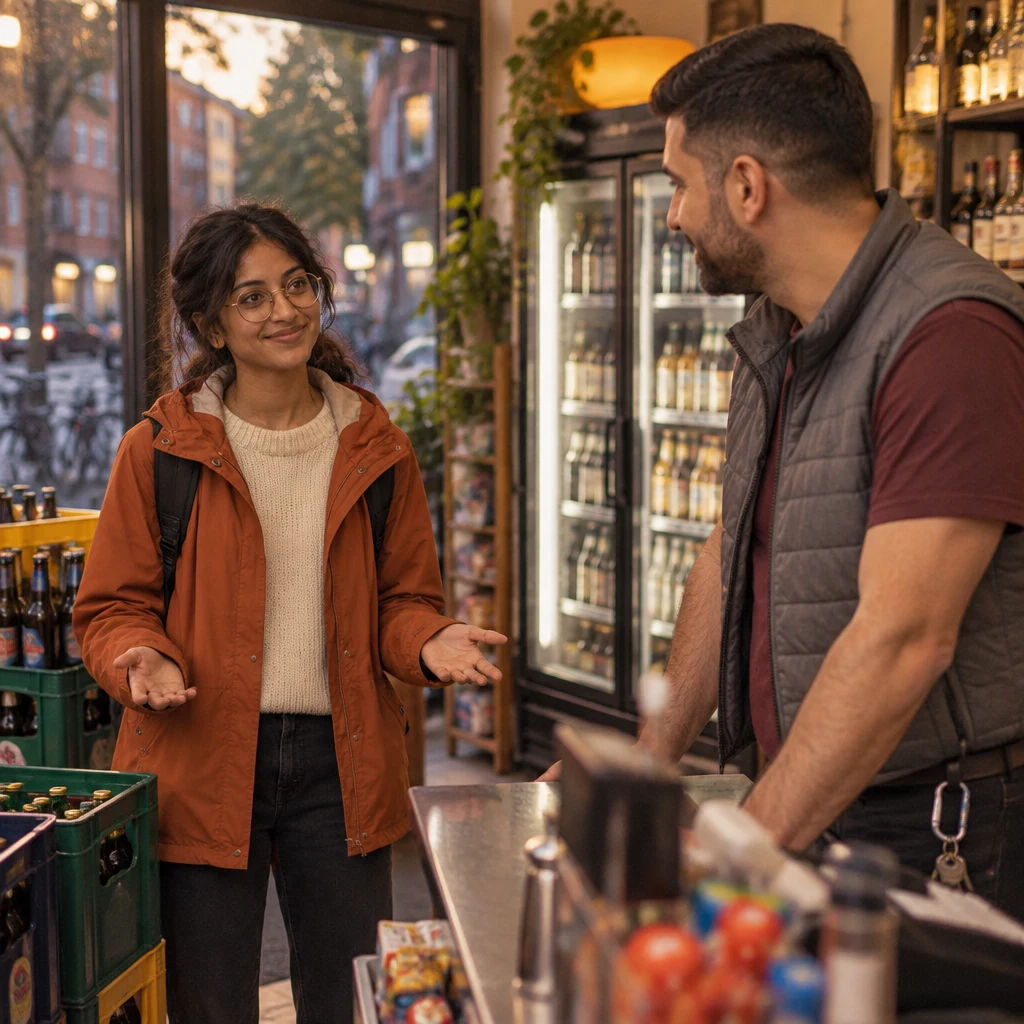
Soll ich dir kurz erklären, wie das hier läuft?
Want me to quickly explain how things work here?
When to use it: Offer this when a peer looks lost and you can walk them through a local habit.
Dir is the du form; you use it with a peer you are helping, not with shop staff.
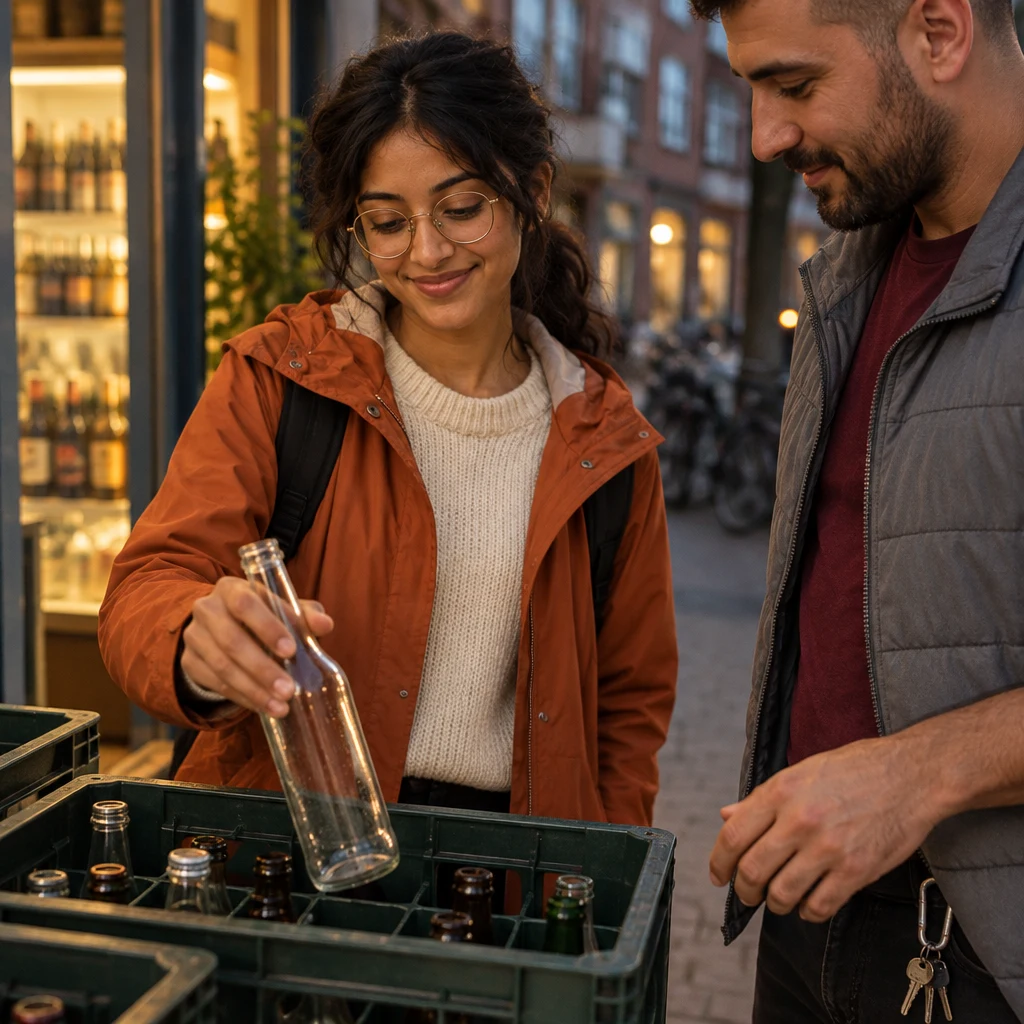
Für die Flasche bekommst du Pfand zurück.
You get the bottle deposit back.
When to use it: Say this when someone is unsure what to do with a bottle.
After the bottle phrase, the verb bekommst still comes next.
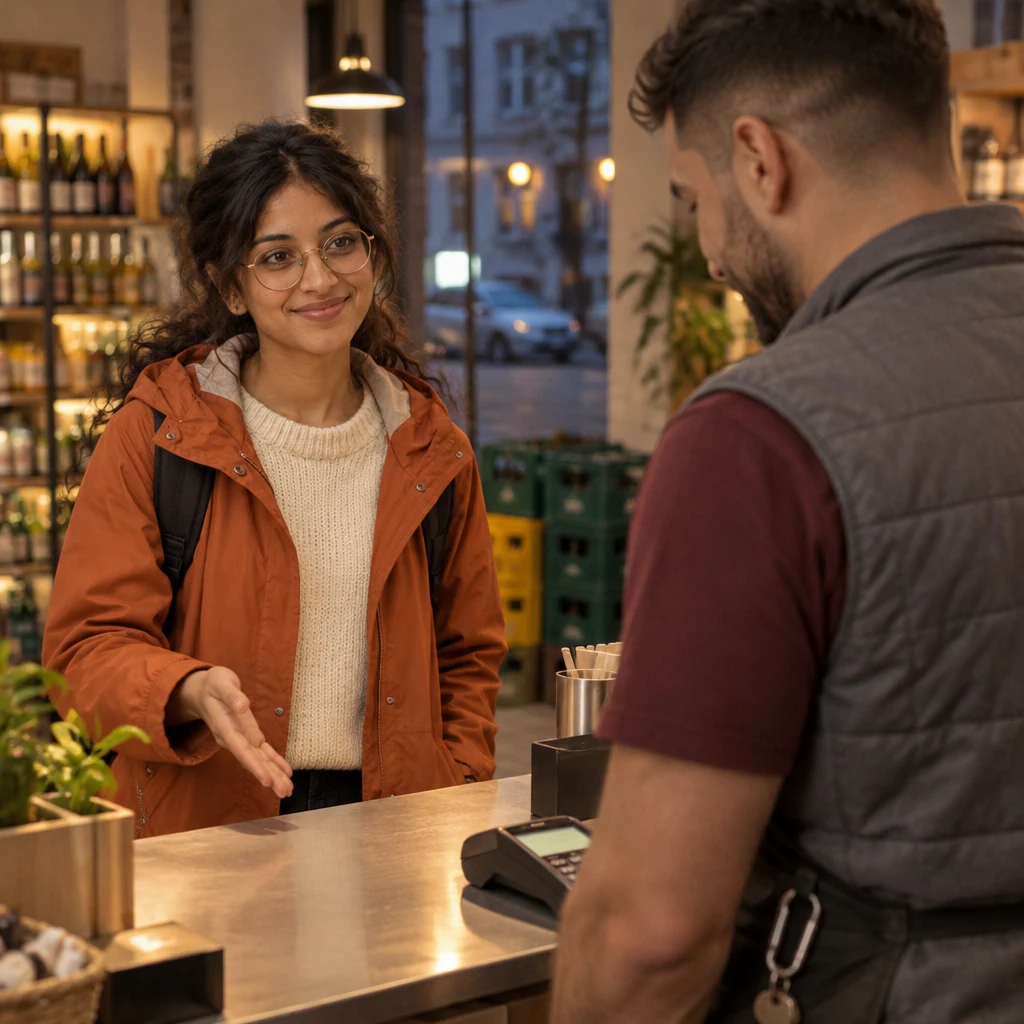
Bar zahlen ist am Schalter oft einfacher.
Paying cash at the counter is often easier.
When to use it: Say this when a card fails at a small counter, and cash will be quicker.
Bar zahlen sits at the front, so the verb ist still comes next.

Beim Rausgehen sagt man hier einfach Tschüss.
On the way out people here just say Tschüss.
When to use it: Explain the local goodbye when a newer visitor is about to leave a shop.
Man here means people in general, not one named person.
Say it: The ü in Tschüss is a tight ee with rounded lips.

Am Anfang war ich genauso unsicher.
I was just as unsure at the start.
When to use it: Say this to show a newer visitor that you felt the same at first.
Am Anfang comes first, so war still comes second in the clause.
Say it: The -er at the end of unsicher is a weak uh sound.
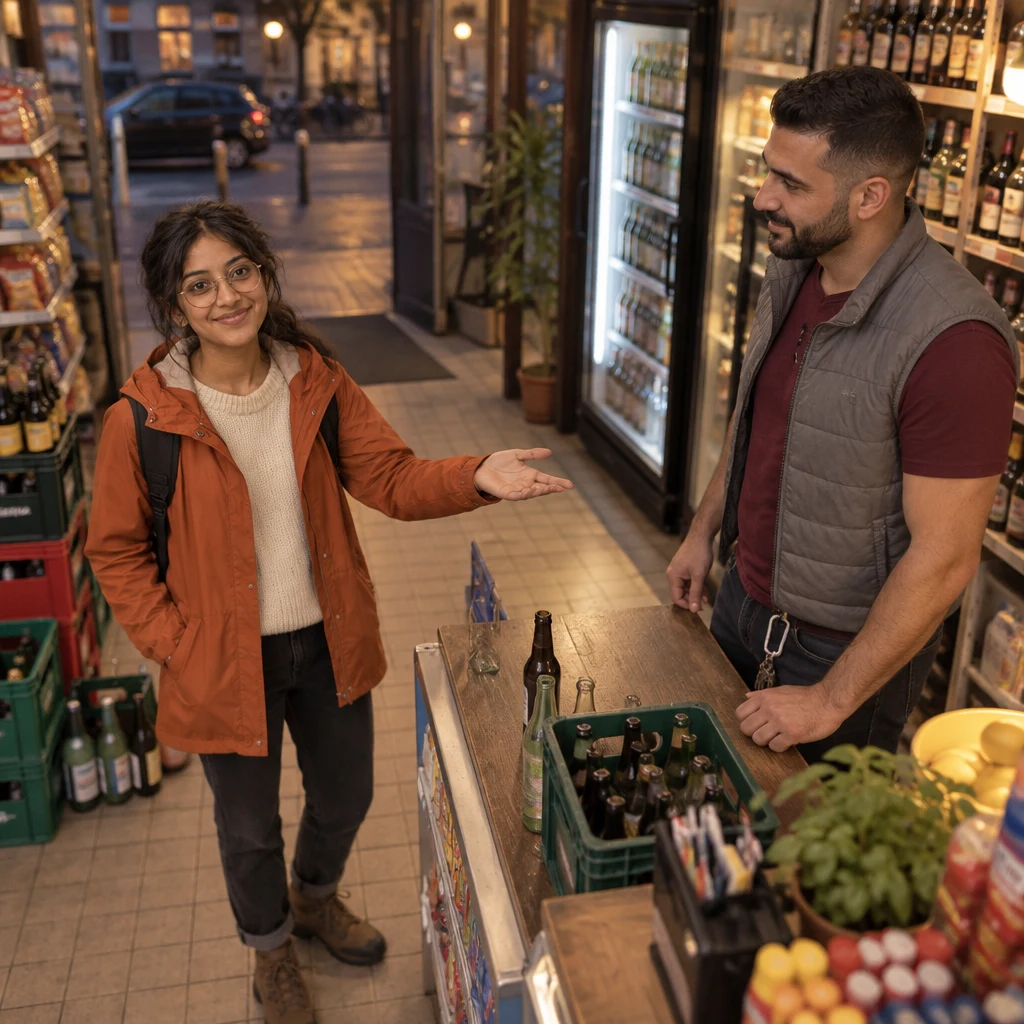
Komm einfach auf mich zu, wenn du nicht weiterweißt.
Just come to me if you're stuck.
When to use it: Leave this open after you have helped, so they can come back if they stall.
The prefix zu stands at the end of the first clause, before the wenn part.
Story — she helps
Watch Priya help a newer customer at Deniz's Späti. The highlighted words are the lines you just learned.
Turn on Show English if you need it. The habits stay small: bottles, cash, and a short goodbye.
- The fridge wall hums. A newer customer holds a glass bottle and looks at the crates.
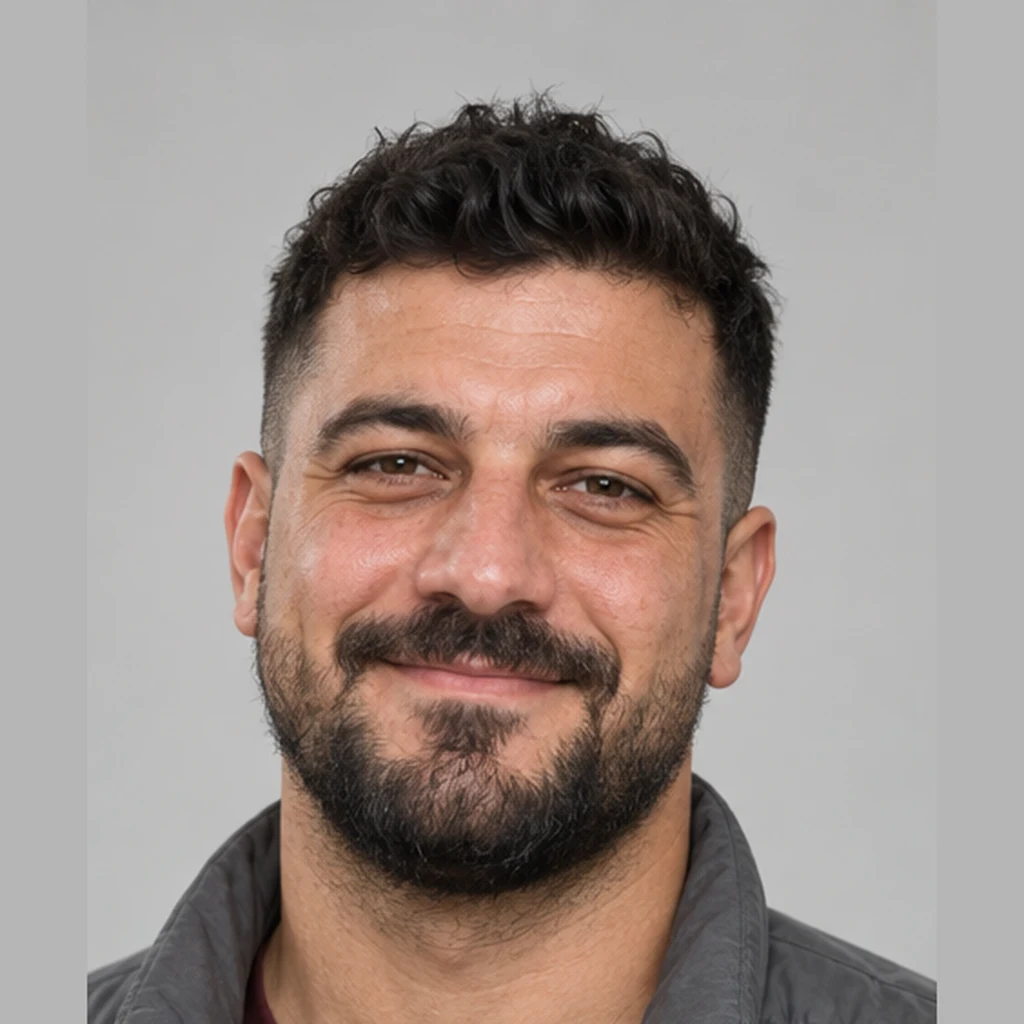 DenizHallo.Hello.
- CustomerHallo. Die Flasche hier, was mache ich damit?Hello. This bottle here, what do I do with it?
 PriyaSoll ich dir kurz erklären, wie das hier läuft?Want me to quickly explain how things work here?
- CustomerJa, bitte. Ich bin erst seit letzter Woche hier.Yes, please. I've only been here since last week.
- PriyaFür die Flasche bekommst du Pfand zurück.You get the bottle deposit back.
- DenizGenau. Die leeren Flaschen kommen in die Kiste vorne.Exactly. The empty bottles go in the crate at the front.
- CustomerUnd zahlen? Meine Karte hat eben nicht geklappt.And paying? My card just didn't work.
- PriyaBar zahlen ist am Schalter oft einfacher.Paying cash at the counter is often easier.
- DenizStimmt. Kleines Geld geht hier am schnellsten.That's right. Small cash is quickest here.
- The customer counts coins. Deniz takes them without fuss.
- PriyaBeim Rausgehen sagt man hier einfach Tschüss.On the way out people here just say Tschüss.
- CustomerNicht auf Wiedersehen? Ich dachte, das wäre höflicher.Not a more formal goodbye? I thought that would be more polite.
- PriyaAm Anfang war ich genauso unsicher.I was just as unsure at the start.
- CustomerEcht? Du klingst schon ziemlich sicher.Really? You already sound pretty sure.
- PriyaKomm einfach auf mich zu, wenn du nicht weiterweißt.Just come to me if you're stuck.
- CustomerDanke, wirklich. Wie geht's?Thanks, really. How are you?
- PriyaGut, danke.I'm good, thanks.
- DenizUnd der alte Schlüssel in der Fundkiste? Das ist ein Schatz, ganz klar.And the old key in the lost-property box? That's a treasure, for sure.
- PriyaNa ja. Erst mal die Flaschen, oder?Well. The bottles first, right?
- CustomerTschüss dann.Bye then.
- DenizTschüss. Bis später.Bye. See you later.
Practice — bottles and goodbye
Ten short tasks. You'll listen, pick, fill a gap, swap a word, and build a line from chips.
They stay on the Späti habits, so the round stays tight.
0 of 10 done
What did you hear?
What did you hear?
What do you say?
What do you say?
A newer customer looks lost at the bottle crates and you want to explain how things work here.
Match the pairs
German
Hallo.Drop the English hereWie geht's?Drop the English hereGut, danke.Drop the English hereEnglish
Fill the gap
Fill the gap
You get the bottle deposit back.
Für die Flasche bekommst du ____ zurück.
What does it mean?
What does it mean?
Bar zahlen ist am Schalter oft einfacher.
Pick the reply
Customer says:
Pick the reply
Ich bin total unsicher, wie das mit den Flaschen läuft.
I'm totally unsure how the bottles work.
And you reply with:
Swap the word
Swap the word
You are telling a newer visitor what people here say on the way out.
Beim Rausgehen sagt man hier einfach ____.
Build the line
Build the line
Just come to me if you're stuck.
, .
Tap the words in order.
Find the mistake
Find the mistake
Put the chat in order
- CustomerWhat comes first?
- Priya…
- Customer…
- Priya…
Say it — say it back
Now you're Priya at the Späti. When it's your turn, tap the microphone and speak the line.
Tap ▶ first if you want to hear the line. Your recording stays on your device.
- CustomerDie Flasche hier, was mache ich damit?This bottle here, what do I do with it?
- Priya (you)Offer to quickly explain how things work here.
Offer to quickly explain how things work here.
Soll ich dir kurz erklären, wie das hier läuft?
Want me to quickly explain how things work here?
0 of 6 said
Recap — what you can say now
| German | English | Play |
|---|---|---|
| Soll ich dir kurz erklären, wie das hier läuft? | Want me to quickly explain how things work here? | |
| Für die Flasche bekommst du Pfand zurück. | You get the bottle deposit back. | |
| Bar zahlen ist am Schalter oft einfacher. | Paying cash at the counter is often easier. | |
| Beim Rausgehen sagt man hier einfach Tschüss. | On the way out people here just say Tschüss. | |
| Am Anfang war ich genauso unsicher. | I was just as unsure at the start. | |
| Komm einfach auf mich zu, wenn du nicht weiterweißt. | Just come to me if you're stuck. |
Save your progress — it’s free
Keep your place in the course and see which lines you’ve learned.
Want the next lesson in your inbox?
Get the next lesson by email, one a day.
Join the newsletterDaily lesson emails are coming soon. Newsletter subscribers get them first.
Keep practicing with Yak Cards
Want to keep these helper lines handy? Grab the Yak Cards for this lesson and review them anywhere.
A quick round with the Yak Cards each day keeps Pfand, cash, and Tschüss ready at the Späti.
Open Yak Cards