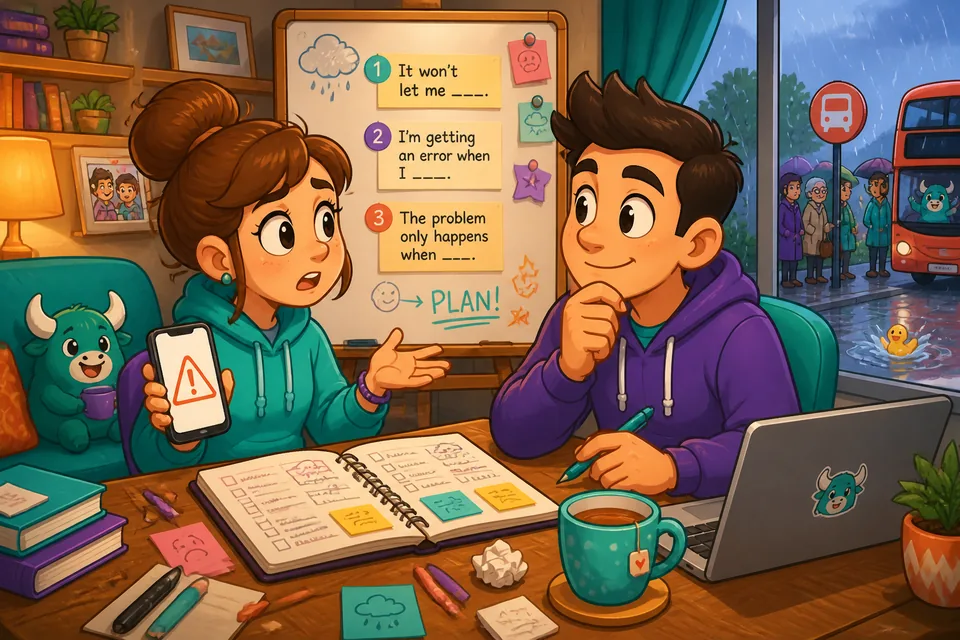
Welcome to Lesson 135 — short, focused, and useful. We'll practice phrases you can use to explain technical problems and ask for help.
Level B1: In this lesson you'll learn and practice natural phrases to describe when an app or system blocks an action, report error messages, suggest possible causes, and ask for fixes. This CEFR-aligned lesson focuses on useful frames like “Es lässt mich nicht ___.” and “Kann man das irgendwie beheben?” — perfect for support conversations and workplace reports.
After this lesson you'll be able to:
Describe what goes wrong and when (B1)
Give possible reasons and admit simple user errors
Ask politely if something can be fixed and set a deadline
Ready? Let's go!
When you tap play on phrases, we track your progress through this lesson.
1. Reading + Listening Practice
Hear core phrases, repeat aloud.
Es lässt mich nicht ___.
It won't let me ___.
Meaning: It won't let me ___.
When to use: Use for apps or systems that block a specific action; the blank is usually an infinitive without “zu”.
Tip: Don't add 'zu' before the infinitive (e.g., avoid 'zu speichern').
Es lässt mich nicht einloggen.
It won't let me log in.
Es lässt mich nicht speichern, obwohl genug Speicherplatz da ist.
It won't let me save, even though there is enough space.
Ich bekomme eine Fehlermeldung, wenn ich ___.
I'm getting an error when I ___.
Meaning: I'm getting an error when I ___.
When to use: Report an error that happens during a specific action; after “wenn ich” the verb often goes at the end.
Tip: Remember to place the verb at the end of the clause (…wenn ich die Datei hochlade).
Ich bekomme eine Fehlermeldung, wenn ich auf 'Senden' klicke.
I get an error when I click 'Send'.
Ich bekomme eine Fehlermeldung, wenn ich die Datei hochlade.
I get an error when I upload the file.
Das Problem tritt nur auf, wenn ___.
The problem only happens when ___.
Meaning: The problem only happens when ___.
When to use: Use to describe the condition that triggers the issue; follow with a subordinate clause.
Das Problem tritt nur auf, wenn ich mit dem VPN verbunden bin.
The problem only happens when I'm connected to the VPN.
Das Problem tritt nur auf, wenn mehrere Tabs geöffnet sind.
The problem only happens when multiple tabs are open.
Ich glaube, es könnte daran liegen, dass ___.
I think it might be because ___.
Meaning: I think it might be because ___.
When to use: Offer a possible reason; follow 'dass' with a subordinate clause.
Ich glaube, es könnte daran liegen, dass die Version veraltet ist.
I think it might be because the version is outdated.
Ich glaube, es könnte daran liegen, dass die Einstellungen geändert wurden.
I think it might be because the settings were changed.
Ich habe ___ vielleicht falsch eingegeben.
I may have entered ___ incorrectly.
Meaning: I may have entered ___ incorrectly.
When to use: Admit a possible user error; the blank is an accusative object like 'die Nummer' or 'das Passwort'.
Tip: Be careful with case: the thing you entered is in the accusative (e.g., 'die Nummer').
Ich habe das Passwort vielleicht falsch eingegeben.
I may have entered the password incorrectly.
Ich habe die Kundennummer vielleicht falsch eingegeben.
I may have entered the customer number incorrectly.
Kann man das irgendwie beheben?
Is there a way to fix this?
Meaning: Is there a way to fix this?
When to use: Ask if the issue can be repaired or corrected; useful for technical and organizational problems.
Kann man das irgendwie beheben?
Is there a way to fix this?
Kann man das Probleme mit einem Update beheben?
Can this be fixed with an update?
Das muss bis ___ behoben sein.
I need this fixed by ___.
Meaning: I need this fixed by ___.
When to use: Explain a deadline; use 'bis' + time (e.g., 'bis morgen', 'bis Freitag').
Das muss bis morgen behoben sein.
This must be fixed by tomorrow.
Das muss bis zum 10. des Monats behoben sein.
This must be fixed by the 10th of the month.
Erst habe ich ___, und dann ___.
First I ___, and then ___.
Meaning: First I ___, and then ___.
When to use: Explain the sequence of actions before the problem occurred; the first part often uses the perfect.
Erst habe ich die App geöffnet, und dann stürzte sie ab.
First I opened the app, and then it crashed.
Erst habe ich die Datei hochgeladen, und dann konnte ich sie nicht öffnen.
First I uploaded the file, and then I couldn't open it.
Ich kann dir zeigen, was passiert.
I can show you what happens.
Meaning: I can show you what happens.
When to use: Offer to demonstrate the issue so someone else can see it; formal with 'Ihnen' if needed.
Ich kann dir zeigen, was passiert.
I can show you what happens.
Ich kann Ihnen die Fehlermeldung zeigen, wenn Sie möchten.
I can show you the error message if you like.
2. Conversational Listening Practice
Hear phrases in a real mini-conversation.
Anna reports a problem to David in the office.
Anna
Erst habe ich die App geöffnet, und dann erhielt ich eine Fehlermeldung.
First I opened the app, and then I received an error message.
David
Was für eine Fehlermeldung bekommst du?
What kind of error are you getting?
Anna
Ich bekomme eine Fehlermeldung, wenn ich versuche, die Datei zu speichern.
I'm getting an error when I try to save the file.
David
Tritt das Problem nur auf, wenn du mit dem Firmennetzwerk verbunden bist?
Does the problem only happen when you're connected to the company network?
Anna
Ich glaube, es könnte daran liegen, dass das Update fehlt.
I think it might be because the update is missing.
Anna
Ich kann dir zeigen, was passiert.
I can show you what happens.
3. Guided Practice
Quizzes and matching to lock in meaning.
Which German sentence means 'Is there a way to fix this?'
Which sentence says 'I may have entered the password incorrectly'?
Choose the sentence that sets a deadline: 'I need this fixed by Friday.'
Which sentence explains a conditional trigger: 'The problem only happens when the VPN is on.'
I'm getting an error when I try to save the report.
When I try to save the report, ___
I can show you what happens.
I want to offer more help: ___.
This must be fixed by Friday.
The manager said: 'We need this done quickly.' Anna answers: ___.
Match the core phrases
Match the extra phrases
4. Speaking Practice
Say phrases yourself (mic/recording).
Recording stays on your device only. Check speech uses your browser's speech tools when available.