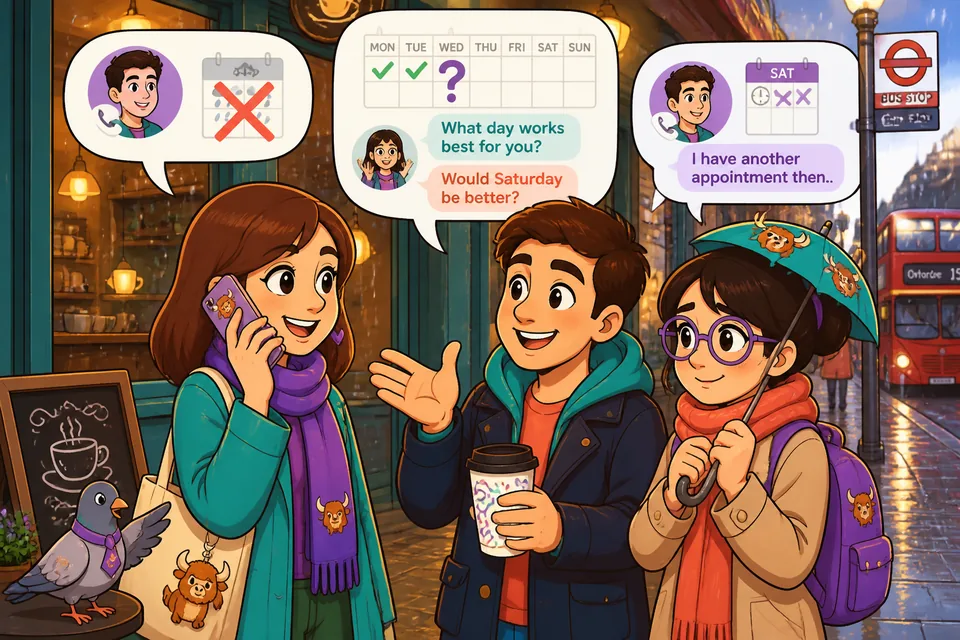
Ready to handle those awkward 'I can't make it' moments in German? This lesson gives you friendly, practical phrases you can say when plans change.
Level A2: In Lesson 131 you'll practice common phrases for cancelling or changing plans — asking which day works, suggesting alternatives, saying you have another appointment, warning about being late, and promising to let someone know. These CEFR-aligned phrases help you manage meetings and social plans politely in everyday situations.
After this lesson you'll be able to:
Understand and use short phrases to cancel or reschedule plans at level A2.
Practice asking for better times and offering alternatives.
Speak and respond politely when you need to delay, arrive late, or cancel.
Ready? Let's go!
When you tap play on phrases, we track your progress through this lesson.
1. Reading + Listening Practice
Hear core phrases, repeat aloud.
Welcher Tag passt dir am besten?
What day works best for you?
Meaning: What day works best for you?
When to use: Ask this when you want the other person to pick a day for a meeting or event.
Tip: Don't use 'wer' — beginners sometimes say 'Wer Tag' by mistake. For formal talk use 'Ihnen' instead of 'dir'.
Welcher Tag passt dir am besten? Ich kann Dienstag oder Donnerstag.
Which day is best for you? I can do Tuesday or Thursday.
Für das Treffen nächste Woche: Welcher Tag passt dir am besten?
For the meeting next week: which day suits you best?
Wäre ___ besser?
Would ___ be better?
Meaning: Would ___ be better?
When to use: Suggest a different day, time, or option. Fill the blank with a day or time (e.g., 'morgen').
Tip: If you suggest multiple options, remember plural: 'Wären Dienstag und Donnerstag besser?'
Wäre morgen besser? Ich habe am Abend mehr Zeit.
Would tomorrow be better? I have more time in the evening.
Wäre 18 Uhr besser? Dann bin ich pünktlich.
Would 6 p.m. be better? Then I'll be on time.
Da hab ich schon einen anderen Termin.
I have another appointment then.
Meaning: I have another appointment then.
When to use: Give this brief reason when you're not available because of a prior commitment.
Tip: Beginners sometimes over-formalize; 'Da habe ich einen Termin' is fine, but spoken 'Da hab ich …' is very natural.
Da hab ich schon einen anderen Termin. Können wir verschieben?
I already have another appointment then. Can we postpone?
Tut mir leid, da hab ich schon einen anderen Termin.
Sorry, I have another appointment then.
Ich komme vielleicht ein bisschen später.
I may be a little late.
Meaning: I may be a little late.
When to use: Warn someone when there's a chance you'll arrive somewhat late.
Ich komme vielleicht ein bisschen später, der Bus hat Verspätung.
I might be a little late, the bus is delayed.
Mach dir keine Sorgen, ich komme vielleicht ein bisschen später.
Don't worry, I may be a little late.
Warte bitte nicht auf mich.
Please don't wait for me.
Meaning: Please don't wait for me.
When to use: Tell a friend not to wait when you're not sure you'll arrive on time or will cancel.
Tip: Remember the form: 'Warte bitte nicht auf mich' for one person; plural would be 'Wartet bitte nicht auf mich.'
Warte bitte nicht auf mich, ich komme wahrscheinlich nicht mehr rechtzeitig.
Please don't wait for me, I probably won't be on time.
Wenn es zu spät wird: Warte bitte nicht auf mich.
If it gets too late: please don't wait for me.
Ich sag dir bald Bescheid.
I'll let you know soon.
Meaning: I'll let you know soon.
When to use: Use this when you promise to update the person later about plans or time.
Ich sag dir bald Bescheid, wenn ich einen genauen Zeitpunkt habe.
I'll let you know soon when I have an exact time.
Keine Entscheidung heute — ich sag dir bald Bescheid.
No decision today — I'll let you know soon.
Heute passt es bei mir doch nicht mehr.
Today doesn't work for me anymore.
Meaning: Today doesn't work for me anymore.
When to use: Explain that plans for today are no longer possible, often used to cancel same-day plans.
Heute passt es bei mir doch nicht mehr. Können wir auf morgen verschieben?
Today doesn't work for me anymore. Can we move it to tomorrow?
Tut mir leid, heute passt es bei mir doch nicht mehr.
Sorry, today doesn't work for me anymore.
Können wir es ein bisschen nach hinten verschieben?
Can we push it back a little?
Meaning: Can we push it back a little?
When to use: Ask to delay a meeting or plan by a short time.
Können wir es ein bisschen nach hinten verschieben? Ich habe vorher noch etwas zu erledigen.
Can we push it back a little? I have something to finish before.
Wenn es geht, können wir es um 30 Minuten nach hinten verschieben?
If possible, can we push it back 30 minutes?
Ich hab mich in der Uhrzeit geirrt.
I got the time wrong.
Meaning: I got the time wrong.
When to use: Explain that you made a mistake about the scheduled time.
Tip: Beginners sometimes confuse 'Uhrzeit' with 'Zeitpunkt' — 'Uhrzeit' is best for clock times.
Oh nein, ich hab mich in der Uhrzeit geirrt — das Treffen war eine Stunde früher.
Oh no, I got the time wrong — the meeting was an hour earlier.
Entschuldige, ich hab mich in der Uhrzeit geirrt. Können wir neu planen?
Sorry, I got the time wrong. Can we reschedule?
2. Conversational Listening Practice
Hear phrases in a real mini-conversation.
Anna calls David to change plans for today.
Anna
Heute passt es bei mir doch nicht mehr. Da hab ich schon einen anderen Termin.
Today doesn't work for me anymore. I already have another appointment then.
David
Oh nein. Welcher Tag passt dir am besten?
Oh no. Which day works best for you?
Anna
Wäre morgen besser? Ich sag dir bald Bescheid, falls es klappt.
Would tomorrow be better? I'll let you know soon if it works.
David
Okay. Und wenn du später kommst: Warte bitte nicht auf mich.
Okay. And if you come later: please don't wait for me.
3. Guided Practice
Quizzes and matching to lock in meaning.
Which German sentence means 'I may be a little late'?
Choose the phrase you'd use to say 'I'll let you know soon.'
Which phrase asks someone to pick a day that suits them?
You want to ask to delay a meeting a little. Which sentence fits?
Anna: The train is delayed. I may be a little late.
Anna: Der Zug hat Verspätung. ___ Ich komme vielleicht ein bisschen später.
David: Today is bad for me. Would tomorrow be better?
David: Heute ist schlecht für mich. ___
Anna: I'm not sure. I'll let you know soon. Then I'll tell you.
Anna: Ich bin mir nicht sicher. ___ Dann sage ich dir Bescheid.
Match the core phrases
Match the extra phrases
4. Speaking Practice
Say phrases yourself (mic/recording).
Recording stays on your device only. Check speech uses your browser's speech tools when available.
Say this phrase out loud:
Welcher Tag passt dir am besten?
What day works best for you?
Say this phrase out loud:
Wäre ___ besser?
Would ___ be better?
Say this phrase out loud:
Da hab ich schon einen anderen Termin.
I have another appointment then.
Say this phrase out loud:
Ich komme vielleicht ein bisschen später.
I may be a little late.
Say this phrase out loud:
Warte bitte nicht auf mich.
Please don't wait for me.
Say this phrase out loud:
Ich sag dir bald Bescheid.
I'll let you know soon.
Say this phrase out loud:
Heute passt es bei mir doch nicht mehr.
Today doesn't work for me anymore.
Say this phrase out loud:
Können wir es ein bisschen nach hinten verschieben?