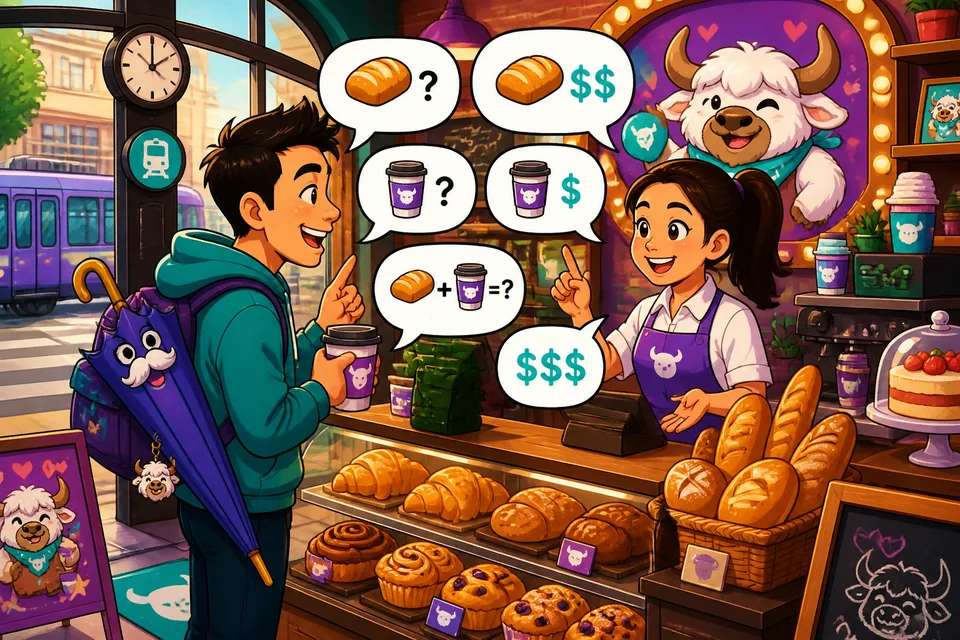
Ready to shop? In this short lesson you'll practice small phrases that make buying things much easier. Listen, repeat, and try them aloud—shopping in German gets less scary fast.
Level A1: In this lesson you will learn and practice basic price and quantity phrases for shopping and paying. We focus on asking and stating prices (Wie viel kostet ___?, Es kostet ___.), asking totals and quantities, requesting specific amounts, and simple payment questions like Bar oder mit Karte?. This is CEFR-aligned and built for quick real-life use.
After this lesson you'll be able to:
Ask the price of an item and understand answers (Wie viel kostet ___? / Es kostet ___.).
Ask about quantity and totals (Wie viele? / Wie viel macht das zusammen?).
Request specific quantities politely and talk about affordability (___, bitte. / Ich habe nicht genug Geld.).
Use simple payment phrases (Bar oder mit Karte?) and ask for cheaper options (Haben Sie etwas Günstigeres?).
Ready? Let's go!
When you tap play on phrases, we track your progress through this lesson.
1. Reading + Listening Practice
Hear core phrases, repeat aloud.
Wie viel kostet ___?
How much is ___?
Meaning: How much is ___?
When to use: Ask this when you want the price of one item. For plurals use 'Wie viel kosten ___?'. You can also say 'Was kostet ___?'.
Tip: Don't mix singular 'kostet' with plural nouns; say 'kosten' for plural.
Wie viel kostet das Brot?
How much is the bread?
Wie viel kostet ein Ticket?
How much is a ticket?
Es kostet ___.
It's ___.
Meaning: It’s ___.
When to use: Use to answer with a single item's price. At the register people also say 'Das macht ___.' for the total.
Es kostet 3 Euro.
It costs 3 euros.
Es kostet nur fünf Euro.
It only costs five euros.
Wie viel macht das zusammen?
How much is the total?
Meaning: How much is the total?
When to use: Ask this at the register when you want the full sum to pay.
Wie viel macht das zusammen?
How much is that together?
Machen das zusammen 12 Euro?
Does that make 12 euros together?
Wie viele?
How many?
Meaning: How many?
When to use: Use for countable items (pieces). For uncountable amounts use 'Wie viel?'.
Tip: Don't use 'Wie viele' for mass nouns like 'Milch'—use 'Wie viel' instead.
Wie viele Äpfel möchten Sie?
How many apples would you like?
Wie viele Stücke brauchen Sie?
How many pieces do you need?
Wie viel?
How much?
Meaning: How much?
When to use: Ask about amount, volume, or price. For price also say 'Wie viel kostet das?'.
Wie viel Zucker brauchen wir?
How much sugar do we need?
Wie viel kostet das?
How much does that cost?
___, bitte.
___, please.
Meaning: ___, please.
When to use: Use after a quantity or item name to ask politely, for example 'Zwei, bitte.' or 'Ein Brot, bitte.'
Zwei, bitte.
Two, please.
Ein Brot, bitte.
One bread, please.
Nur ___, bitte.
Just ___, please.
Meaning: Just ___, please.
When to use: Use when you want only a limited quantity, for example when you don't want extras: 'Nur eins, bitte.'
Nur eins, bitte.
Just one, please.
Nur drei, bitte.
Only three, please.
Das ist zu teuer.
That's too expensive.
Meaning: That's too expensive.
When to use: Say this when an item's price is higher than you want to pay.
Das ist zu teuer.
That's too expensive.
Für mich ist das zu teuer.
For me, that's too expensive.
Haben Sie etwas Günstigeres?
Do you have a cheaper one?
Meaning: Do you have a cheaper one?
When to use: Ask a shop assistant politely if there is a lower-priced option. This uses formal 'Sie'.
Haben Sie etwas Günstigeres?
Do you have something cheaper?
Haben Sie etwas Günstigeres in Größe M?
Do you have a cheaper one in size M?
Ich habe nicht genug Geld.
I don't have enough money.
Meaning: I don't have enough money.
When to use: Use when you need to explain you can't pay the full price right now.
Ich habe nicht genug Geld.
I don't have enough money.
Tut mir leid, ich habe nicht genug Geld.
Sorry, I don't have enough money.
Bar oder mit Karte?
Cash or card?
Meaning: Cash or card?
When to use: Ask this at the register to choose a payment method. Full form: 'Zahlen Sie bar oder mit Karte?'.
Bar oder mit Karte?
Cash or card?
Bar oder mit Karte? Wie möchten Sie zahlen?
Cash or card? How would you like to pay?
Ist das pro Stück?
Is that each?
Meaning: Is that each?
When to use: Use to ask if the stated price is for one item (per piece).
Ist das pro Stück?
Is that per piece?
Ist das pro Stück oder für zwei?
Is that per piece or for two?
___ pro Stück.
___ each.
Meaning: ___ each.
When to use: Use to state a unit price, e.g. '2 Euro pro Stück.' The price usually comes before 'pro Stück'.
2 Euro pro Stück.
2 euros each.
5 Euro pro Stück, bitte.
5 euros each, please.
2. Conversational Listening Practice
Hear phrases in a real mini-conversation.
At a bakery counter
Anna
Wie viel kostet das Brot?
How much is the bread?
David
Es kostet 2 Euro pro Stück.
It costs 2 euros each.
Anna
Wie viele Brötchen wollen Sie?
How many rolls do you want?
David
Nur zwei, bitte.
Just two, please.
Anna
Wie viel macht das zusammen?
How much is that together?
David
Bar oder mit Karte?
Cash or card?
3. Guided Practice
Quizzes and matching to lock in meaning.
How do you ask 'How much is the bread?' in German?
Which phrase means 'That's too expensive'?
What does 'Bar oder mit Karte?' ask?
Which phrase asks 'Is that per piece?'
Two, please.
At the counter Anna asks for two rolls: '___'
How much is that together?
You're at the register and want the total. You ask: '___'
Is that per piece?
You see a price tag and want to know if it's per item: '___'
Match the core phrases
Match the extra phrases
4. Speaking Practice
Say phrases yourself (mic/recording).
Recording stays on your device only. Check speech uses your browser's speech tools when available.