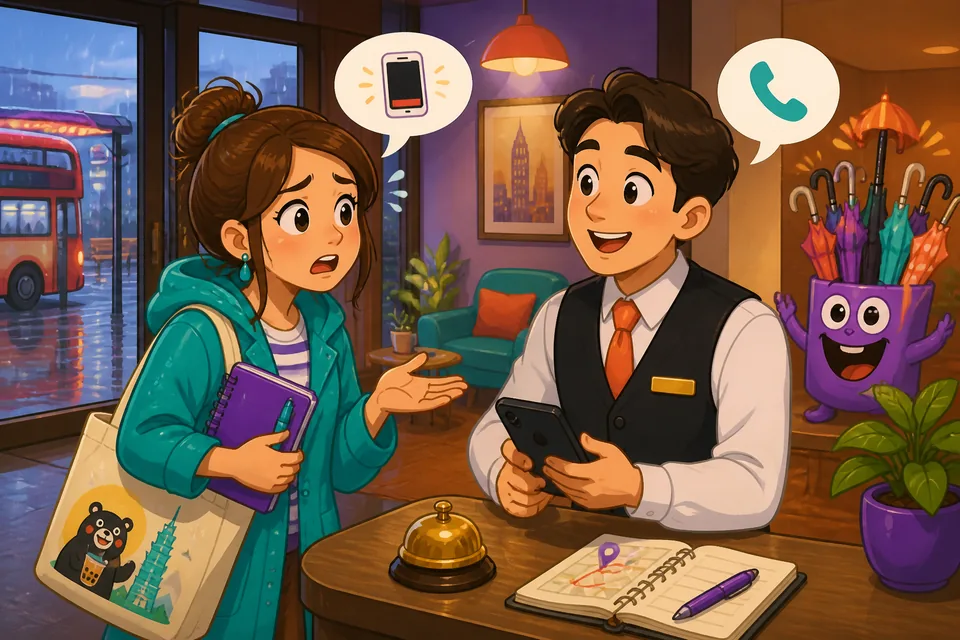
Ready to ask for help in everyday situations? This lesson gives you quick, polite German phrases you can use now. Have fun and speak out loud—practice helps confidence!
Level A1: In this short lesson you'll learn and practice seven core phrases for asking for help—calling someone, using a phone, asking what to do, saying it's an emergency, asking someone to look at something, asking someone to come with you, and asking someone to get help. CEFR-aligned and very practical: listen, repeat, and try the mini-conversation.
After this lesson you'll be able to:
Recognize and say seven common help-asking phrases in German.
Understand when to use each phrase in a polite or urgent situation.
Use short questions to get help with phones, people, or emergencies.
Ready? Let's go!
When you tap play on phrases, we track your progress through this lesson.
1. Reading + Listening Practice
Hear core phrases, repeat aloud.
Kannst du ___ anrufen?
Can you call ___?
Meaning: Can you call ___?
When to use: Ask someone to phone a person or service (police, reception, a friend). Use a name or service in the blank.
Kannst du die Polizei anrufen?
Can you call the police?
Kannst du meine Mutter anrufen?
Can you call my mother?
Kann ich kurz dein Handy benutzen?
Can I use your phone?
Meaning: Can I use your phone?
When to use: Politely ask to borrow someone's mobile phone for a short call. Use informal 'dein' with friends and 'Ihr' in formal situations.
Tip: Beginners sometimes forget formal 'Ihr' in polite situations; use 'Ihr' with strangers or officials.
Mein Akku ist leer. Kann ich kurz dein Handy benutzen?
My battery is dead. Can I use your phone for a moment?
Kann ich kurz dein Handy benutzen, um 112 anzurufen?
Can I use your phone quickly to call 112?
Was soll ich tun?
What should I do?
Meaning: What should I do?
When to use: Ask for immediate guidance about next steps when you are unsure what to do.
Tip: Don't confuse 'sollen' with 'müssen'—'Was soll ich tun?' asks for advice, not a strict obligation.
Ich bin gestürzt. Was soll ich tun?
I fell. What should I do?
Der Computer funktioniert nicht. Was soll ich tun?
The computer isn't working. What should I do?
Es ist ein Notfall.
It's an emergency.
Meaning: It's an emergency.
When to use: Use when there is an urgent situation that needs immediate attention.
Hilfe! Es ist ein Notfall.
Help! It's an emergency.
Rufen Sie schnell jemanden, bitte — es ist ein Notfall.
Call someone quickly please — it's an emergency.
Kannst du dir das mal anschauen?
Can you look at this?
Meaning: Can you look at this?
When to use: Ask someone to inspect or check something (a device, a document, an injury). 'mal' makes it sound natural and polite.
Mein Bildschirm ist schwarz. Kannst du dir das mal anschauen?
My screen is black. Can you take a look at it?
Ich glaube, das ist kaputt. Kannst du dir das mal anschauen?
I think this is broken. Can you look at it?
Kannst du mit mir kommen?
Can you come with me?
Meaning: Can you come with me?
When to use: Ask someone to accompany you, for example to find help or show a problem to staff.
Kannst du mit mir kommen zur Rezeption?
Can you come with me to reception?
Ich fühle mich nicht gut. Kannst du mit mir kommen?
I don't feel well. Can you come with me?
Kannst du bitte jemanden holen?
Can you get someone, please?
Meaning: Can you get someone, please?
When to use: Ask someone to find another person who can help (a staff member, a medic, or security). Polite with 'bitte'.
Kannst du bitte jemanden holen? Ich brauche Hilfe.
Can you please get someone? I need help.
Das funktioniert nicht. Kannst du bitte jemanden holen?
This isn't working. Can you please fetch someone?
2. Conversational Listening Practice
Hear phrases in a real mini-conversation.
Small hotel lobby emergency
Anna
Es ist ein Notfall.
It's an emergency.
David
Was soll ich tun?
What should I do?
Anna
Kannst du bitte jemanden holen?
Can you get someone, please?
David
Ich rufe die Rezeption an. Kann ich kurz dein Handy benutzen?
I'll call reception. Can I use your phone for a moment?
Anna
Ja, und kannst du mit mir kommen?
Yes, and can you come with me?
David
Natürlich. Ich komme mit.
Of course. I'll come with you.
3. Guided Practice
Quizzes and matching to lock in meaning.
Which German sentence means 'Can you call the police?'
Which phrase asks to borrow someone's phone?
Which sentence would you say to signal an urgent situation?
How do you ask someone to accompany you?
My battery is dead. Can I use your phone?
My battery is dead. ___
There is a small fire in the kitchen. It's an emergency.
There is a small fire in the kitchen. ___
I don't know where the office is. Can you come with me to help find it?
I don't know where the office is. ___ to help find it?
Match the core phrases
Match the extra phrases
4. Speaking Practice
Say phrases yourself (mic/recording).
Recording stays on your device only. Check speech uses your browser's speech tools when available.