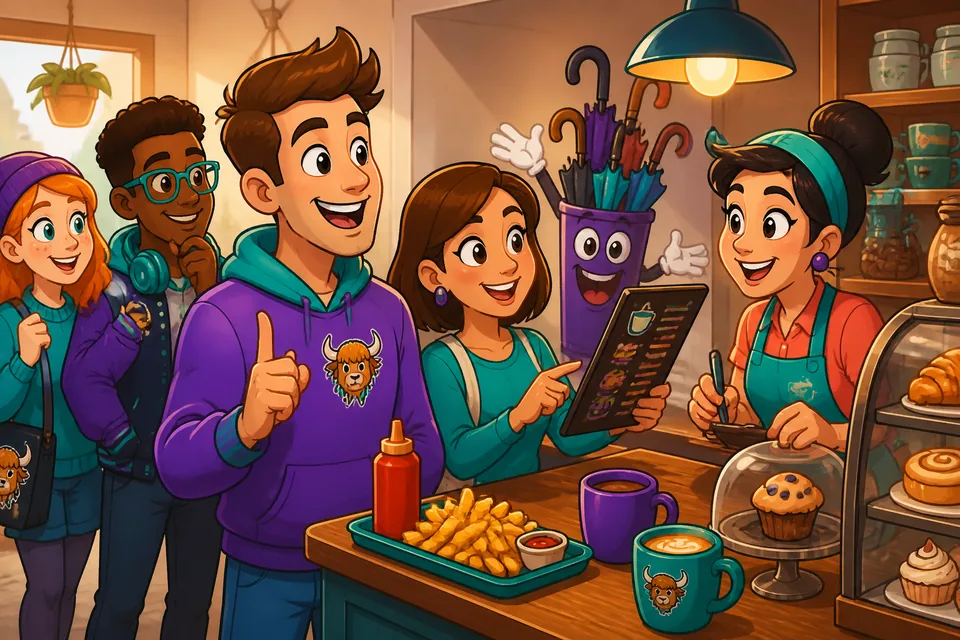
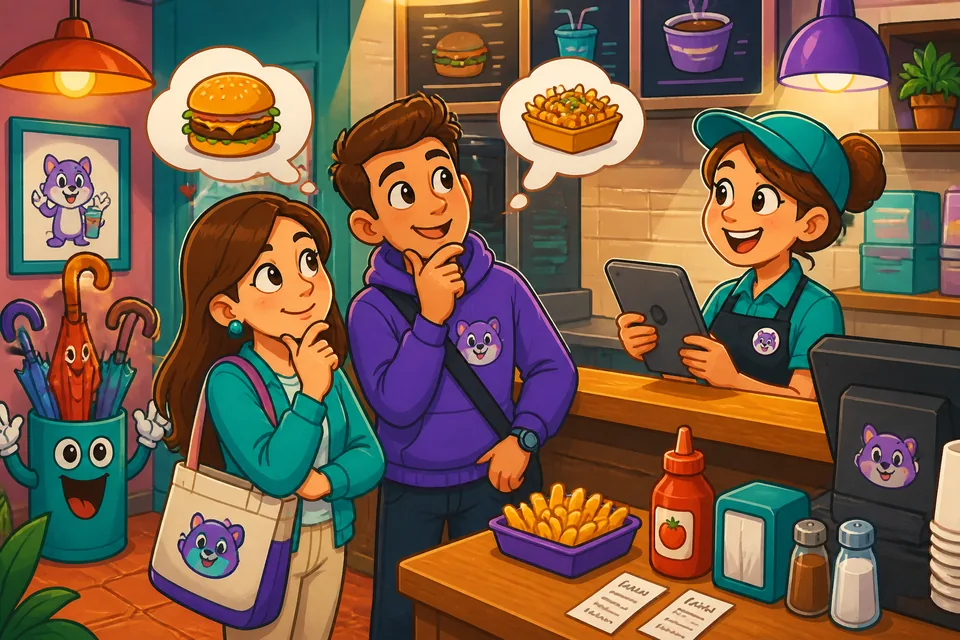
Nice — lesson 100! Let's keep building confidence in cafés and at counters. This short lesson focuses on polite, everyday phrases for ordering, asking about ingredients, and choosing takeaway or eating here.
Level A1: In this CEFR-aligned mini-lesson you'll practice common phrases for ordering food and drinks in German. You will learn how to ask for the menu, order politely, choose size, ask about ingredients or spiciness, request takeaway or the check, and finish your order. Quick, practical, and café-ready.
After this lesson you'll be able to:
Practice polite ordering phrases at Level A1.
Ask for the menu, order items, and request the check.
Say sizes, ask about ingredients, and choose takeaway or eating in.
Ready? Let's go!
When you tap play on phrases, we track your progress through this lesson.
1. Reading + Listening Practice
Hear core phrases, repeat aloud.
Ich hätte gern ___.
I'd like ___.
Meaning: I'd like ___.
When to use: Use this polite frame when you want to order a specific food or drink (add the item in the accusative: einen Kaffee, eine Cola, ein Wasser).
Tip: Beginners sometimes forget the correct article in the accusative (einen/ eine/ ein).
Ich hätte gern einen Kaffee.
I'd like a coffee.
Ich hätte gern eine Suppe, bitte.
I'd like a soup, please.
Kann ich bitte die Speisekarte haben?
Can I see the menu?
Meaning: Can I see the menu?
When to use: Ask this when you want the menu in a restaurant, café, or bakery; it's polite and common.
Kann ich bitte die Speisekarte haben?
Can I have the menu, please?
Entschuldigung, kann ich die Speisekarte haben?
Excuse me, can I have the menu?
Das war's, danke.
That's all, thanks.
Meaning: That's all, thanks.
When to use: Say this when you have finished ordering and do not want to add anything else.
Das war's, danke.
That's all, thanks.
Das war's. Danke sehr!
That's all. Thank you very much!
Einen kleinen ___, bitte.
A small ___, please.
Meaning: A small ___, please.
When to use: Use this to choose a size for a drink or food item; adjust the article/adjective for gender and case (einen kleinen Kaffee, eine kleine Cola, ein kleines Wasser).
Tip: Watch adjective endings: 'kleinen' for masculine accusative (einen kleinen Kaffee).
Einen kleinen Kaffee, bitte.
A small coffee, please.
Einen kleinen Salat, bitte.
A small salad, please.
Ohne ___, bitte.
No ___, please.
Meaning: No ___, please.
When to use: Use this to ask for an item to be left out (ingredients like onions, cheese). Put the ingredient after 'ohne' (e.g., ohne Zwiebeln).
Ohne Zwiebeln, bitte.
No onions, please.
Ohne Käse, bitte.
No cheese, please.
Kann ich bitte die Rechnung haben?
Can I have the check, please?
Meaning: Can I have the check, please?
When to use: Ask this at the end of a meal when you want to pay; in Germany ask for 'die Rechnung'.
Kann ich bitte die Rechnung haben?
Can I have the check, please?
Entschuldigung, die Rechnung bitte.
Excuse me, the bill please.
Zum Mitnehmen, bitte.
To go, please.
Meaning: To go, please.
When to use: Say this when you want your order for takeaway rather than eating in.
Zum Mitnehmen, bitte.
To go, please.
Können Sie das bitte zum Mitnehmen verpacken?
Can you pack this to go, please?
Ich hätte gern ___.
I'd like to order ___.
Meaning: I'd like to order ___.
When to use: Another common polite frame for ordering an item; add the item in the accusative (einen Kaffee, eine Cola).
Ich hätte gern ein Stück Kuchen.
I'd like a piece of cake.
Ich hätte gern einen Tee, bitte.
I'd like a tea, please.
Kann ich ___ bekommen?
Can I get ___?
Meaning: Can I get ___?
When to use: Use this casually at a counter or café to request an item; include the desired item (often with its accusative article).
Kann ich einen Cappuccino bekommen?
Can I get a cappuccino?
Kann ich eine Cola bekommen?
Can I get a cola?
Einmal ___, bitte.
One ___, please.
Meaning: One ___, please.
When to use: Use this simple quantity phrase to order one item (works well to avoid article confusion).
Einmal Wiener Schnitzel, bitte.
One Wiener schnitzel, please.
Einmal Brötchen, bitte.
One bread roll, please.
Zum Hieressen, bitte.
For here, please.
Meaning: For here, please.
When to use: Use this to say you will eat at the café or restaurant, as opposite to takeaway.
Zum Hieressen, bitte.
For here, please.
Wir bleiben hier, zum Hieressen bitte.
We're staying here, for here please.
Ist das scharf?
Is it spicy?
Meaning: Is it spicy?
When to use: Ask this when you want to know if a dish is hot/spicy (würzig/scharf).
Ist das scharf?
Is it spicy?
Ist das sehr scharf?
Is it very spicy?
Ist da ___ drin?
Is there ___ in it?
Meaning: Is there ___ in it?
When to use: Use this to ask if a dish contains a specific ingredient (Ist da Nuss drin? / Ist da Fleisch drin?).
Ist da Milch drin?
Is there milk in it?
Ist da Nuss drin?
Is there nut in it?
2. Conversational Listening Practice
Hear phrases in a real mini-conversation.
Anna and David at a café counter
Anna
Kann ich bitte die Speisekarte haben?
Can I have the menu, please?
David
Einmal Brötchen und einen kleinen Kaffee, bitte.
One bread roll and a small coffee, please.
Anna
Ist das scharf?
Is it spicy?
David
Ohne Zwiebeln, bitte.
No onions, please.
Anna
Das war's, danke.
That's all, thanks.
David
Zum Hieressen, bitte.
For here, please.
3. Guided Practice
Quizzes and matching to lock in meaning.
Which phrase do you use to ask for the menu?
Which phrase means 'No onions, please'?
Which phrase is a simple way to order one item?
Which phrase asks for the check at the end of a meal?
You say: Kann ich bitte die Speisekarte haben?
You want the menu. You say: ___.
You say: Ohne Zwiebeln, bitte. (Use the 'Ohne ___, bitte.' frame.)
You do not want onions on your dish, so you say: ___.
When you've finished ordering you say: Das war's, danke.
When you've finished ordering you say: ___.
Match the core phrases
Match the extra phrases
4. Speaking Practice
Say phrases yourself (mic/recording).
Recording stays on your device only. Check speech uses your browser's speech tools when available.