
New here? This is lesson 231 of a free 240-lesson German course.
Back home and here in German
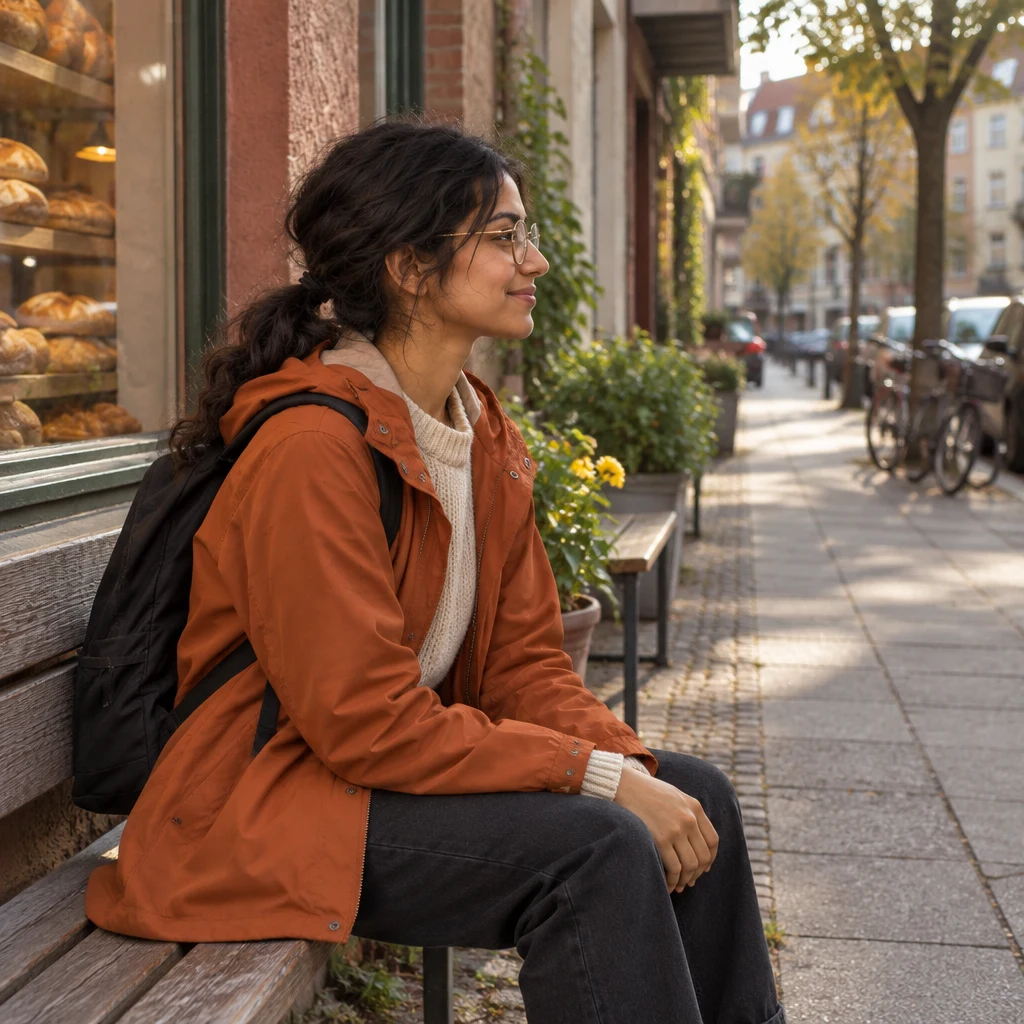
Priya and Jule sit on the bench outside Bäckerei Krause and compare home with Kreuzberg, fairly and without a ranking.
Anton arrives exactly on time, but for the wrong story, as if a meeting were about to start.
By the end, you'll say how home works differently, what was hard at first, and what still feels foreign.
You'll also name the Kiez, say you have settled in, and give both sides their due.
By the end of this lesson
Compare life back home with life in Berlin, fairly.
- Bei uns zu Hause läuft das etwas anders.Where I'm from it works a bit differently.
- Am Anfang ist mir das ziemlich schwergefallen.I found that pretty hard at first.
- Mittlerweile habe ich mich gut eingelebt.I've settled in well by now.
- Was ich hier besonders mag, ist der Kiez.What I especially like here is the neighbourhood.
- Manches hier ist mir immer noch fremd.Some things here are still foreign to me.
- Beides hat seine Vor- und Nachteile.Both have their pros and cons.
Scene — the bakery bench
The wooden bench outside Bäckerei Krause is warm from the late sun. Jule sits with Keks at her feet, and Priya has a paper cup.
Anton is still inside with his Milchkaffee. He will come out exactly on time, though not for this talk.

Learn — home and here
Six lines let you compare home and Berlin without picking a winner.
You get the hard start, the settled-in now, the Kiez, and what still feels foreign.

Bei uns zu Hause läuft das etwas anders.
Where I'm from it works a bit differently.
When to use it: Use this when home and Berlin handle the same thing in different ways.
Learn zu Hause as the phrase for being at home.

Am Anfang ist mir das ziemlich schwergefallen.
I found that pretty hard at first.
When to use it: Say this when a new habit or rule felt hard at first.
The person who found it hard takes mir after the verb, not ich.
Say it: Schwergefallen starts with the German sch sound.

Mittlerweile habe ich mich gut eingelebt.
I've settled in well by now.
When to use it: Use this once you feel at home in the new place.
In this past form, the prefix stays joined in the participle: eingelebt.
Say it: ich uses the soft ch, not the ach sound.

Was ich hier besonders mag, ist der Kiez.
What I especially like here is the neighbourhood.
When to use it: Name the neighbourhood as the thing you especially like here.
Kiez is the Berlin word for your local streets and shops.
Manches hier ist mir immer noch fremd.
Some things here are still foreign to me.
When to use it: Admit that some things here still feel strange to you.
fremd takes mir for the person who still feels that way.
Say it: Manches uses the soft ich sound for ch, not the ach sound.

Beides hat seine Vor- und Nachteile.
Both have their pros and cons.
When to use it: Close a fair comparison when neither side wins outright.
Vor- und Nachteile is short for Vorteile und Nachteile.
Story — the wrong story
Watch Priya and Jule weigh home against the Kiez on the bench outside. Anton will walk into the wrong story.
The highlighted words are the lines you just learned. Turn on Show English if you need it.
- The late sun is on the bench. Keks lies by Jule's boots.
 JuleLäuft bei euch zu Hause vieles anders als hier?Do many things work differently where you're from than they do here?
 PriyaBei uns zu Hause läuft das etwas anders.Where I'm from it works a bit differently.
- Jule tilts her head. She does not rush the answer.
- JuleAnders in einem guten Sinn, oder einfach nur anders?Different in a good way, or just different?
- PriyaAm Anfang ist mir das ziemlich schwergefallen.I found that pretty hard at first.
- JuleDie U-Bahn, die Nachbarn, oder einfach alles auf einmal?The underground, the neighbours, or just everything at once?
- PriyaEigentlich alles. Mittlerweile habe ich mich gut eingelebt.Pretty much everything. I've settled in well by now.
- JuleDas höre ich gern. Was hält dich hier?I'm glad to hear that. What keeps you here?
- PriyaWas ich hier besonders mag, ist der Kiez.What I especially like here is the neighbourhood.
- JuleJa, der Kiez. Und trotzdem klingt da irgendwie noch etwas mit.Yes, the neighbourhood. And yet I still hear something in there.
- PriyaManches hier ist mir immer noch fremd.Some things here are still foreign to me.
- JuleKönnte man das auch anders sehen?Could there be another way to look at it?
- PriyaBeides hat seine Vor- und Nachteile.Both have their pros and cons.
- The bakery door opens. Anton checks the time, then sits on the far end of the bench.
 AntonIch bin pünktlich. Wir wollten doch den Zeitplan durchgehen, oder?I'm on time. We were going to go through the timeline, right?
- JuleFalsche Geschichte, Anton. Wir vergleichen nur zu Hause und hier.Wrong story, Anton. We're only comparing home and here.
- AntonAch so. Das stand nicht auf dem Zettel.Ah. That wasn't on the tag.
- PriyaSo hatte ich mir das nicht vorgestellt.That's not how I had pictured it.
- AntonDen Vergleich? Oder mich auf dieser Bank?The comparison? Or me on this bench?
- PriyaDen Vergleich. Dich auf der Bank meine ich nicht.The comparison. I don't mean you on the bench.
Practice — a fair comparison
Ten short exercises wait here. You will listen, match, fill a gap, and build a line.
They stay on a fair comparison, not a ranking of two homes.
0 of 10 done
What did you hear?
What did you hear?
Match the pairs
German
Am Anfang ist mir das ziemlich schwergefallen.Drop the English hereMittlerweile habe ich mich gut eingelebt.Drop the English hereManches hier ist mir immer noch fremd.Drop the English hereEnglish
What do you say?
What do you say?
A friend on the bench asks what you especially like about living here.
Fill the gap
Fill the gap
I found that pretty hard at first.
Am Anfang ist mir das ziemlich ____.
What does it mean?
What does it mean?
Beides hat seine Vor- und Nachteile.
Fill the gap
Fill the gap
I've settled in well by now.
Mittlerweile habe ich mich gut ____.
Pick the reply
Jule says:
Pick the reply
Ist dir hier schon alles vertraut?
Does everything here already feel familiar to you?
And you reply with:
Swap the word
Swap the word
You are comparing a habit at home with the same habit in Berlin.
Bei uns zu Hause läuft das etwas ____.
True or false?
True or false?
This line means you pictured the situation exactly this way.
What do you say?
What do you say?
A friend ranks one city as simply better. You want a fairer look.
Say it — say it fairly
Now you're Priya on the bench outside with Jule. When it's your turn, tap the microphone and speak the line.
Tap ▶ first if you want to hear the line. Your recording stays on your device.
- JuleNa, wie läuft das bei dir zu Hause?So, how do things work at home for you?
- Priya (you)Say things work a bit differently where you are from.
Say things work a bit differently where you are from.
Bei uns zu Hause läuft das etwas anders.
Where I'm from it works a bit differently.
0 of 6 said
Recap — what you can say now
| German | English | Play |
|---|---|---|
| Bei uns zu Hause läuft das etwas anders. | Where I'm from it works a bit differently. | |
| Am Anfang ist mir das ziemlich schwergefallen. | I found that pretty hard at first. | |
| Mittlerweile habe ich mich gut eingelebt. | I've settled in well by now. | |
| Was ich hier besonders mag, ist der Kiez. | What I especially like here is the neighbourhood. | |
| Manches hier ist mir immer noch fremd. | Some things here are still foreign to me. | |
| Beides hat seine Vor- und Nachteile. | Both have their pros and cons. |
Save your progress — it’s free
Keep your place in the course and see which lines you’ve learned.
Want the next lesson in your inbox?
Get the next lesson by email, one a day.
Join the newsletterDaily lesson emails are coming soon. Newsletter subscribers get them first.
Keep practicing with Yak Cards
Want to keep these comparisons handy? Grab the Yak Cards for this lesson and review them anywhere.
A quick round with the Yak Cards each day keeps these fair comparisons ready for the bench.
Open Yak Cards