Welcome back — Lesson 12! Ready to manage wants and needs in German? We'll practice short, useful phrases you can use every day. Repeat aloud, try the mini-conversation, then check your answers.
Level A1: In this lesson you'll learn polite ways to accept or refuse more, ask if you need something, and say whether an action is necessary. You'll practice phrases like "Nein danke, nichts mehr.", "Ich brauche ___ nicht.", "Brauche ich ___?", "Muss ich ___?", "Ich muss nicht ___.", "Das hier, bitte.", and "Ein bisschen, bitte." — short, practical lines for cafés, shops and simple questions. This lesson is CEFR-aligned and focused on speaking and listening.
After this lesson you'll be able to:
Practice A1 phrases to refuse politely and ask about needs.
Be able to choose or request small amounts and items.
Ask and say whether something is necessary (questions and short answers).
Ready? Let's go!
When you tap play on phrases, we track your progress through this lesson.
1. Reading + Listening Practice
Hear core phrases, repeat aloud.
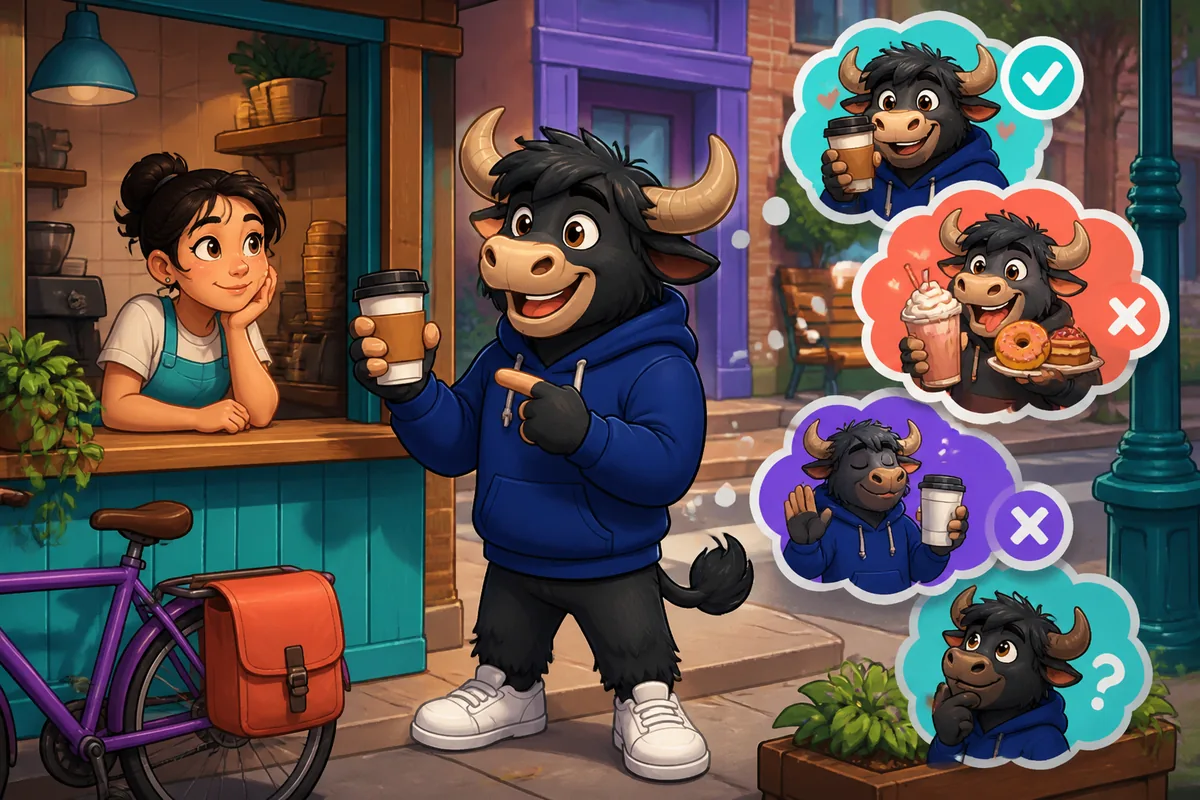
Nein danke, nichts mehr.
No more, thanks.
Meaning: No more, thanks.
When to use: Use this polite refusal when someone offers more food, drink, or another portion.
Möchtest du noch Kuchen? — Nein danke, nichts mehr.
Would you like more cake? — No more, thanks.
Der Kellner fragt nach Nachtisch: „Noch Kaffee?“ — „Nein danke, nichts mehr.“
The waiter asks about dessert: 'More coffee?' — 'No more, thanks.'
Ich brauche ___ nicht.
I don't need ___.
Meaning: I don't need ___.
When to use: Use this to say that an object or thing is not necessary (usually with an accusative noun).
Tip: Beginners sometimes place 'nicht' before the noun (e.g., 'Ich nicht brauche'), but correct order is 'Ich brauche ___ nicht.'
Ich brauche das Besteck nicht.
I don't need the cutlery.
Ich brauche keine Tasche, danke.
I don't need a bag, thanks.
Brauche ich ___?
Do I need ___?
Meaning: Do I need ___?
When to use: Use this question to ask if an object or item is necessary (insert a noun or phrase in the blank).
Brauche ich einen Regenschirm?
Do I need an umbrella?
Brauche ich einen Ausweis, um einzutreten?
Do I need an ID to enter?
Muss ich ___?
Do I have to ___?
Meaning: Do I have to ___?
When to use: Ask if an action is required. An infinitive or action usually follows.
Muss ich heute arbeiten?
Do I have to work today?
Muss ich das Formular ausfüllen?
Do I have to fill out the form?
Ich muss nicht ___.
I don't have to ___.
Meaning: I don't have to ___.
When to use: Use this to say an action is not necessary (not to be confused with 'I’m not allowed to').
Tip: Don't confuse with 'Ich darf nicht' (I am not allowed to).
Ich muss heute nicht kommen.
I don't have to come today.
Ich muss nicht alles trinken.
I don't have to drink everything.
Das hier, bitte.
This one, please.
Meaning: This one, please.
When to use: Use this when pointing at an item you want to buy or order; polite and natural.
An der Bäckerei: „Das hier, bitte.“
At the bakery: 'This one, please.'
Im Laden zeige ich auf das Hemd: „Das hier, bitte.“
In the shop I point to the shirt: 'This one, please.'
Ein bisschen, bitte.
A little, please.
Meaning: A little, please.
When to use: Use this when asking for a small amount (food, drink, or something measured).
Nur ein bisschen, bitte.
Only a little, please.
Möchten Sie Zucker? — Ein bisschen, bitte.
Would you like sugar? — A little, please.
2. Conversational Listening Practice
Hear phrases in a real mini-conversation.
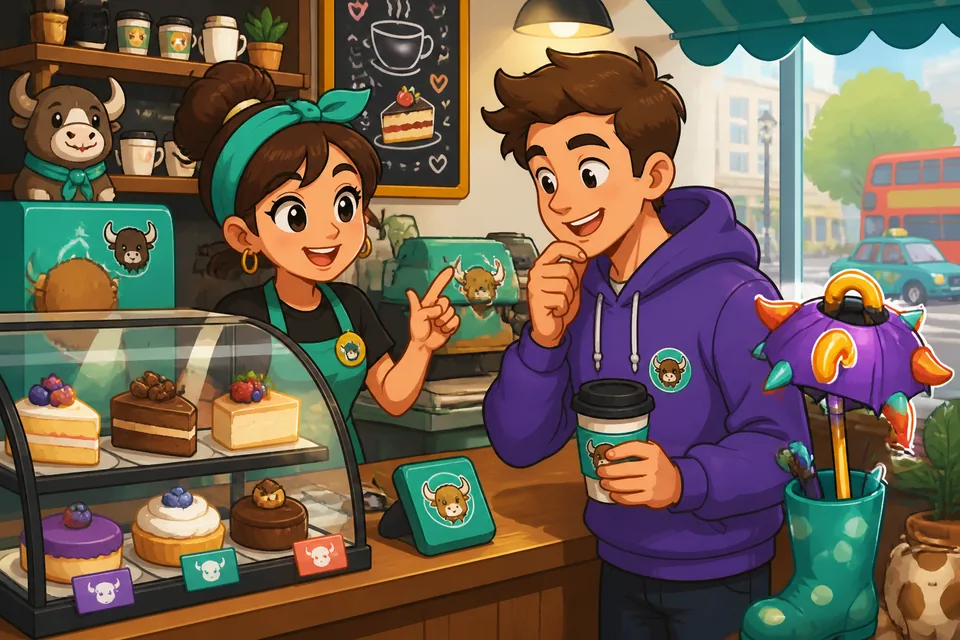
At a small café counter choosing cake and coffee.
Anna
Das hier, bitte.
This one, please.
David
Möchtest du Kaffee? Ein bisschen Zucker?
Do you want coffee? A little sugar?
Anna
Ein bisschen, bitte.
A little, please.
David
Noch ein Stück Kuchen?
Another piece of cake?
Anna
Nein danke, nichts mehr.
No more, thanks.
David
Brauche ich noch Geld für Trinkgeld?
Do I need money for a tip?
Anna
Ich brauche es nicht.
I don't need it.
3. Guided Practice
Quizzes and matching to lock in meaning.
Which phrase means 'No more, thanks.'?
Which question asks 'Do I need ___?' in German?
Which phrase would you use to politely choose an item?
Which phrase asks whether an action is required (Do I have to ___?)
At the café you only want a small amount of sugar: A little, please.
At the café you only want a small amount of sugar: ___
When someone offers more cake you politely say: No more, thanks.
When someone offers more cake you politely say: ___
To say 'I don't have to go' in German you would say: I don't have to go.
To say 'I don't have to go' in German you would say: ___
Match the core phrases
Match the extra phrases
4. Speaking Practice
Say phrases yourself (mic/recording).
Recording stays on your device only. Check speech uses your browser's speech tools when available.