
New here? This is lesson 234 of a free 240-lesson French course.
News and opinions in French
A local paper says the Saturday market may move one street over.
Karim is loud about it. Sam tries to be fair, and Odile will not pass on rumours.
You'll ask if someone saw the piece, say the neighbourhood is talking, and hold a balanced view.
You'll also wait and see, and say it is not as simple as people claim.
By the end of this lesson
Talk about a local news item and give a balanced view.
- Tu as vu l'article sur le marché ?Did you see the piece about the market?
- Tout le quartier en parle.The whole neighbourhood is talking about it.
- Il y a du vrai des deux côtés.There's some truth on both sides.
- Ça va changer le quotidien de pas mal de gens.It's going to change daily life for quite a few people.
- Moi, j'attendrai de voir comment ça se passe.I'll wait and see how it goes.
- Ce n'est pas aussi simple qu'on le dit.It's not as simple as people say.
Scene — the paper on the zinc
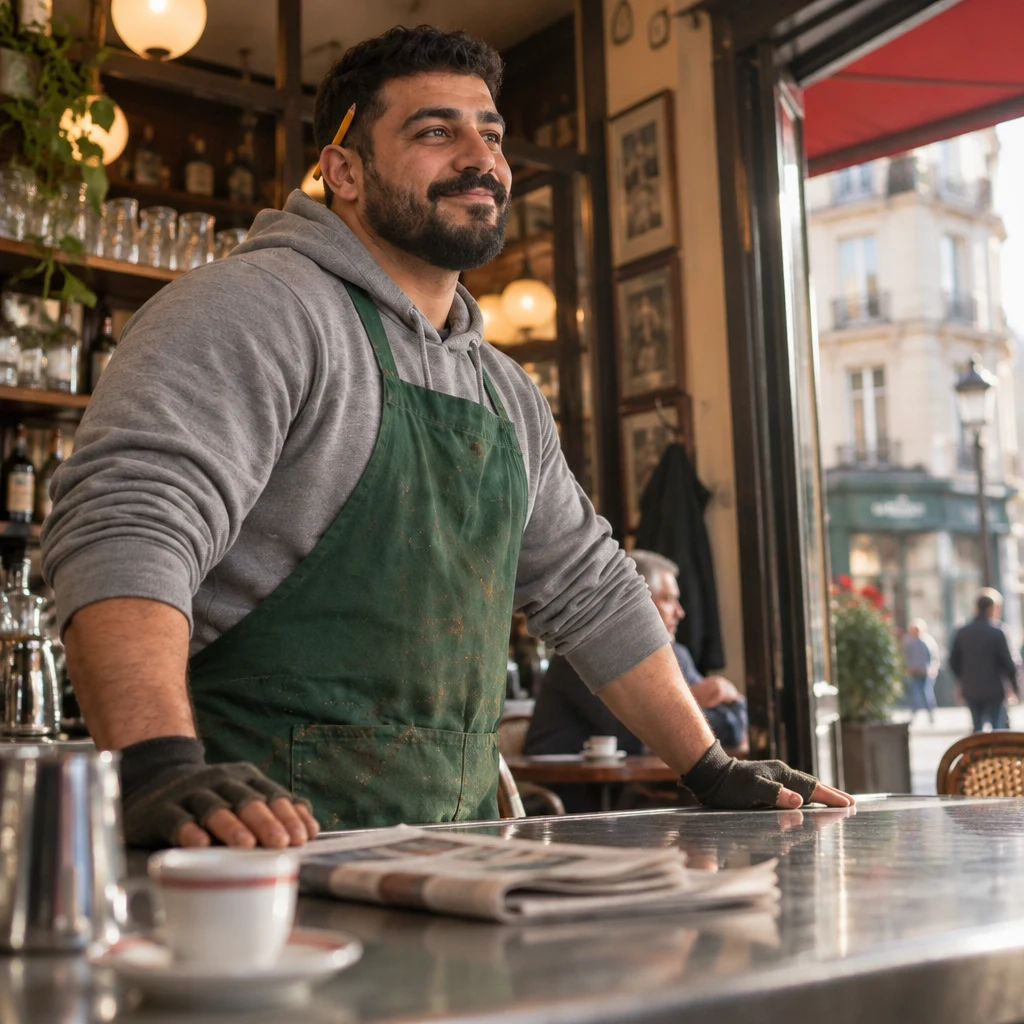
Saturday at Café des Tilleuls. Karim is in from the market in his green apron, a local paper on the zinc.
Odile will not trade rumours. Gaspard sits at the table next to the window table, café crème untouched.
The window table keeps its blank brass sign. Sam wants a fair take, not a fight.

Learn — a local piece
Six lines help you raise a local story and stay balanced.
You ask about the piece, note the talk, and wait to see how it goes.

Tu as vu l'article sur le marché ?
Did you see the piece about the market?
When to use it: Ask a friend or regular if they saw a local news piece.
Tu is fine with Karim and Odile now; they are café regulars.
Say it: The l' in l'article is elision of le before a vowel.

Tout le quartier en parle.
The whole neighbourhood is talking about it.
When to use it: Use this when a local story is already going around the street.
En points back to the story already named, so you do not repeat it.

Il y a du vrai des deux côtés.
There's some truth on both sides.
When to use it: Give a balanced view when both sides have a point.
This keeps you in the middle; it is not a yes or a no.
Ça va changer le quotidien de pas mal de gens.
It's going to change daily life for quite a few people.
When to use it: Say this when a change will affect quite a few people's routines.
Pas mal de means quite a few, not that something is badly done.
Say it: The an in changer is a nasal vowel.

Moi, j'attendrai de voir comment ça se passe.
I'll wait and see how it goes.
When to use it: Hold back from picking a side until you see what happens.
J'attendrai is the speaker's own wait-and-see, not advice to someone else.
Say it: The j' in j'attendrai is elision of je.

Ce n'est pas aussi simple qu'on le dit.
It's not as simple as people say.
When to use it: Push back when people make a local story sound too neat.
On here means people in general, not a named group.
Say it: The qu' in qu'on is elision of que before on.
Story — both sides
Karim is loud about the market piece. Sam stays fair, and Odile refuses rumours.
The highlighted words are the lines you just learned. Turn on Show English if you need it.
- Karim drops a paper on the zinc. Odile looks at it, then at Sam.
 SamTu as vu l'article sur le marché ?Did you see the piece about the market?
 KarimOui, je l'ai vu. Tout le quartier en parle.Yes, I saw it. The whole neighbourhood is talking about it.
- He taps the paper with a glove still on.
- KarimIls veulent nous déplacer d'une rue. Les clients vont se perdre.They want to move us one street over. Customers will get lost.
 OdileJ'ai entendu dire que ça dégagerait le boulevard.I heard that it would clear the boulevard.
- SamIl y a du vrai des deux côtés.There's some truth on both sides.
- KarimPour moi, c'est simple. On sait où on est le samedi.For me it's simple. People know where we are on Saturday.
- SamÇa va changer le quotidien de pas mal de gens.It's going to change daily life for quite a few people.
- OdileJe ne fais pas les ragots. Rien n'est signé.I don't do rumours. Nothing is signed.
- Gaspard looks up from the next table. His café crème is still full.
 GaspardCe n'est pas aussi simple qu'on le dit.It's not as simple as people say.
- SamMoi, j'attendrai de voir comment ça se passe.I'll wait and see how it goes.
- KarimToi tu attends. Moi, demain, j'ai des caisses.You wait. Me, tomorrow, I've got crates.
- KarimIl paraît que c'est vrai.Word is it's true.
- Odile wipes the zinc and does not pick up the paper.
- OdileOn n'en sait rien encore. On verra samedi.We don't know anything yet. We'll see on Saturday.
- SamJe comprends les deux points de vue.I can see both sides.
- OdileTrès bien. Ici, on attend les faits.Very good. Here we wait for the facts.
Practice — fair or loud
Eleven short tasks. You'll listen, fill a gap, build a line, and pick a fair reply.
Wrong options are lines a Paris speaker would not use in that moment.
0 of 11 done
What did you hear?
What did you hear?
What does it mean?
What does it mean?
Tout le quartier en parle.
What do you say?
What do you say?
Someone says only one camp is right. You want to say there is some truth on both sides.
Fill the gap
Fill the gap
It's going to change daily life for quite a few people.
Ça va changer le ____ de pas mal de gens.
Pick the reply
Karim says:
Pick the reply
Alors, tu es pour ou contre, toi ?
So, are you for or against it?
And you reply with:
Build the line
Build the line
It's not as simple as people say.
.
Tap the words in order.
Swap the word
Swap the word
Ask a friend if they saw the local news piece.
Tu as ____ l'article sur le marché ?
True or false?
True or false?
Use this to pass on that people say the story is true.
What do you say?
What do you say?
Karim wants you for or against the market move. You can see why stallholders and neighbours both have a case.
Match the pairs
French
Tout le quartier en parle.Drop the English hereIl y a du vrai des deux côtés.Drop the English hereCe n'est pas aussi simple qu'on le dit.Drop the English hereEnglish
What do you say?
What do you say?
You want to pass on a rumour as something you heard, without saying it is certain.
Say it — hold the middle
Now you're Sam at the zinc. Karim still has his market apron on, and Gaspard is at the next table.
When it's your turn, tap the microphone and speak the line.
Tap ▶ first if you want to hear the line. Your recording stays on your device.
- KarimTu as deux minutes ?Have you got two minutes?
- Sam (you)Ask if he saw the local piece.
Ask if he saw the local piece.
Tu as vu l'article sur le marché ?
Did you see the piece about the market?
0 of 5 said
Recap — what you can say now
| French | English | Play |
|---|---|---|
| Tu as vu l'article sur le marché ? | Did you see the piece about the market? | |
| Tout le quartier en parle. | The whole neighbourhood is talking about it. | |
| Il y a du vrai des deux côtés. | There's some truth on both sides. | |
| Ça va changer le quotidien de pas mal de gens. | It's going to change daily life for quite a few people. | |
| Moi, j'attendrai de voir comment ça se passe. | I'll wait and see how it goes. | |
| Ce n'est pas aussi simple qu'on le dit. | It's not as simple as people say. |
Save your progress — it’s free
Keep your place in the course and see which lines you’ve learned.
Want the next lesson in your inbox?
Get the next lesson by email, one a day.
Join the newsletterDaily lesson emails are coming soon. Newsletter subscribers get them first.
Keep practicing with Yak Cards
Want these news lines on your phone? Grab the Yak Cards for this lesson and review them anywhere.
A short Yak Cards round keeps your balanced view ready for the next café argument.
Open Yak Cards