
New here? This is lesson 55 of a free 240-lesson French course.
Food I can't eat in French
Sam is at Café des Tilleuls again. He wants a tartine, but he needs to say what he cannot eat.
Odile is already at the counter. Gaspard sits at the next table, croissant in reach, café crème untouched.
By the end, you'll say you are vegetarian, skip meat, name a food you cannot eat, and ask what is in a dish.
Sam will ask if the tartine has butter. Odile will look at him as if Paris had just been invented.
By the end of this lesson
Say what you don't eat, and ask if something has an ingredient.
- Je suis végétarien.I'm vegetarian.
- Je ne mange pas de viande.I don't eat meat.
- Je ne peux pas manger ___.I can't eat ___.
- Il y a ___ dedans ?Does it have ___ in it?
- C'est épicé ?Is it spicy?
- Je suis allergique.I'm allergic.
Scene — butter on the bread
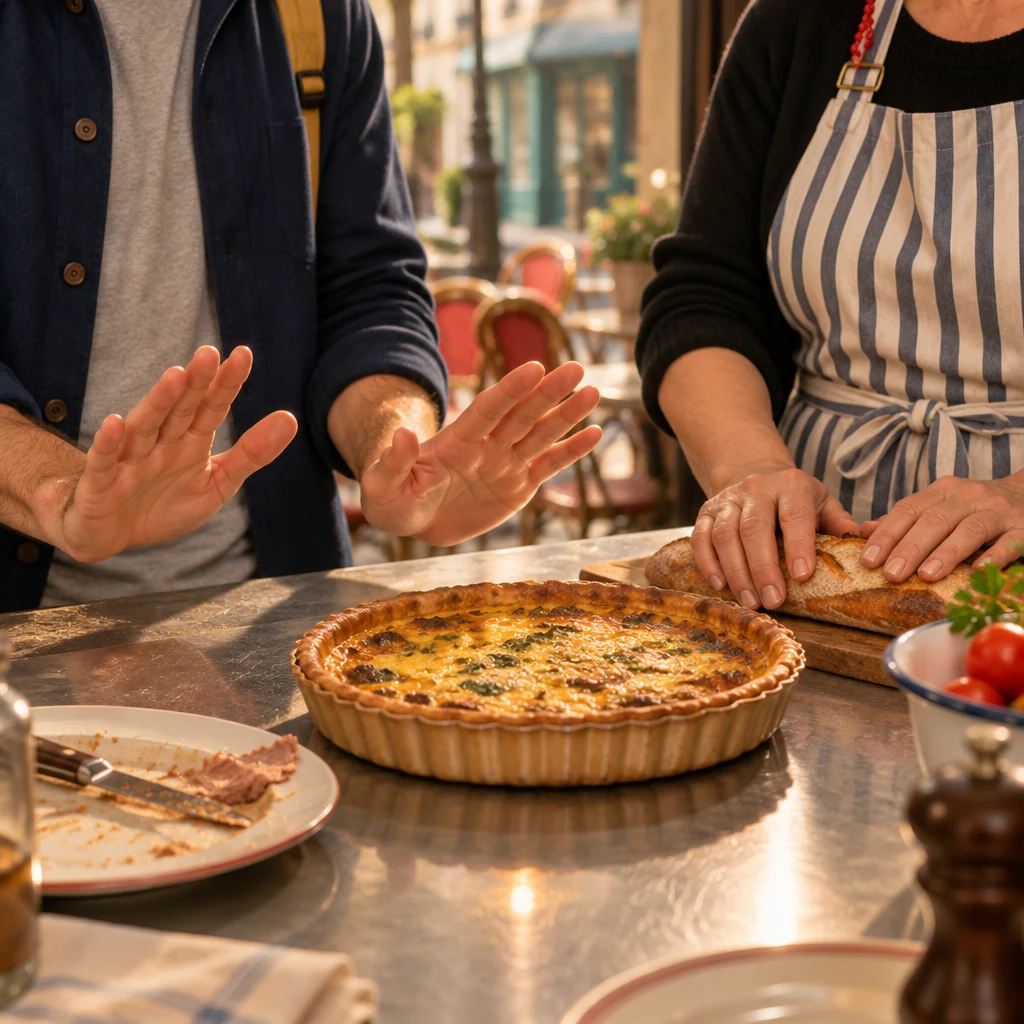
Morning on rue des Tilleuls. Sam is at the zinc counter. Odile has the bread ready. The window table still has its blank brass sign.
Gaspard sits at the table next to it on two chairs. His croissant is in reach. His café crème is still full.

Learn — food you cannot eat
Six short lines cover being vegetarian, skipping meat, naming a food you cannot eat, and checking a dish.
You'll also ask if something is spicy, and say you are allergic.

Je suis végétarien.
I'm vegetarian.
When to use it: Say this to tell someone you are vegetarian.
Learn it as one piece if you do not eat meat. A woman says végétarienne.
Say it: The ien at the end is nasal.

Je ne mange pas de viande.
I don't eat meat.
When to use it: Say this when a dish has meat and you skip it.
Learn it as one piece to skip meat on a plate.
Say it: The last e on viande is silent.
Je ne peux pas manger ___.
I can't eat ___.
When to use it: Use this to name a food you cannot eat.
Learn it as one piece and fill in the food.
Say it: The x in peux is silent.

Il y a ___ dedans ?
Does it have ___ in it?
When to use it: Ask this to check if a dish has something in it.
Learn it as one piece when you check a dish.

C'est épicé ?
Is it spicy?
When to use it: Ask this before you eat if spice is a problem.
Learn it as one piece before you take a bite.
Say it: The t in C'est links into épicé.

Je suis allergique.
I'm allergic.
When to use it: Say this when a food is not safe for you.
Learn it as one piece when a food is not safe.
Say it: The que at the end sounds like k.
Story — the tartine
Watch Sam order at the counter. He needs to say what he cannot eat, then he asks about the tartine.
The highlighted words are the lines you just learned. Turn on Show English if you need it.
- The lamps are on. Odile looks up from the zinc counter. She waits for hello before the bread.
 OdileBonjour.Hello.
 SamBonjour. Je suis végétarien.Hello. I'm vegetarian.
- OdileD'accord.Okay.
- SamJe ne mange pas de viande.I don't eat meat.
- OdileUne tartine ?A tartine?
- SamOui. Il y a du beurre dedans ?Yes. Does it have butter in it?
- Odile looks at him as if Paris had just been invented. Gaspard does not look up from his croissant. The window table stays empty.
- OdileOui, il y a du beurre.Yes, it has butter.
- SamJe ne peux pas manger de beurre. Je suis allergique.I can't eat butter. I'm allergic.
- OdileDu pain.Some bread.
- SamC'est épicé ?Is it spicy?
- OdileNon.No.
- SamMerci.Thank you.
Practice — meat, spice, allergy
Eleven quick exercises wait here. You'll listen, pick, match, fill a gap, and build a line.
They stay tiny, so the round moves fast.
0 of 11 done
What did you hear?
What did you hear?
Match the pairs
French
Je suis végétarien.Drop the English hereJe ne mange pas de viande.Drop the English hereC'est épicé ?Drop the English hereJe suis allergique.Drop the English hereEnglish
What do you say?
What do you say?
A server you do not know waits for your order. You want a tartine.
Fill the gap
Fill the gap
I don't eat meat.
Je ne mange pas de ____.
What does it mean?
What does it mean?
C'est épicé ?
Build the line
Build the line
I'm allergic.
.
Tap the words in order.
Find the mistake
Find the mistake
What do you say?
What do you say?
You want to know if the dish has butter in it.
Swap the word
Swap the word
You do not eat meat. Tell Odile what you are.
Je suis ____.
True or false?
True or false?
This means some bread.
Pick the reply
Odile says:
Pick the reply
Bonjour.
Hello.
And you reply with:
Say it — tell her at the counter
Now you're Sam at the counter. When it's your turn, tap the microphone and speak the line.
Tap ▶ first if you want to hear the line. Your recording stays on your device.
- OdileBonjour.Hello.
- Sam (you)Say hello back. It is still morning.
Say hello back. It is still morning.
Bonjour.
Hello
0 of 7 said
Recap — what you can say now
| French | English | Play |
|---|---|---|
| Je suis végétarien. | I'm vegetarian. | |
| Je ne mange pas de viande. | I don't eat meat. | |
| Je ne peux pas manger ___. | I can't eat ___. | |
| Il y a ___ dedans ? | Does it have ___ in it? | |
| C'est épicé ? | Is it spicy? | |
| Je suis allergique. | I'm allergic. |
Save your progress — it’s free
Keep your place in the course and see which lines you’ve learned.
Want the next lesson in your inbox?
Get the next lesson by email, one a day.
Join the newsletterDaily lesson emails are coming soon. Newsletter subscribers get them first.
Keep practicing with Yak Cards
Want to keep these food lines handy? Grab the Yak Cards for this lesson and review them anywhere.
A quick round with the Yak Cards each day keeps your no-meat lines ready for the counter.
Open Yak Cards