
New here? This is lesson 82 of a free 240-lesson French course.
Foods I love and skip in French
Saturday at the market on the boulevard, Karim holds out a taste from his stall. Sam likes the first bite, then wonders if everything here is this sweet.
By the end you can name a favorite dish, say when food is too sweet or too greasy, and skip fried plates without sounding rude.
Karim uses tu with everyone at the stall. Keep ne in je n'aime pas.
By the end of this lesson
Describe food you like and dislike with details.
- Tu aimes quoi comme cuisine ?What kind of food do you like?
- C'est mon plat préféré.This is my favorite dish.
- Je n'aime pas trop le sucré.I don't like things too sweet.
- C'est trop gras.This is too greasy.
- J'évite les plats frits.I avoid fried food.
- C'est bon, mais ce n'est pas mon préféré.It's good, but it's not my favorite.
Scene — a taste at the stall
Saturday on the boulevard. Karim's fruit stall is open, crates on the pavement, his cargo bike parked beside it.
The next stall fries snacks in a pan. Sam stops with his backpack. Karim already has a taste on a napkin.

Learn — favorite, sweet, and greasy
Six lines cover a favorite dish, food that is too sweet or too greasy, and fried plates you skip.
You also get a polite way to say a taste is good, but not your favorite.

Tu aimes quoi comme cuisine ?
What kind of food do you like?
When to use it: Ask a friend what kind of food they like.
Use tu with a friend; cuisine here means a kind of food.
Say it: The s at the end of aimes is silent.
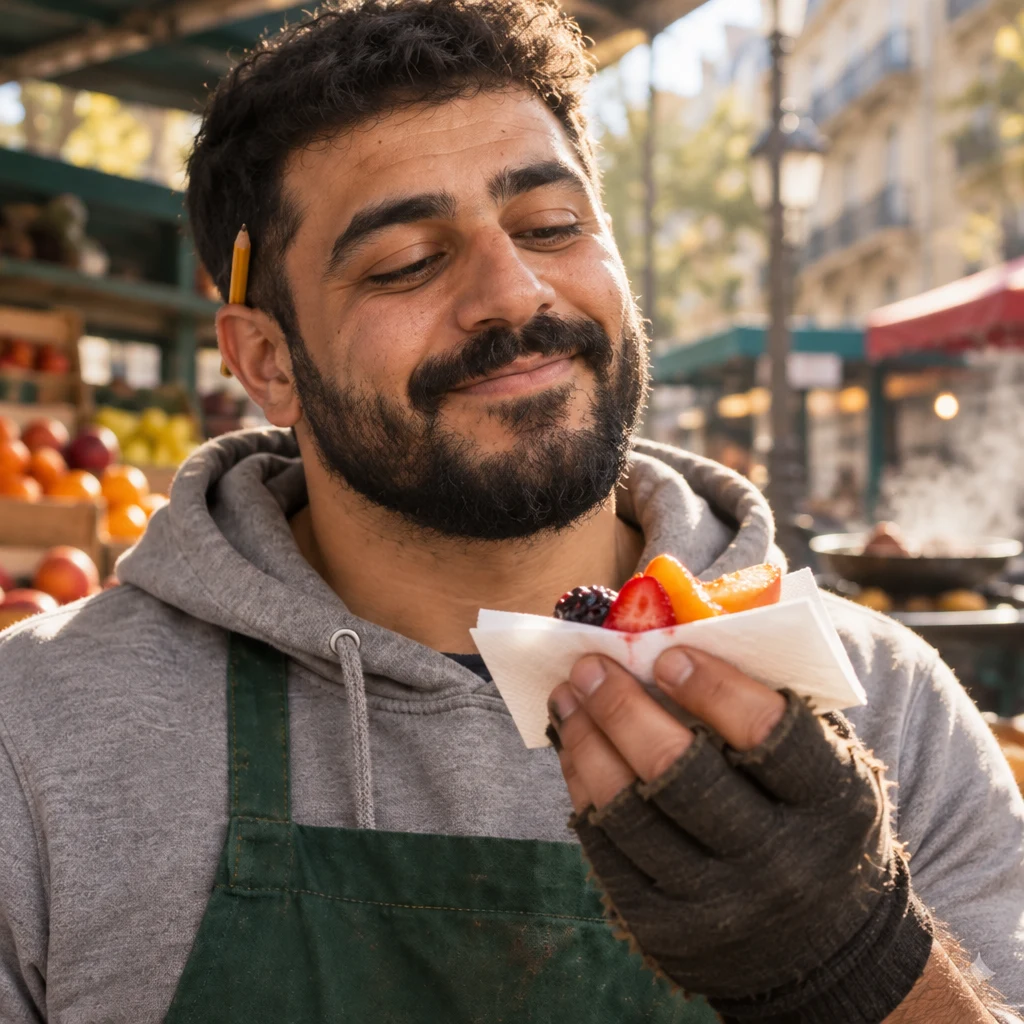
C'est mon plat préféré.
This is my favorite dish.
When to use it: Point at a dish you like more than the others.
Mon goes with plat because plat is a masculine noun.
Say it: The t at the end of plat is silent.

Je n'aime pas trop le sucré.
I don't like things too sweet.
When to use it: Say this when fruit or dessert is sweeter than you like.
Keep ne with pas even in this everyday line.
Say it: N'aime drops the e of ne before aime.
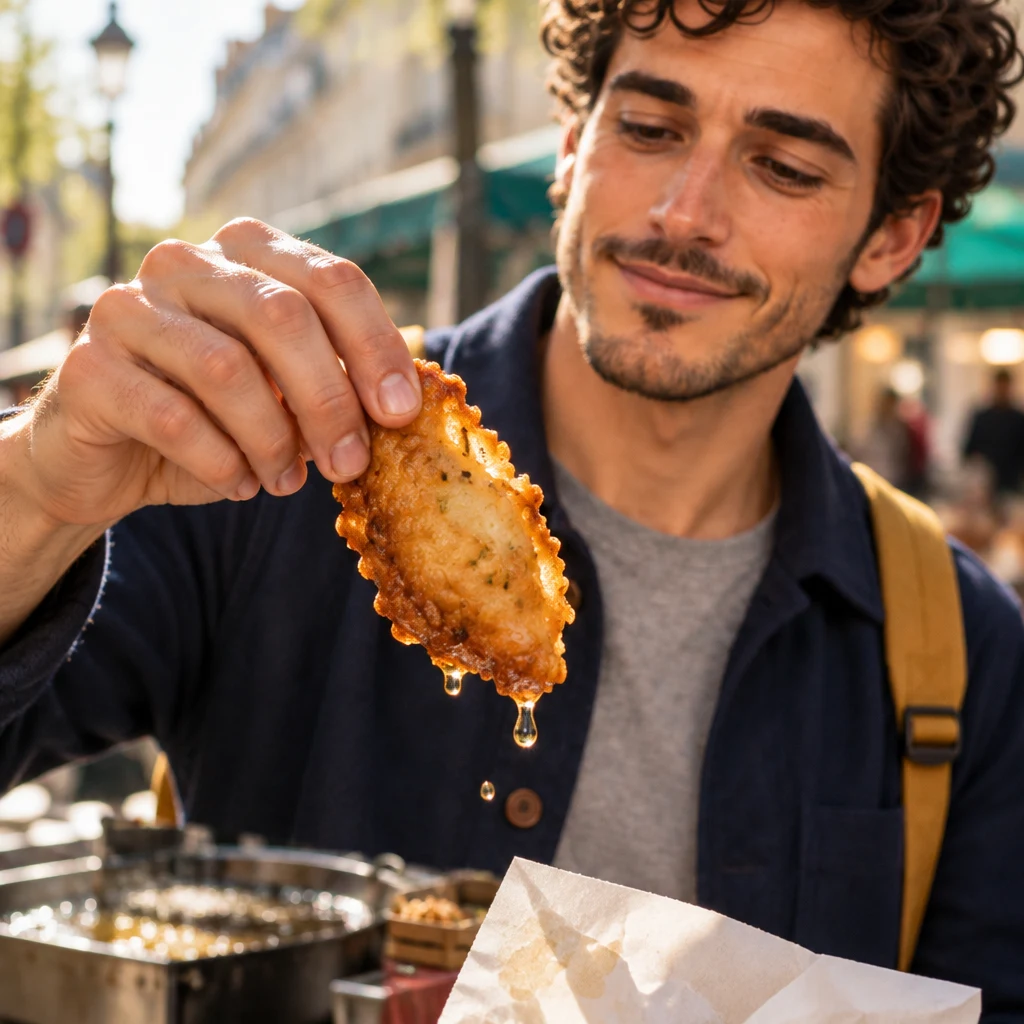
C'est trop gras.
This is too greasy.
When to use it: Say this when a dish sits in too much oil.
Trop before gras means too greasy, not just a bit fatty.
Say it: The s at the end of gras is silent.
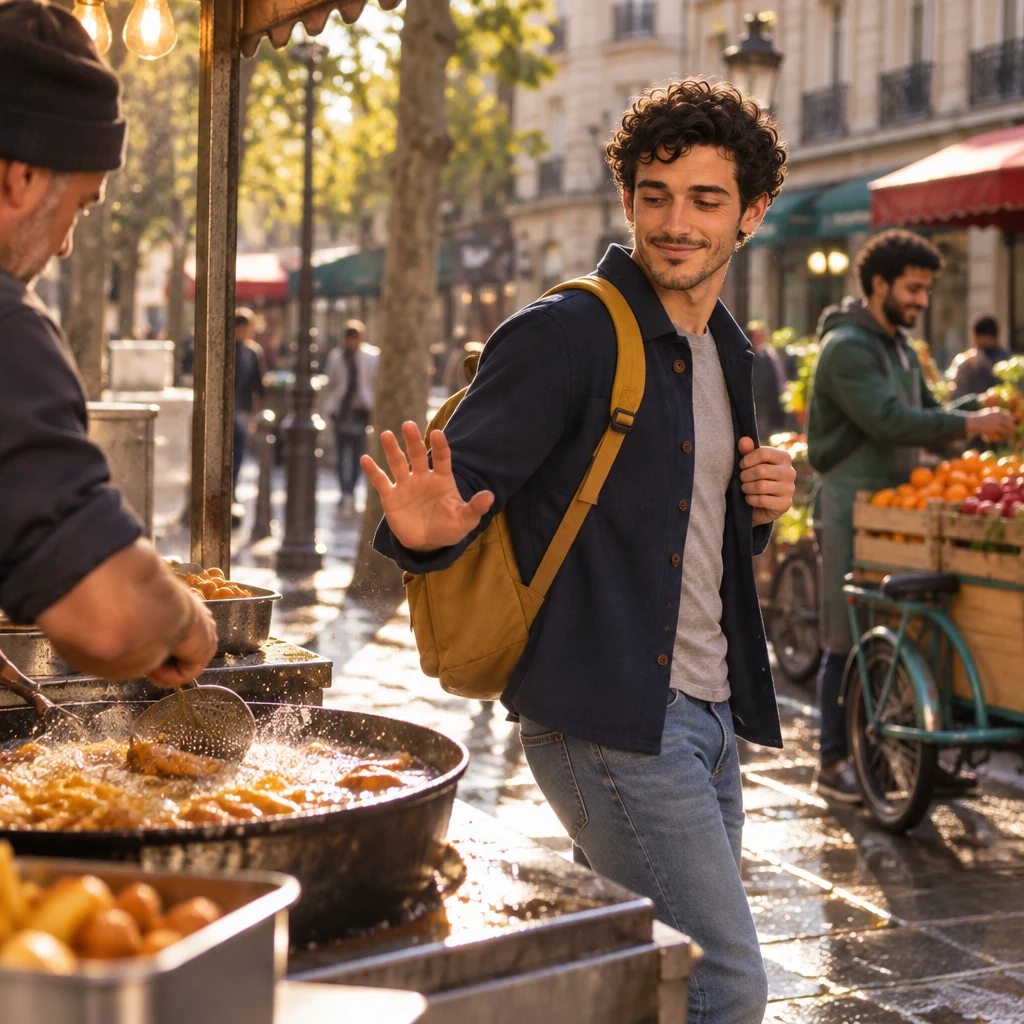
J'évite les plats frits.
I avoid fried food.
When to use it: Say this when you skip fried dishes on purpose.
Les plats frits names fried dishes as a group.
Say it: J'évite drops the e of je before évite.

C'est bon, mais ce n'est pas mon préféré.
It's good, but it's not my favorite.
When to use it: Praise a taste, then say another dish is your favorite.
Keep ne in n'est when you say it is not your favorite.
Say it: N'est drops the e of ne before est.
Story — too sweet, maybe
Watch Sam taste something at Karim's stall. He likes it, then asks if everything is this sweet.
The highlighted words are the lines you just learned. Turn on Show English if you need it.
- The Saturday market is loud. Karim's crates are open. Sam has already said hello.
 KarimSalut. Tu aimes quoi comme cuisine ?Hi. What kind of food do you like?
 SamLes plats simples, plutôt.Simple dishes, mostly.
- KarimAllez, goûte. C'est mon plat préféré.Go on, taste. This is my favorite dish.
- SamC'est bon, mais ce n'est pas mon préféré.It's good, but it's not my favorite.
- Karim laughs and holds out a darker piece, sticky with juice.
- KarimTu aimes ça ?Do you like that?
- SamJ'adore ça.I love that.
- SamTout est sucré comme ça ? Je n'aime pas trop le sucré.Is everything this sweet? I don't like things too sweet.
- KarimD'accord. Et les frites, là ?Okay. And the fries, over there?
- SamC'est trop gras. J'évite les plats frits.This is too greasy. I avoid fried food.
- KarimPrends des figues, alors.Take some figs, then.
- SamMerci beaucoup.Thank you very much.
Practice — sweet or greasy
Eleven short exercises wait here. You will listen, pick, fill a gap, and build a line.
They stay tiny, so the round moves fast.
0 of 11 done
What did you hear?
What did you hear?
Match the pairs
French
C'est mon plat préféré.Drop the English hereC'est trop gras.Drop the English hereJ'évite les plats frits.Drop the English hereEnglish
What do you say?
What do you say?
Karim's fruit is sticky-sweet. You do not want that much sugar.
Pick the reply
Karim says:
Pick the reply
C'est bon, hein ? Mais c'est l'autre, ton préféré ?
It's good, right? But the other one is your favorite?
And you reply with:
Fill the gap
Fill the gap
It's good, but it's not my favorite.
C'est bon, mais ce n'est pas mon ____.
Build the line
Build the line
This is my favorite dish.
.
Tap the words in order.
Swap the word
Swap the word
Oil pops at the next stall. Say you skip that kind of dish.
J'évite les plats ____.
What does it mean?
What does it mean?
C'est trop gras.
What do you say?
What do you say?
You point at a tart on the next stall and check if Karim likes it.
True or false?
True or false?
This means you love the taste you just had.
What do you say?
What do you say?
Karim puts figs in your bag and waits.
Say it — tell him what you skip
Now you're Sam at Karim's stall. When it's your turn, tap the microphone and speak the line.
Tap ▶ first if you want to hear the line. Your recording stays on your device.
- Sam (you)Ask Karim what kind of food he likes.
Ask Karim what kind of food he likes.
Tu aimes quoi comme cuisine ?
What kind of food do you like?
0 of 6 said
Recap — what you can say now
| French | English | Play |
|---|---|---|
| Tu aimes quoi comme cuisine ? | What kind of food do you like? | |
| C'est mon plat préféré. | This is my favorite dish. | |
| Je n'aime pas trop le sucré. | I don't like things too sweet. | |
| C'est trop gras. | This is too greasy. | |
| J'évite les plats frits. | I avoid fried food. | |
| C'est bon, mais ce n'est pas mon préféré. | It's good, but it's not my favorite. |
Save your progress — it’s free
Keep your place in the course and see which lines you’ve learned.
Want the next lesson in your inbox?
Get the next lesson by email, one a day.
Join the newsletterDaily lesson emails are coming soon. Newsletter subscribers get them first.
Keep practicing with Yak Cards
Want to keep these tastes handy? Grab the Yak Cards for this lesson and review them anywhere.
A quick round with the Yak Cards keeps favorite, too sweet, and too greasy ready for the market.
Open Yak Cards