Bienvenue! This short lesson helps you say and ask simple identity details in French—phone, email, name, where you study or work, birthday, and nationality. Practice by listening, repeating, and speaking aloud.
Level A1: In this lesson you will learn friendly, everyday phrases to give and ask for contact details (phone and email), say your first name and birthday, tell where you study or work, and state your nationality. This CEFR-aligned mini-lesson focuses on ready-to-use chunks you can repeat and use right away—think of it as a quick identity toolkit for meeting people (Lesson 49: small talk, big connections).
After this lesson you'll be able to:
Read and repeat nine essential identity phrases used in informal introductions.
Ask and give a phone number and email address in French.
Say your first name, birthday, where you study or work, and your nationality (Level A1).
Ready? Let's go!
When you tap play on phrases, we track your progress through this lesson.
1. Reading + Listening Practice
Hear core phrases, repeat aloud.
Mon numéro de téléphone, c'est ___.
My phone number is ___.
Meaning: My phone number is ___.
When to use: Use this neutral, natural phrase when you want to tell someone your phone number in everyday conversation.
Tip: Don’t forget the phrase « c'est »—just giving digits can sound abrupt; also French numbers often use spaces.
Mon numéro de téléphone, c'est 06 12 34 56 78.
My phone number is 06 12 34 56 78.
Si tu veux, mon numéro de téléphone, c'est celui-ci.
If you like, my phone number is this one.
C'est quoi, ton numéro de téléphone ?
What's your phone number?
Meaning: What's your phone number?
When to use: Ask this casually to a friend or classmate when you want their phone number. It's informal because of « ton ». For politeness, use the formal version.
C'est quoi, ton numéro de téléphone ?
What's your phone number?
Salut! C'est quoi, ton numéro de téléphone ?
Hi! What's your phone number?
Mon adresse e-mail, c'est ___.
My email address is ___.
Meaning: My email address is ___.
When to use: Use this neutral phrase to give your email address in casual or semi-formal contexts. « Adresse e-mail » is common in speech.
Tip: Remember to say the whole phrase; beginners sometimes only say the email and skip the lead-in phrase.
Mon adresse e-mail, c'est lucie@example.com.
My email address is lucie@example.com.
Pour m'envoyer les infos, mon adresse e-mail, c'est pierre@mail.fr.
To send me the info, my email is pierre@mail.fr.
C'est quoi, ton adresse e-mail ?
What's your email address?
Meaning: What's your email address?
When to use: Ask a friend or new contact informally for their email address using « ton ». For polite/formal situations choose a different phrasing.
C'est quoi, ton adresse e-mail ?
What's your email address?
Excuse-moi, c'est quoi, ton adresse e-mail ?
Excuse me, what's your email address?
J'étudie à ___.
I study at ___.
Meaning: I study at ___.
When to use: Say this when someone asks where you study. Remember that some place names need a different preposition (au, à la, à l').
Tip: Beginner error: always using only « à » — sometimes you must say « au » or « à la » depending on the place.
J'étudie à l'université de Lyon.
I study at the University of Lyon.
J'étudie à la faculté de lettres.
I study at the faculty of humanities.
Mon prénom, c'est ___.
My first name is ___.
Meaning: My first name is ___.
When to use: Give your first name when introducing yourself; this phrasing is friendly and common in speech.
Mon prénom, c'est Anna.
My first name is Anna.
Salut, mon prénom, c'est Karim.
Hi, my first name is Karim.
Mon anniversaire, c'est le ___.
My birthday is ___.
Meaning: My birthday is ___.
When to use: Use this phrase to say the date of your birthday, e.g. « le 12 mai ». It's a simple way to share your birthday.
Mon anniversaire, c'est le 3 mars.
My birthday is March 3rd.
Mon anniversaire, c'est le 14 juillet.
My birthday is July 14th.
Tu travailles où ?
Where do you work?
Meaning: Where do you work?
When to use: Ask this casually to someone you know or are getting to know. It's informal; use a formal alternative in polite situations.
Tu travailles où ?
Where do you work?
Tu travailles où en ce moment ?
Where are you working at the moment?
Je suis ___.
My nationality is ___.
Meaning: My nationality is ___.
When to use: Use this to say your nationality. Remember that nationality words change with gender (for example, « français » / « française »).
Tip: Pay attention to gender forms: many nationality adjectives change ending for feminine forms.
Je suis française.
I am French. (female speaker)
Je suis espagnol.
I am Spanish. (male speaker)
2. Conversational Listening Practice
Hear phrases in a real mini-conversation.
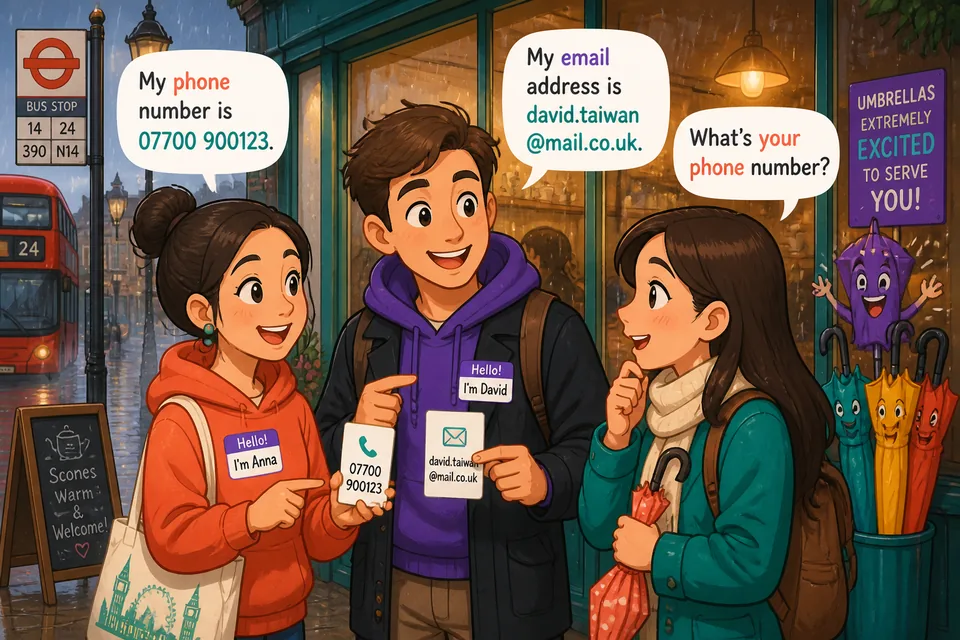
Anna and David meet after class and exchange basic contact and identity info.
Anna
Salut, je m'appelle Anna. Mon prénom, c'est Anna.
Hi, my name is Anna. My first name is Anna.
David
Enchanté ! C'est quoi, ton numéro de téléphone ?
Nice to meet you! What's your phone number?
Anna
Mon numéro de téléphone, c'est 06 99 88 77 66. Et mon adresse e-mail, c'est anna@mail.com.
My phone number is 06 99 88 77 66. And my email address is anna@mail.com.
David
Super. Tu étudies où ?
Great. Where do you study?
Anna
J'étudie à l'université. Je suis française.
I study at the university. I am French.
3. Guided Practice
Quizzes and matching to lock in meaning.
Which French sentence asks "What's your phone number?"
How do you say "My email address is ..." in French?
Which phrase means "Where do you work?"
Choose the French sentence that says "I study at ..."
What's your email address?
You want to ask a classmate for their email: ___.
I study at ___.
You're introducing yourself and want to say where you study: ___.
My birthday is ___.
A friend asks when your birthday is. You answer: ___.
Match the core phrases
Match the extra phrases
4. Speaking Practice
Say phrases yourself (mic/recording).
Recording stays on your device only. Check speech uses your browser's speech tools when available.