Bienvenue.
Welcome.
Bienvenue chez nous !
Welcome to our home!
Bienvenue à la réunion.
Welcome to the meeting.
Lesson 2 of 159

Goal: Quick phrases to welcome people and start a chat
Free French lessons with guided practice, audio, and speaking support.
Welcome back — nice to see you on Lesson 2! This short lesson helps you open conversations smoothly with simple, natural phrases. Listen, repeat, and try them out aloud.
Level A1: In this lesson you'll practice six friendly opening phrases in French: welcoming someone, a weather comment, saying how you want to be called, asking if someone speaks English, greeting someone you know, and returning a question with “And you?”. CEFR-aligned and focused on real openings you'll use right away.
After this lesson you'll be able to:

Ready? Let's go!
When you tap play on phrases, we track your progress through this lesson.
Hear core phrases, repeat aloud.
Bienvenue.
Welcome.
Il fait beau aujourd'hui.
Nice weather today.
Appelle-moi ___.
Call me ___.
Tu parles anglais ?
Do you speak English?
Ça fait plaisir de te voir.
Good to see you.
Et toi ?
And you?
Hear phrases in a real mini-conversation.
A short meeting between two acquaintances at a small event.
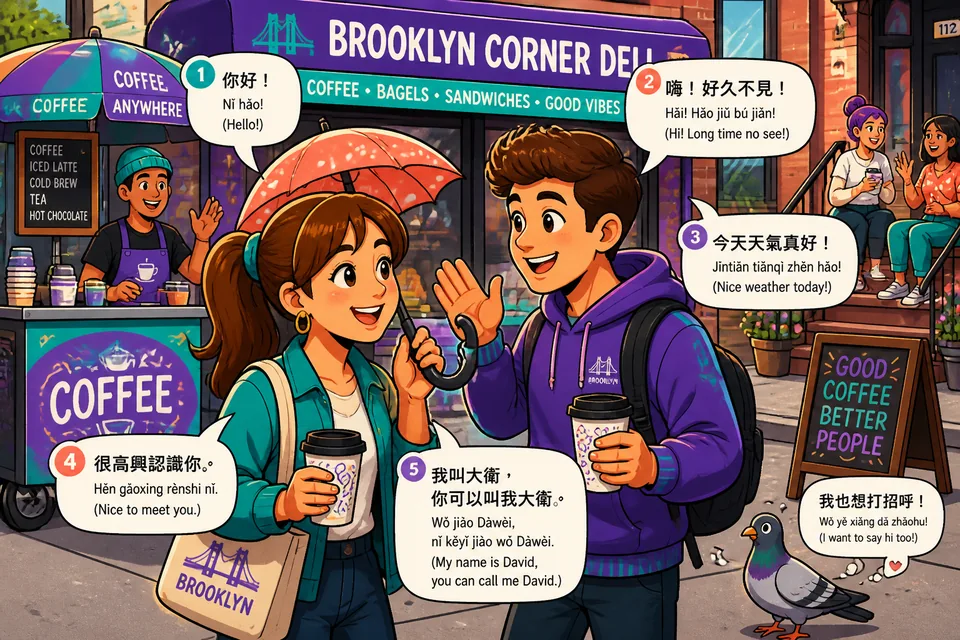

Anna
Bienvenue.
Welcome.

David
Merci. Il fait beau aujourd'hui.
Thanks. Nice weather today.
Anna
Ça fait plaisir de te voir.
Good to see you.
David
Appelle-moi David.
Call me David.
Anna
Tu parles anglais ?
Do you speak English?
David
Et toi ?
And you?
Quizzes and matching to lock in meaning.
Nous sommes arrivés à la fête. - ___ !
Le soleil brille et tout le monde est dehors. - ___
Je préfère que mes amis utilisent mon petit nom. - ___ Marc.
Say phrases yourself (mic/recording).
Recording stays on your device only. Check speech uses your browser's speech tools when available.
Say this phrase out loud:
Bienvenue.
Welcome.
Say this phrase out loud:
Il fait beau aujourd'hui.
Nice weather today.
Say this phrase out loud:
Appelle-moi ___.
Call me ___.
Say this phrase out loud:
Tu parles anglais ?
Do you speak English?
Say this phrase out loud:
Ça fait plaisir de te voir.
Good to see you.
Say this phrase out loud:
Et toi ?
And you?