
New here? This is lesson 9 of a free 240-lesson French course.
Have a good evening in French
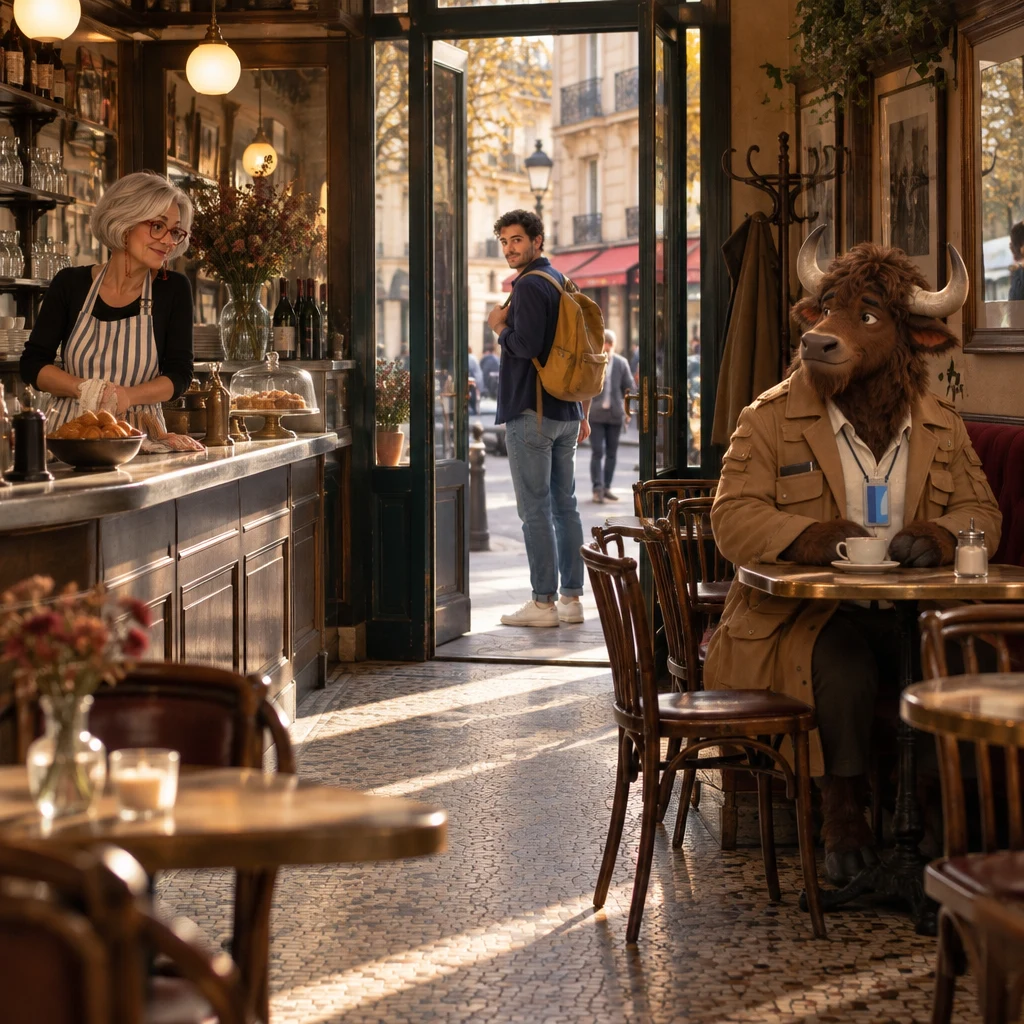
Later the same day, Sam is leaving Café des Tilleuls. Odile sends him off from the zinc counter.
A polite yak is still at the next table. He says he will see Sam later, then does not stand.
By the end, you'll wish someone a good day, evening, or weekend, say see you later today, and let a friend go.
Bonne journée is a goodbye as you leave. It is never the first hello at the door.
By the end of this lesson
Wish someone a good day, evening or weekend as you leave, and say you'll see them later today.
- Bonne journée.Have a good day
- Bonne soirée.Have a good evening
- Bon week-end.Have a good weekend
- À tout à l'heure.See you later today
- Je te laisse.I'll let you go
- Toi aussi.You too
Scene — later the same day
Same Friday, later on rue des Tilleuls. Sam has his mustard backpack on and is leaving Café des Tilleuls.
Odile watches from the zinc counter. The window table still has its blank brass sign.
Gaspard sits at the table next to it on two chairs. His café crème is still full and cold.
Learn — a good day and later
Six short lines cover a good day, a good evening, a good weekend, see you later today, and two friend lines.
You'll also get I'll let you go, and you too.

Bonne journée.
Have a good day
When to use it: Say this as you leave a shop or café in the day.
Learn it as one piece for a daytime goodbye.

Bonne soirée.
Have a good evening
When to use it: Say this as you leave once it is evening.
Learn it as one piece for an evening goodbye.

Bon week-end.
Have a good weekend
When to use it: Say this as you leave on Friday or Saturday.
Learn it as one piece for a weekend goodbye.
Say it: The on in Bon is a nasal sound.

À tout à l'heure.
See you later today
When to use it: Say this when you will see them later today.
Learn it as one piece for later the same day.
Say it: In « l'heure », the a of la is elided before heure.

Je te laisse.
I'll let you go
When to use it: Say this to a friend when you end the chat.
Learn it as one piece with a friend, not staff.

Toi aussi.
You too
When to use it: Say this back to a friend who wished you well.
Learn it as one piece to return a goodbye.
Story — he does not stand
Watch Sam leave the café later the same day. Odile sends him off, and Gaspard stays seated in his chair.
The highlighted words are the lines you just learned. Turn on Show English if you need it.
- The light is lower. Odile looks up from the counter.
 OdileBonne journée.Have a good day.
 SamBonne journée.Have a good day.
- Gaspard looks at the door, then at his cold café crème.
 GaspardBonne soirée.Have a good evening.
- SamToi aussi.You too.
- GaspardÀ tout à l'heure.See you later today.
- He does not stand. The window table stays empty.
- SamJe te laisse.I'll let you go.
- Sam is at the door. Odile calls after him.
- OdileBon week-end.Have a good weekend.
- SamBon week-end. Au revoir.Have a good weekend. Goodbye.
Practice — day or weekend
Ten quick exercises wait here. You'll listen, pick, match, fill a gap, and build a line.
They stay tiny, so the round moves fast.
0 of 10 done
What did you hear?
What did you hear?
What do you say?
What do you say?
You are leaving the café in the early afternoon. Odile looks at you.
What does it mean?
What does it mean?
Bonne soirée.
Match the pairs
French
Bonne journée.Drop the English hereBonne soirée.Drop the English hereBon week-end.Drop the English hereEnglish
Fill the gap
Fill the gap
See you later today
À tout à ____.
Build the line
Build the line
I'll let you go
.
Tap the words in order.
Swap the word
Swap the word
You are leaving your friend Gaspard at his table.
Je ____ laisse.
Pick the reply
Gaspard says:
Pick the reply
Bonne soirée.
Have a good evening.
And you reply with:
Fill the gap
Fill the gap
Have a good weekend
Bon ____-end.
What do you say?
What do you say?
You walk into the café after dark. Odile looks up and waits.
Say it — say it as you leave
Now you're Sam leaving the café later the same day. When it's your turn, tap the microphone and speak the line.
Tap ▶ first if you want to hear the line. Your recording stays on your device.
- OdileBonne journée.Have a good day.
- Sam (you)Return her goodbye as you leave. It is still day.
Return her goodbye as you leave. It is still day.
Bonne journée.
Have a good day
0 of 5 said
Recap — what you can say now
| French | English | Play |
|---|---|---|
| Bonne journée. | Have a good day | |
| Bonne soirée. | Have a good evening | |
| Bon week-end. | Have a good weekend | |
| À tout à l'heure. | See you later today | |
| Je te laisse. | I'll let you go | |
| Toi aussi. | You too |
Save your progress — it’s free
Keep your place in the course and see which lines you’ve learned.
Want the next lesson in your inbox?
Get the next lesson by email, one a day.
Join the newsletterDaily lesson emails are coming soon. Newsletter subscribers get them first.
Keep practicing with Yak Cards
Want to keep these goodbyes handy? Grab the Yak Cards for this lesson and review them anywhere.
A quick round with the Yak Cards each day keeps your leaving lines ready for the door.
Open Yak Cards