Quick and calm — that's the idea. In this short lesson you'll hear, repeat, and use essential emergency phrases in French.
Level A2: Lesson 137 — in this CEFR-aligned mini-lesson you'll practice nine short French phrases used in emergencies (for example: "Reste calme.", "J'ai besoin d'une ambulance."). We'll listen, repeat, and do quick quizzes so you can use these lines if something urgent happens.
After this lesson you'll be able to:
Understand and say nine basic emergency phrases in French.
Recognize when to use each phrase in urgent situations.
Practice short role-play lines to ask for help and describe injuries.
Ready? Let's go!
When you tap play on phrases, we track your progress through this lesson.
1. Reading + Listening Practice
Hear core phrases, repeat aloud.
Reste calme.
Stay calm.
Meaning: Stay calm.
When to use: Use when someone is panicking and you need them to relax a little so you can help or call for assistance.
Tip: Don’t say 'Restez calme' only if addressing one close friend informally; use 'Restez calme' for formal/plural.
Reste calme, j'appelle les secours.
Stay calm, I'll call emergency services.
Reste calme, respire lentement.
Stay calm, breathe slowly.
Sors tout de suite.
Get out now.
Meaning: Get out now.
When to use: Say this when people must leave a dangerous place immediately (fire, gas leak, unstable structure).
Il y a de la fumée — sors tout de suite !
There's smoke — get out now!
Sors tout de suite de la voiture.
Get out of the car right now.
Ne touche pas à ça.
Don't touch it.
Meaning: Don't touch it.
When to use: Use this to warn someone not to touch an object that could be dangerous (broken glass, a wire, a hot surface).
Ne touche pas à ça — c'est très chaud.
Don't touch that — it's very hot.
Ne touche pas à ça, c'est peut-être cassé.
Don't touch that, it might be broken.
Il y a eu un accident.
There was an accident.
Meaning: There was an accident.
When to use: Report that an accident happened when you call someone for help or inform responders on the scene.
Il y a eu un accident sur la route.
There was an accident on the road.
Il y a eu un accident devant le magasin.
There was an accident in front of the shop.
Je n'arrive pas à bouger mon ___.
I can't move my ___.
Meaning: I can't move my ___.
When to use: Use this to tell a responder that a specific body part won't move after an injury. Add the body part: 'bras', 'jambe', etc.
Tip: Remember to change 'mon' to 'ma' when the body part is feminine (e.g., 'ma jambe').
Je n'arrive pas à bouger mon bras.
I can't move my arm.
Après la chute, je n'arrive pas à bouger ma jambe.
After the fall, I can't move my leg.
J'ai besoin d'une ambulance.
I need an ambulance.
Meaning: I need an ambulance.
When to use: Say this when someone needs urgent medical transport right away.
C'est grave — j'ai besoin d'une ambulance.
It's serious — I need an ambulance.
J'ai besoin d'une ambulance pour la victime.
I need an ambulance for the victim.
J'ai mal ici.
It hurts here.
Meaning: It hurts here.
When to use: Point to a place on your body and say this to show where you feel pain.
J'ai mal ici, au dos.
It hurts here, in my back.
J'ai mal ici — c'est mon épaule.
It hurts here — it's my shoulder.
Je saigne.
I'm bleeding.
Meaning: I'm bleeding.
When to use: Use to tell someone that you have an active wound that is bleeding and may need urgent care.
Je saigne beaucoup, aidez-moi.
I'm bleeding a lot, help me.
Je saigne de la tête.
I'm bleeding from my head.
Mon ___ a disparu.
My ___ is missing.
Meaning: My ___ is missing.
When to use: Use to report a missing person or an essential item; replace ___ with the noun (sac, enfant, passeport).
Mon sac a disparu après l'accident.
My bag went missing after the accident.
Mon portefeuille a disparu quand il y a eu la panne.
My wallet is missing when the outage happened.
2. Conversational Listening Practice
Hear phrases in a real mini-conversation.
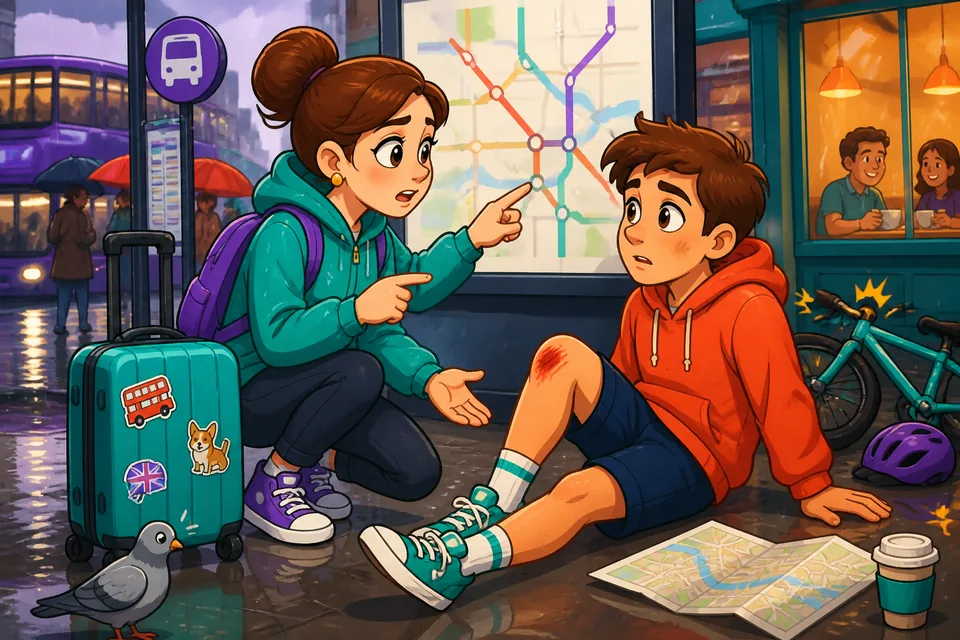
Anna finds David injured after a small crash.
Anna
Il y a eu un accident.
There was an accident.
David
Je saigne et j'ai mal ici.
I'm bleeding and it hurts here.
Anna
Reste calme. J'appelle les secours. J'ai besoin d'une ambulance ?
Stay calm. I'll call help. Do we need an ambulance?
David
Oui, je n'arrive pas à bouger mon bras.
Yes, I can't move my arm.
Anna
Ne touche pas à ça, c'est dangereux.
Don't touch that, it's dangerous.
3. Guided Practice
Quizzes and matching to lock in meaning.
Which French phrase means 'Call for an ambulance' or 'I need an ambulance'?
You see someone near broken glass about to pick it up. What do you say?
Which phrase reports that "something bad already happened"?
A friend hurts themselves and points at their chest. Which short phrase fits to show the pain location?
The house is filling with smoke. You shout to everyone: Get out now.
The house is filling with smoke. You shout to everyone: ___.
Someone has a deep cut and tells you about the injury: I'm bleeding.
Someone has a deep cut and tells you about the injury: ___.
A child moves toward an exposed electrical wire and you warn them: Don't touch it.
A child moves toward an exposed electrical wire and you warn them: ___.
Match the core phrases
Match the extra phrases
4. Speaking Practice
Say phrases yourself (mic/recording).
Recording stays on your device only. Check speech uses your browser's speech tools when available.