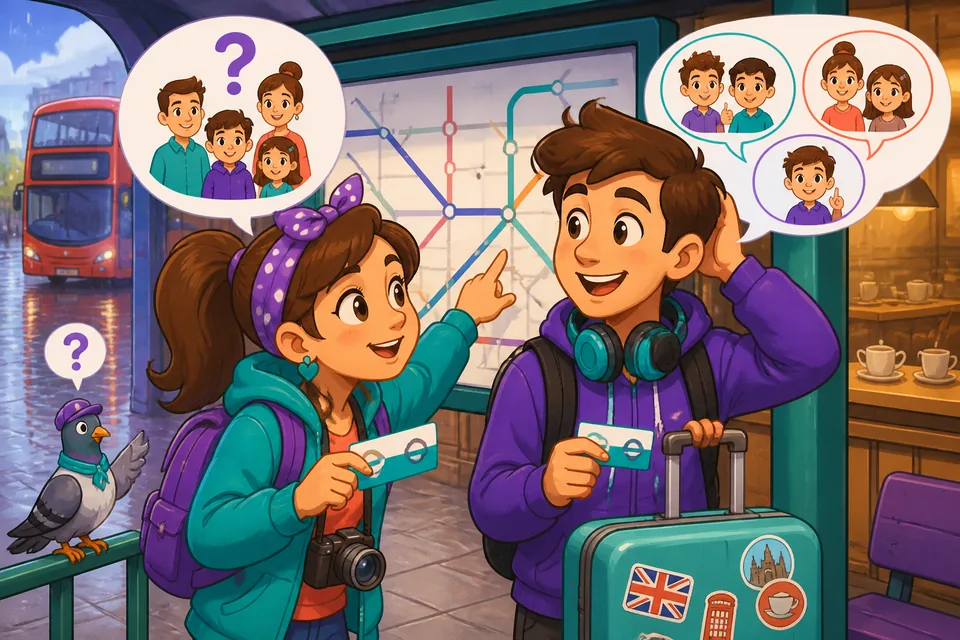
Welcome to Lesson 52 — a cozy dive into talking about family. We'll practice simple questions and short answers you can use right away.
Keep it friendly: listen, repeat, and try the speaking prompts to build confidence.
Level A2: In this lesson you'll practice common family phrases — asking about siblings, who you live with, marital status, and family size. This CEFR-aligned lesson focuses on ready-to-use questions and short answers you can repeat and use in conversation. Lesson 52 has short dialogues and speaking prompts so you can speak about your family with ease.
After this lesson you'll be able to:
Ask and answer 'Do you have siblings?' and 'Who do you live with?'
Say how many brothers/sisters or people are in your family
Describe basic family facts: only child, married, who someone is
Practice speaking aloud simple family phrases (Level A2)
Ready? Let's go!
When you tap play on phrases, we track your progress through this lesson.
1. Reading + Listening Practice
Hear core phrases, repeat aloud.
Tu as des frères et sœurs ?
Do you have any brothers or sisters?
Meaning: Do you have any brothers or sisters?
When to use: Ask informally when you want to know if someone has siblings.
Tu as des frères et sœurs ?
Do you have any brothers or sisters?
Tu as des frères et sœurs ou tu es enfant unique ?
Do you have siblings or are you an only child?
J'ai ___ frères et ___ sœurs.
I have ___ brothers and ___ sisters.
Meaning: I have ___ brothers and ___ sisters.
When to use: Give numbers of brothers and sisters when someone asks about siblings.
Tip: Beginners sometimes forget they can say only the part needed (e.g., 'J'ai deux frères.').
J'ai deux frères et une sœur.
I have two brothers and one sister.
J'ai zéro frère et trois sœurs.
I have zero brothers and three sisters.
Je suis enfant unique.
I'm an only child.
Meaning: I'm an only child.
When to use: Say this when you have no brothers or sisters.
Je suis enfant unique.
I'm an only child.
Je suis enfant unique, donc j'ai grandi seul.
I'm an only child, so I grew up alone.
C'est mon ___.
He is my ___.
Meaning: He is my ___.
When to use: Identify a male family member (father, brother, cousin, etc.).
Tip: Watch 'mon' vs 'ma' — use 'mon' for masculine words; learners sometimes use 'ma' incorrectly.
C'est mon frère.
He is my brother.
C'est mon père, il habite près d'ici.
He is my father; he lives nearby.
C'est ma ___.
She is my ___.
Meaning: She is my ___.
When to use: Identify a female family member (mother, sister, cousin, etc.).
C'est ma mère.
She is my mother.
C'est ma cousine; elle est drôle.
She is my cousin; she is funny.
Tu habites avec qui ?
Who do you live with?
Meaning: Who do you live with?
When to use: Ask informally about someone's household members.
Tu habites avec qui ?
Who do you live with?
Tu habites avec qui chez toi ?
Who do you live with at your place?
J'habite avec mon/ma ___.
I live with my ___.
Meaning: I live with my ___.
When to use: Say which family member(s) you live with (use mon/ma/mes correctly).
J'habite avec ma sœur.
I live with my sister.
J'habite avec mon père et mes parents le week-end.
I live with my father and my parents on weekends.
Tu as des enfants ?
Do you have children?
Meaning: Do you have children?
When to use: Ask someone if they have children in an informal setting.
Tu as des enfants ?
Do you have children?
Tu as des enfants ou pas encore ?
Do you have children yet or not?
Je suis marié(e).
I'm married.
Meaning: I'm married.
When to use: State your marital status (use marié or mariée depending on gender).
Tip: Remember to write marié or mariée for gender in writing; pronunciation is the same.
Je suis marié(e).
I'm married.
Je suis mariée depuis cinq ans.
I've been married for five years.
Il y a combien de personnes dans ta famille ?
How many people are in your family?
Meaning: How many people are in your family?
When to use: Ask about total family size informally.
Il y a combien de personnes dans ta famille ?
How many people are in your family?
Il y a combien de personnes dans ta famille, en tout ?
How many people are in your family, total?
On est ___ dans ma famille.
There are ___ people in my family.
Meaning: There are ___ people in my family.
When to use: Give the total number of people in your family.
On est quatre dans ma famille.
There are four of us in my family.
On est six dans ma famille, y compris les grands-parents.
There are six of us in my family, including grandparents.
Ma famille est ___.
My family is ___.
Meaning: My family is ___.
When to use: Describe your family using a short adjective (grande, petite, proche, unie...).
Ma famille est petite.
My family is small.
Ma famille est très proche; on parle souvent.
My family is very close; we talk often.
Mes parents sont ___.
My parents are ___.
Meaning: My parents are ___.
When to use: Describe your parents' relationship status or situation (mariés, séparés, ensemble...).
Mes parents sont mariés.
My parents are married.
Mes parents sont séparés depuis longtemps.
My parents have been separated for a long time.
2. Conversational Listening Practice
Hear phrases in a real mini-conversation.
Anna asks David about siblings and household.
Anna
Tu as des frères et sœurs ?
Do you have any brothers or sisters?
David
J'ai deux frères et une sœur.
I have two brothers and one sister.
Anna
Tu habites avec qui ?
Who do you live with?
David
J'habite avec ma mère et mon frère.
I live with my mother and my brother.
Anna
Il y a combien de personnes dans ta famille ?
How many people are in your family?
David
On est quatre dans ma famille.
There are four of us in my family.
3. Guided Practice
Quizzes and matching to lock in meaning.
Which French question means 'Who do you live with?'
What does 'Je suis enfant unique.' mean?
Choose the best reply to 'Il y a combien de personnes dans ta famille ?'
Which French sentence means 'She is my mother.'?
Anna asks: 'How many people are in your family?' David answers: 'There are three of us in my family.'
Anna asks: 'Il y a combien de personnes dans ta famille ?' David answers: '___'
If someone has no brothers or sisters, they can say: 'I'm an only child.'
If someone has no brothers or sisters, they can say: '___'
To say 'I live with my sister' choose: 'J'habite avec ma sœur.'
To say 'I live with my sister' choose: '___'
Match the core phrases
Match the extra phrases
4. Speaking Practice
Say phrases yourself (mic/recording).
Recording stays on your device only. Check speech uses your browser's speech tools when available.