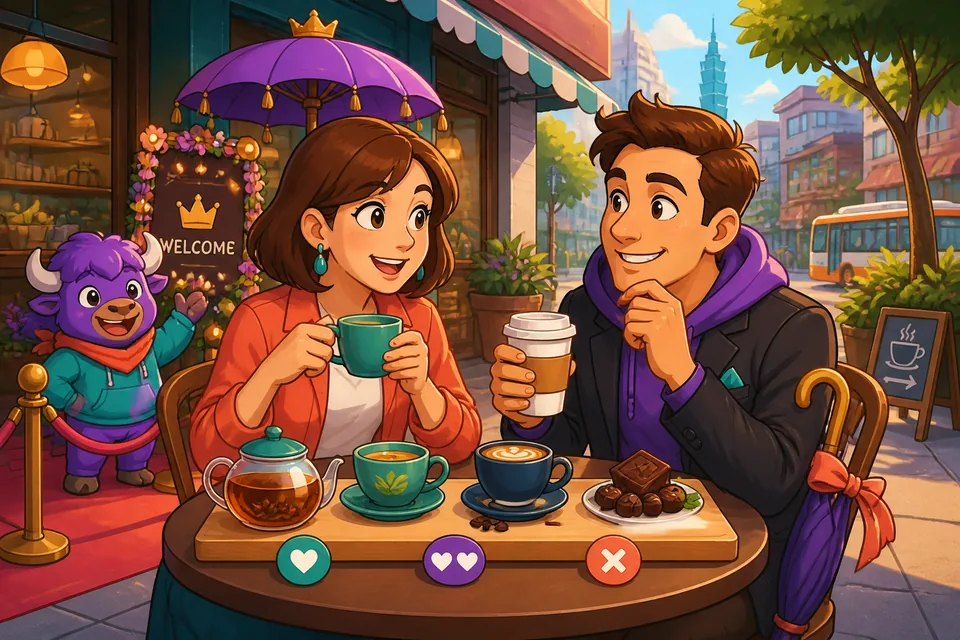
Ready to tune your taste vocabulary? In this short lesson you'll practice friendly, natural ways to say what you like and don't like in French.
Have fun — you'll hear, repeat, and use these phrases in a tiny conversation.
Level A2: In this lesson you’ll learn common ways to talk about preferences: saying you like, love, prefer, or can’t stand something, and asking someone else what they prefer. We practice phrases like J'aime bien, J'aime beaucoup, Je préfère ___ à ___, Je déteste, and Je suis pas très fan de — useful for everyday conversation. This CEFR-aligned set is Lesson 32 and focuses on subtle differences between like, love, and dislike.
After this lesson you'll be able to:
Understand and use common spoken phrases for likes and dislikes.
Ask and answer simple preference questions (tu aimes bien? / Tu préfères ___ ou ___ ?).
Practice Level A2 vocabulary for stronger and milder opinions.
Ready? Let's go!
When you tap play on phrases, we track your progress through this lesson.
1. Reading + Listening Practice
Hear core phrases, repeat aloud.
J'aime bien ___.
I like ___.
Meaning: I like ___.
When to use: Use J'aime bien + a noun or verb when you want to say you like something in a normal, friendly way.
J'aime bien le chocolat.
I like chocolate.
J'aime bien danser le samedi.
I like dancing on Saturdays.
J'aime beaucoup ___.
I really like ___.
Meaning: I really like ___.
When to use: Use J'aime beaucoup to show a stronger liking than J'aime bien; works with activities or things.
J'aime beaucoup les films français.
I really like French films.
J'aime beaucoup cuisiner le weekend.
I really like cooking on weekends.
J'aime pas ___.
I don't like ___.
Meaning: I don't like ___.
When to use: Use J'aime pas in everyday spoken French to say you don’t like something (casual). For more formal speech say Je n'aime pas ___.
Tip: Beginner learners sometimes try to use 'ne' in casual speech; both forms are fine but spoken French often drops 'ne'.
J'aime pas le poisson.
I don't like fish.
J'aime pas me lever tôt.
I don't like getting up early.
Je suis pas très fan de ___.
I'm not a big fan of ___.
Meaning: I'm not a big fan of ___.
When to use: Use Je suis pas très fan de when you want to say a mild dislike politely in casual conversations.
Tip: Learners sometimes add 'ne' in very formal contexts; spoken French commonly drops it: Je suis pas très fan de...
Je suis pas très fan de la pluie.
I'm not a big fan of rain.
Je suis pas très fan des émissions de télé-réalité.
I'm not a big fan of reality TV shows.
Je préfère ___.
I prefer ___.
Meaning: I prefer ___.
When to use: Use Je préfère to state a simple preference for a thing, activity, or option.
Je préfère le thé.
I prefer tea.
Je préfère travailler le matin.
I prefer working in the morning.
Je préfère ___ à ___.
I prefer ___ to ___.
Meaning: I prefer ___ to ___.
When to use: Use Je préfère ___ à ___ when you compare two options and say which one you like more.
Tip: A common error is using 'que' instead of 'à' before the second option; use 'à' here: Je préfère X à Y.
Je préfère le thé au café.
I prefer tea to coffee.
Je préfère lire à regarder la télé.
I prefer reading to watching TV.
Mon ___ préféré, c'est ___.
My favorite ___ is ___.
Meaning: My favorite ___ is ___.
When to use: Use Mon ___ préféré, c'est ___ to name a favorite thing in a specific category (sport, color, film, etc.). Adjust gender: Ma ... préférée for feminine nouns.
Mon film préféré, c'est Amélie.
My favorite movie is Amélie.
Mon sport préféré, c'est le tennis.
My favorite sport is tennis.
Tu aimes bien ___ ?
Do you like ___?
Meaning: Do you like ___?
When to use: Use Tu aimes bien ___ ? to ask informally whether someone likes something (use articles with nouns: le, la, les).
Tu aimes bien le fromage ?
Do you like cheese?
Tu aimes bien chanter ?
Do you like singing?
Tu préfères ___ ou ___ ?
Which do you prefer, ___ or ___?
Meaning: Which do you prefer, ___ or ___?
When to use: Use Tu préfères ___ ou ___ ? to ask someone to choose between two options in an informal situation.
Tu préfères le matin ou le soir ?
Do you prefer morning or evening?
Tu préfères voyager en train ou en avion ?
Do you prefer to travel by train or by plane?
J'adore ___.
I love ___.
Meaning: I love ___.
When to use: Use J'adore to express a strong liking for an activity, thing, or non-romantic affection for a person.
J'adore voyager.
I love traveling.
J'adore le fromage français.
I love French cheese.
J'aime bien ___.
I enjoy ___.
Meaning: I enjoy ___.
When to use: J'aime bien can also express enjoying an activity; use it with an infinitive verb or a noun.
J'aime bien écouter de la musique.
I enjoy listening to music.
J'aime bien les nouvelles séries.
I enjoy the new series.
Je déteste ___.
I hate ___.
Meaning: I hate ___.
When to use: Use Je déteste to express a strong dislike. It's common and direct in everyday speech.
Je déteste les araignées.
I hate spiders.
Je déteste attendre.
I hate waiting.
Je ne supporte pas ___.
I can't stand ___.
Meaning: I can’t stand ___.
When to use: Use Je ne supporte pas ___ for a very strong dislike. In casual speech people may drop 'ne' and say Je supporte pas ___.
Je ne supporte pas le bruit tard la nuit.
I can't stand noise late at night.
Je ne supporte pas les mensonges.
I can't stand lies.
2. Conversational Listening Practice
Hear phrases in a real mini-conversation.
Anna and David compare tea, coffee, and chocolate
Anna
Tu préfères le thé ou le café ?
Do you prefer tea or coffee?
David
Je préfère le thé au café.
I prefer tea to coffee.
Anna
Ah bon ? Tu aimes bien le café pourtant ?
Oh really? You like coffee, though?
David
J'aime pas le café le matin. Je suis pas très fan du café fort.
I don't like coffee in the morning. I'm not a big fan of strong coffee.
Anna
Moi, j'adore le chocolat.
Me, I love chocolate.
David
Moi aussi, j'aime beaucoup le chocolat.
Me too, I really like chocolate.
3. Guided Practice
Quizzes and matching to lock in meaning.
Which French phrase means 'I'm not a big fan of ___'?
Which phrase would you use to compare two options (X to Y)?
Which French phrase means 'I can't stand ___' (very strong dislike)?
Which phrase is used to say 'My favorite film is ...'?
Anna: Do you like cheese? David: I like cheese.
Anna: Do you like cheese? David: ___.
Anna: Coffee or tea? David: I prefer tea to coffee.
Anna: Coffee or tea? David: ___.
Anna: What’s your favorite sport? David: My favorite sport is tennis.
Anna: What’s your favorite sport? David: ___.
Match the core phrases
Match the extra phrases
4. Speaking Practice
Say phrases yourself (mic/recording).
Recording stays on your device only. Check speech uses your browser's speech tools when available.