Nice work getting this far — lesson 27! In this short lesson you'll learn friendly follow-up questions that keep stories moving. Keep it light: listen, repeat, then try them aloud.
Level A2: This lesson focuses on follow-up questions you can use when someone tells a story or describes an experience — questions about duration, sequence, details, reasons, and the best part. You'll hear short phrases, try a mini conversation, and practice with quizzes and speaking prompts. CEFR-aligned and ready for real chat.
After this lesson you'll be able to:
Recognize and use common French follow-up questions to ask for more details.
Practice asking about duration, sequence, difficulty, reasons, and examples.
Build confidence asking quick, natural questions in everyday conversation (A2).
Ready? Let's go!
When you tap play on phrases, we track your progress through this lesson.
1. Reading + Listening Practice
Hear core phrases, repeat aloud.
Ça a duré combien de temps ?
How long did it last?
Meaning: How long did it last?
When to use: Use this to ask about the duration of an event, activity, or situation someone just described.
Tip: Don't mix with « Depuis combien de temps ? » which asks how long something has been happening (ongoing).
Le film était long. Ça a duré combien de temps ?
The movie was long. How long did it last?
Vous avez attendu au téléphone — ça a duré combien de temps ?
You waited on the phone — how long did that last?
Et après, tu as fait quoi ?
What did you do after that?
Meaning: What did you do after that?
When to use: Use this in a personal story to ask what happened next or what the person did afterward.
Tip: Beginners sometimes say word-for-word 'Et après vous avez fait quoi ?' — keep natural spoken order with « Et après, tu as fait quoi ? »
J'ai fini le travail. Et après, tu as fait quoi ?
I finished work. And after that, what did you do?
Elle a quitté la réunion; et après, tu as fait quoi ?
She left the meeting; what did you do after that?
C’était facile ou difficile ?
Was it easy or hard?
Meaning: Was it easy or hard?
When to use: Ask this when you want to know if a task or situation was simple or difficult.
Tu as réparé la voiture toi-même ? C'était facile ou difficile ?
You fixed the car yourself? Was it easy or hard?
Le test ? C'était facile ou difficile pour toi ?
The test? Was it easy or hard for you?
C’était quoi le meilleur moment ?
What was the best part?
Meaning: What was the best part?
When to use: Ask this to find out the most enjoyable or memorable moment of an experience.
Tu as voyagé en Italie. C'était quoi le meilleur moment ?
You traveled to Italy. What was the best part?
Pendant le spectacle, c'était quoi le meilleur moment pour toi ?
During the show, what was the best moment for you?
Comme quoi ?
Like what?
Meaning: Like what?
When to use: Use this short phrase to ask for a concrete example after someone says something general.
Il y a beaucoup de problèmes. — Comme quoi ?
There are a lot of problems. — Like what?
Tu as aidé les voisins. — Comme quoi ?
You helped the neighbors. — Like what?
Comment tu sais ?
How do you know?
Meaning: How do you know?
When to use: Ask this when you want the source or reason for someone's claim or knowledge.
Il dit qu'il va pleuvoir. — Comment tu sais ?
He says it's going to rain. — How do you know?
Tu es sûr que le train est à l'heure ? Comment tu sais ?
Are you sure the train is on time? How do you know?
Pourquoi ça ?
Why is that?
Meaning: Why is that?
When to use: Use this to ask briefly for the reason behind a statement someone just made.
Je n'aime pas ce café. — Pourquoi ça ?
I don't like this coffee. — Why is that?
Tu veux partir tôt. — Pourquoi ça ?
You want to leave early. — Why is that?
C’était comment ?
What was it like?
Meaning: What was it like?
When to use: Ask someone to describe an experience, place, or situation in general terms.
Tu as visité le musée. C'était comment ?
You visited the museum. What was it like?
La réunion d'hier, c'était comment ?
Yesterday's meeting, what was it like?
Qu’est-ce qui s’est passé avant ?
What happened before that?
Meaning: What happened before that?
When to use: Use this to ask for events or details that occurred earlier in a sequence or story.
Le concert a été interrompu. Qu'est-ce qui s'est passé avant ?
The concert was interrupted. What happened before that?
Ils ont quitté. Qu'est-ce qui s'est passé avant ?
They left. What happened before that?
J’ai bien compris ?
Did I understand that right?
Meaning: Did I understand that right?
When to use: Say this to check that you've correctly understood what someone just said.
Tip: Learners sometimes add unnecessary words; keep it short: « J’ai bien compris ? » or « C'est ça ? »
Tu as dit que tu pars demain, j'ai bien compris ?
You said you're leaving tomorrow — did I understand that right?
Il faut payer maintenant, j'ai bien compris ?
We have to pay now — did I understand that correctly?
Ça arrive souvent ?
How often does that happen?
Meaning: How often does that happen?
When to use: Ask this to learn the frequency of an event the speaker mentioned.
Les bus sont en retard. Ça arrive souvent ?
Buses are late. Does that happen often?
Tu perds tes clés ? Ça arrive souvent ?
You lose your keys? How often does that happen?
Tu peux préciser ?
Can you be more specific?
Meaning: Can you be more specific?
When to use: Use this to politely ask for clearer or more precise information.
Tu veux dire 'problème technique' — tu peux préciser ?
You mean 'technical problem' — can you be more specific?
La date change. Tu peux préciser ?
The date changed. Can you be more specific?
2. Conversational Listening Practice
Hear phrases in a real mini-conversation.
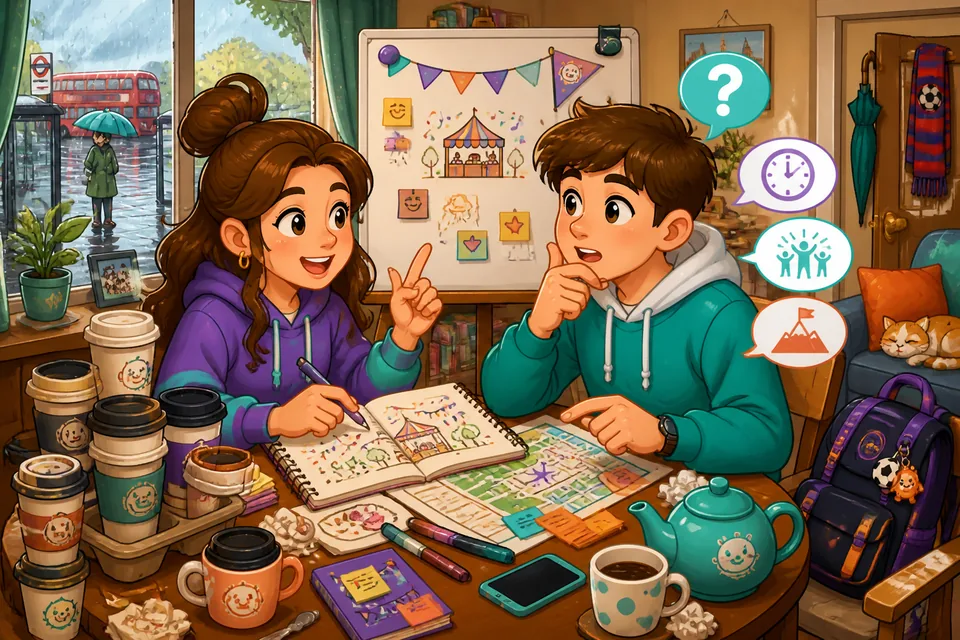
Anna tells David about organizing a small festival and David asks follow-up questions.
Anna
Hier j'ai aidé à organiser un petit festival.
Yesterday I helped organize a small festival.
David
Ça a duré combien de temps ?
How long did it last?
Anna
De midi à vingt-deux heures, donc assez longtemps.
From noon to ten pm, so quite long.
David
C'était comment ?
What was it like?
Anna
Très animé, mais parfois stressant.
Very lively, but sometimes stressful.
David
C'était quoi le meilleur moment ?
What was the best moment?
Anna
Quand le groupe local a fini, tout le monde a applaudi.
When the local band finished, everyone applauded.
3. Guided Practice
Quizzes and matching to lock in meaning.
Which question asks 'How do you know?'
You want the person to give a specific example. Which phrase do you choose?
Which phrase checks if you understood correctly?
Which question asks about frequency?
David asks, 'What happened before that?'
Anna says the concert stopped. David asks: '___' to know what came earlier.
You ask, 'Was it easy or hard?'
You hear someone say fixing the bike was hard. You ask: '___' to check difficulty.
You ask, 'What was the best part?'
Someone describes a trip. You want to know the highlight, so you ask: '___'
Match the core phrases
Match the extra phrases
4. Speaking Practice
Say phrases yourself (mic/recording).
Recording stays on your device only. Check speech uses your browser's speech tools when available.