Ready to dig a little deeper in conversations? This lesson helps you ask quick follow-up questions to understand people better. Keep it friendly and curious!
Level A2: In this lesson you'll practice common French follow-up questions — asking for clarification, more detail, timing, place, and feelings. These short prompts help conversations flow and are great for everyday chats. We'll listen, repeat, and use them in a short dialogue.
After this lesson you'll be able to:
Recognize and use everyday follow-up questions in French.
Ask for clarification (spelling, meaning, details) and for feelings or next steps.
Build confidence at A2 with short, natural prompts in conversation.
Ready? Let's go!
When you tap play on phrases, we track your progress through this lesson.
1. Reading + Listening Practice
Hear core phrases, repeat aloud.
Tu veux dire quoi ?
What do you mean?
Meaning: What do you mean?
When to use: When you didn't understand the meaning of what someone said and need clarification.
Tu veux dire quoi par « bizarre » ?
What do you mean by "bizarre"?
Je suis un peu perdu — tu veux dire quoi ?
I'm a bit lost — what do you mean?
Tu peux parler plus lentement, s'il te plaît ?
Can you speak more slowly, please?
Meaning: Can you speak more slowly, please?
When to use: When someone talks too fast and you need them to slow down.
Tip: Sometimes learners drop "s'il te plaît" and it sounds blunt.
Tu peux parler plus lentement, s'il te plaît ? Je note.
Can you speak more slowly, please? I'm taking notes.
Pardon, tu peux parler plus lentement, s'il te plaît ?
Sorry, can you speak more slowly, please?
Ça s'écrit comment, ___ ?
How do you spell ___?
Meaning: How do you spell ___?
When to use: When you need the spelling of a name or word.
Ça s'écrit comment, « Marseille » ?
How do you spell "Marseille"?
Excusez-moi, ça s'écrit comment, ton nom ?
Excuse me, how do you spell your name?
Tu peux m'en dire plus sur ___ ?
Can you tell me more about ___?
Meaning: Can you tell me more about ___?
When to use: When you want someone to expand on a topic or give details.
Tu peux m'en dire plus sur ton travail ?
Can you tell me more about your work?
Tu peux m'en dire plus sur ce projet ?
Can you tell me more about this project?
Et après, qu'est-ce qui s'est passé ?
What happened next?
Meaning: What happened next?
When to use: When someone is telling a story and you want to hear the next event.
Et après, qu'est-ce qui s'est passé ? Raconte la suite.
What happened next? Tell me the rest.
Il est tombé ? Et après, qu'est-ce qui s'est passé ?
He fell? What happened next?
Pourquoi tu penses ça ?
Why do you think that?
Meaning: Why do you think that?
When to use: When you want the reason behind an opinion or comment.
Tu trouves ce film ennuyeux. Pourquoi tu penses ça ?
You find the movie boring. Why do you think that?
Pourquoi tu penses ça ? Peux-tu expliquer ?
Why do you think that? Can you explain?
Tu t'es senti comment ?
How did you feel about it?
Meaning: How did you feel about it?
When to use: When you ask about someone's emotional reaction to an event.
Tip: Some learners write "sentie" for feminine in writing; spoken form is the same.
Après l'examen, tu t'es senti comment ?
After the exam, how did you feel?
Tu t'es senti comment quand tu as entendu la nouvelle ?
How did you feel when you heard the news?
Et toi ?
What about you?
Meaning: What about you?
When to use: When you return the same question to the other person.
J'ai adoré le concert. Et toi ?
I loved the concert. What about you?
Je préfère le thé. Et toi ?
I prefer tea. What about you?
Quel genre de ___ ?
What kind of ___?
Meaning: What kind of ___?
When to use: When you want a more specific category or type of something.
Quel genre de musique écoutes-tu ?
What kind of music do you listen to?
Quel genre de film préfères-tu ?
What kind of movie do you prefer?
Tu parles duquel ?
Which one are you talking about?
Meaning: Which one are you talking about?
When to use: When there are several options and you need the speaker to point to one.
Tu parles duquel ? Le rouge ou le bleu ?
Which one are you talking about? The red or the blue?
Tu parles duquel dans la liste ?
Which one are you talking about in the list?
C’était quand ?
When was that?
Meaning: When was that?
When to use: When you want the time or date of a past event.
C’était quand, ton voyage en Espagne ?
When was your trip to Spain?
Ils ont déménagé ? C’était quand ?
They moved? When was that?
Ça s’est passé où ?
Where did that happen?
Meaning: Where did that happen?
When to use: When you ask for the place of an event already mentioned.
Ça s’est passé où, exactement ?
Where did that happen, exactly?
Tu dis que c’était drôle — ça s’est passé où ?
You say it was funny — where did that happen?
Tu étais avec qui ?
Who were you with?
Meaning: Who were you with?
When to use: When you ask which people were present during an event.
Tu étais avec qui quand tu as vu ça ?
Who were you with when you saw that?
Tu étais avec qui au concert ?
Who were you with at the concert?
2. Conversational Listening Practice
Hear phrases in a real mini-conversation.
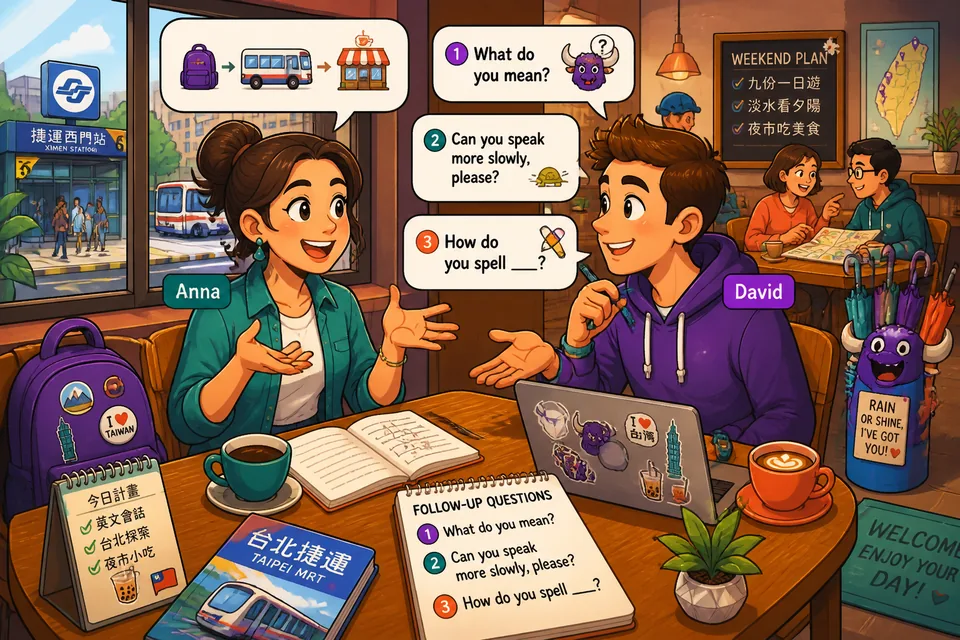
Anna and David at a café — Anna tells a short story, David asks follow-up questions.
Anna
La semaine dernière, j'ai raté mon train et ensuite tout a changé.
Last week I missed my train and then everything changed.
David
Et après, qu'est-ce qui s'est passé ?
What happened next?
Anna
J'ai dû attendre trois heures et finalement j'ai rencontré une amie.
I had to wait three hours and finally I met a friend.
David
Tu étais avec qui ?
Who were you with?
Anna
Personne au début. Et toi ?
No one at first. What about you?
David
Ça s'est passé où ? Et tu t'es senti comment ?
Where did that happen? And how did you feel?
3. Guided Practice
Quizzes and matching to lock in meaning.
Which French phrase asks "Why do you think that?"
Which phrase asks someone to slow down their speech?
If you want to know the place of an event, which question fits?
Choose the phrase that asks for more detail about a topic.
I didn't hear your name. How do you spell 'Dupont'?
Je n'ai pas entendu ton nom. ___ "Dupont" ?
He explained the problem very fast. You say: Can you speak more slowly, please?
Il a expliqué le problème très vite. Tu dis: ___
Anna tells an accident story. David asks: What happened next?
Anna raconte un accident. David demande: ___
Match the core phrases
Match the extra phrases
4. Speaking Practice
Say phrases yourself (mic/recording).
Recording stays on your device only. Check speech uses your browser's speech tools when available.