
New here? This is lesson 99 of a free 240-lesson French course.
Getting off in French
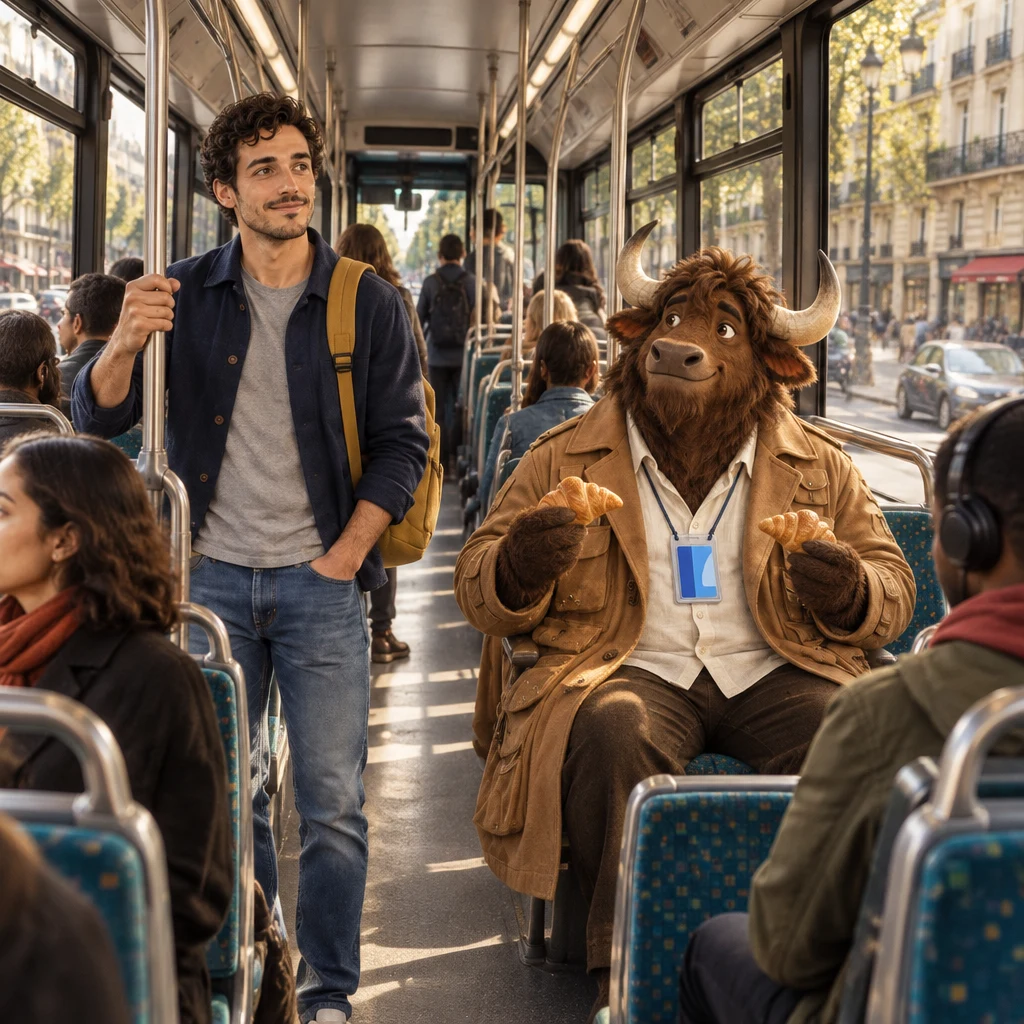
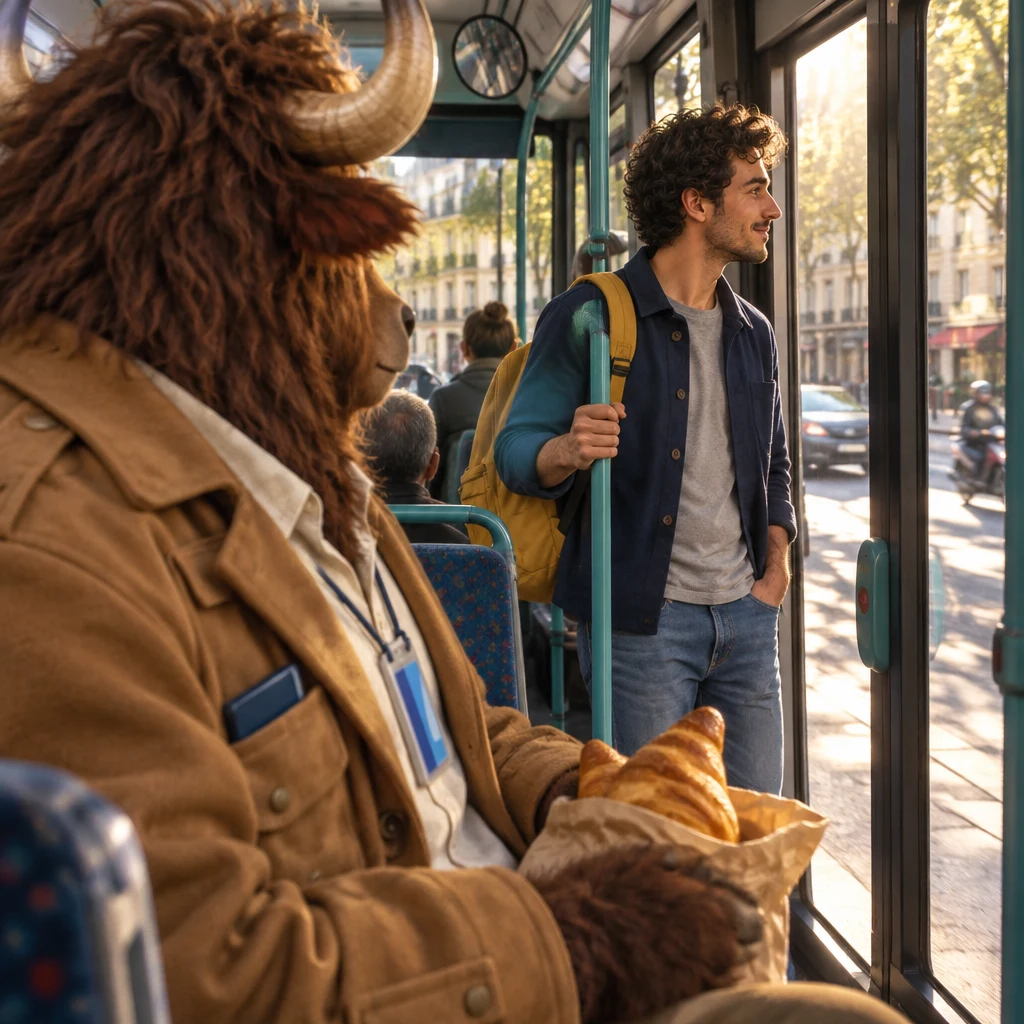
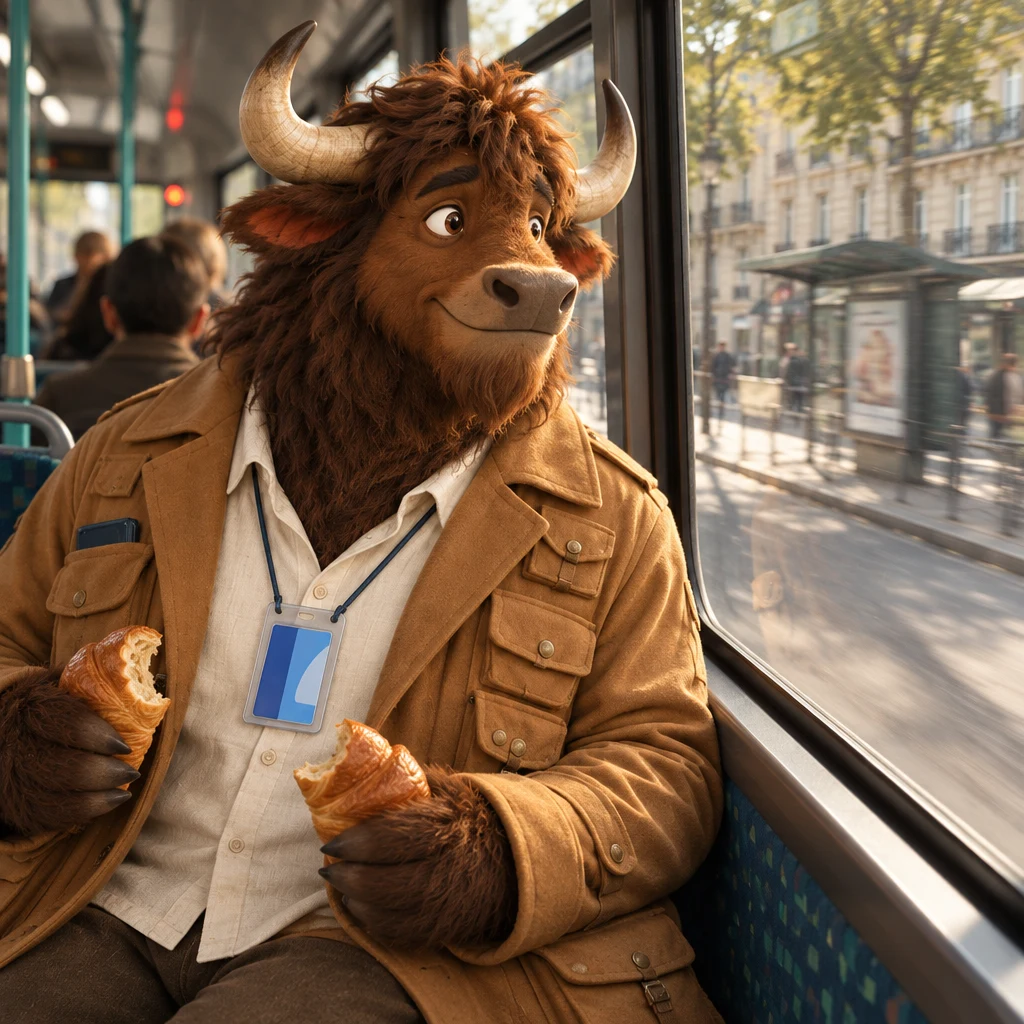
Gaspard is on the bus with a croissant, and he misses the stop. Sam has to talk to the driver.
You'll ask to get off, name the next stop, and say you missed yours.
Then you'll ask if you can buy a ticket on the bus, and where to buy one.
The driver gets vous. Keep the questions short.
By the end of this lesson
Ask to get off, say you missed your stop, and buy a ticket.
- Je dois descendre à ___.I need to get off at ___
- Quel est le prochain arrêt ?What's the next stop?
- Je descends ici.I'm getting off here
- J'ai raté mon arrêt.I missed my stop
- Je peux acheter un ticket dans le bus ?Can I buy a ticket on the bus?
- Où est-ce que je peux acheter un ticket ?Where can I buy a ticket?
Scene — the croissant
A bus on the boulevard near Parmentier. Sam stands by a pole. Gaspard takes two seats, croissant in both hands.
Morning light hits the aisle. The doors hiss, and the next stop is coming up fast.
Learn — getting off
Six lines cover getting off, the next stop, a missed stop, and buying a ticket.
You tell the driver where you get off, then you ask for a ticket.
Je dois descendre à ___.
I need to get off at ___
When to use it: Say this to name the stop where you need to get off.
Put the stop name in the blank after à.
Say it: The en in descendre is a nasal sound.

Quel est le prochain arrêt ?
What's the next stop?
When to use it: Ask this when you need the name of the next stop.
Arrêt is a masculine word, so it takes quel and le.
Say it: In prochain arrêt, the n links to the next vowel as /n/.

Je descends ici.
I'm getting off here
When to use it: Say this when you want to get off at this stop.
With je, the verb is descends, with an s.
Say it: The last s in descends is silent.
J'ai raté mon arrêt.
I missed my stop
When to use it: Say this when the bus has already passed your stop.
J'ai is je and ai said as one piece.
Say it: J'ai drops the e of je before ai.

Je peux acheter un ticket dans le bus ?
Can I buy a ticket on the bus?
When to use it: Ask this if you still need a ticket once you are on the bus.
Un ticket is a paper ticket, not a travel pass.
Say it: The t at the end of ticket is silent.
Où est-ce que je peux acheter un ticket ?
Where can I buy a ticket?
When to use it: Ask this when you need a place that sells tickets.
Est-ce que after Où turns this into a where question.
Say it: The t in est-ce is silent.
Story — he missed it
Watch Gaspard miss the stop over a croissant. Sam has to ask the driver what comes next.
The highlighted words are the lines you just learned. Turn on Show English if you need it.
- The bus rolls toward Parmentier. Gaspard holds a croissant with both hands.
 SamJe dois descendre à Oberkampf.I need to get off at Oberkampf.
 GaspardOui, oui. Le croissant d'abord.Yes, yes. The croissant first.
- He does not look at the street. The bus leaves a stop.
- GaspardJ'ai raté mon arrêt.I missed my stop.
- Sam walks up to the driver at the front of the bus.
- SamExcusez-moi. Quel est le prochain arrêt ?Excuse me. What's the next stop?
- DriverC'est Oberkampf.It's Oberkampf.
- SamJe descends ici.I'm getting off here.
- DriverD'accord.Okay.
- SamJe peux acheter un ticket dans le bus ?Can I buy a ticket on the bus?
- DriverNon, pas dans le bus.No, not on the bus.
- SamOù est-ce que je peux acheter un ticket ?Where can I buy a ticket?
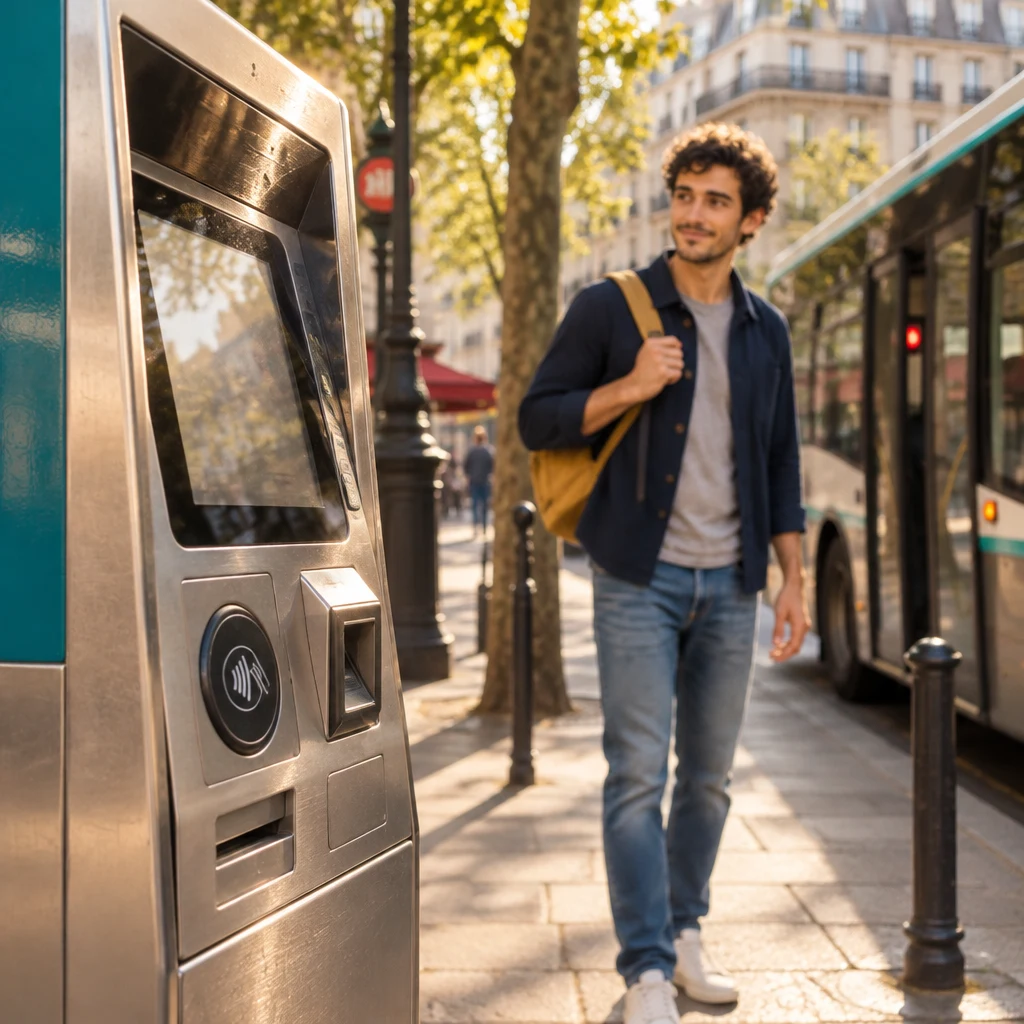
- DriverAu distributeur, à la station.At the machine, at the station.
- SamMerci.Thank you.
Practice — the next stop
Eleven short exercises wait here. You'll listen, pick, fill a gap, swap a word, and build a line.
They stay on the bus, so the round moves fast.
0 of 11 done
What did you hear?
What did you hear?
Match the pairs
French
Je descends ici.Drop the English hereJ'ai raté mon arrêt.Drop the English hereOù est-ce que je peux acheter un ticket ?Drop the English hereEnglish
What do you say?
What do you say?
You are still on the way. Tell the driver you need to get off at Oberkampf.
Fill the gap
Fill the gap
I missed my stop
J'ai ____ mon arrêt.
Pick the reply
Driver says:
Pick the reply
On est à Oberkampf, votre arrêt.
We're at Oberkampf, your stop.
And you reply with:
What does it mean?
What does it mean?
Je peux acheter un ticket dans le bus ?
Swap the word
Swap the word
Ask the driver what the next stop is.
Quel est le ____ arrêt ?
Build the line
Build the line
Where can I buy a ticket?
- ?
Tap the words in order.
Fill the gap
Fill the gap
Can I buy a ticket on the bus?
Je peux ____ un ticket dans le bus ?
What do you say?
What do you say?
You need the bus driver's attention.
Pick the reply
Driver says:
Pick the reply
Au distributeur, à la station.
At the machine, at the station.
And you reply with:
Say it — tell the driver
Now you're Sam on the bus with Gaspard and the driver. When it's your turn, tap the microphone and speak the line.
Tap ▶ first if you want to hear the line. Your recording stays on your device.
- GaspardJ'ai raté mon arrêt.I missed my stop.
- Sam (you)Get the driver's attention, the polite way.
Get the driver's attention, the polite way.
Excusez-moi.
Excuse me (polite)
0 of 5 said
Recap — what you can say now
| French | English | Play |
|---|---|---|
| Je dois descendre à ___. | I need to get off at ___ | |
| Quel est le prochain arrêt ? | What's the next stop? | |
| Je descends ici. | I'm getting off here | |
| J'ai raté mon arrêt. | I missed my stop | |
| Je peux acheter un ticket dans le bus ? | Can I buy a ticket on the bus? | |
| Où est-ce que je peux acheter un ticket ? | Where can I buy a ticket? |
Save your progress — it’s free
Keep your place in the course and see which lines you’ve learned.
Want the next lesson in your inbox?
Get the next lesson by email, one a day.
Join the newsletterDaily lesson emails are coming soon. Newsletter subscribers get them first.
Keep practicing with Yak Cards
Want to keep these bus lines handy? Grab the Yak Cards for this lesson and review them anywhere.
A quick round with the Yak Cards keeps your next-stop lines ready on the bus.
Open Yak Cards