
New here? This is lesson 96 of a free 240-lesson French course.
More, less, same in French
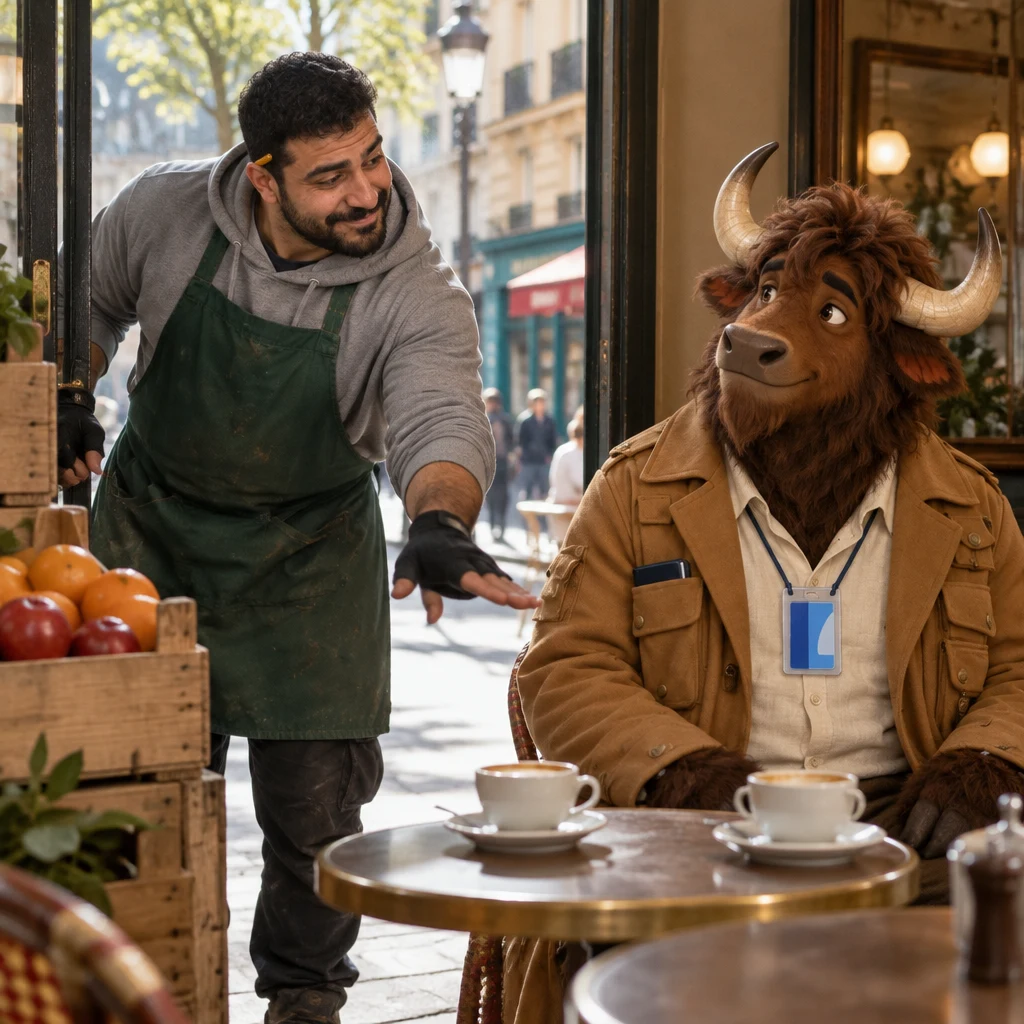
At Café des Tilleuls, two cups sit on the table: Sam's crème and Gaspard's. Gaspard has opinions about price and strength.
Odile is not so sure they differ much. Karim stops by with a crate and votes for market coffee.
You'll say more expensive, weaker, as good, about the same, and better. You'll also ask which one is cheaper.
By the end of this lesson
Compare two things as more, less, or the same.
- C'est plus cher que ça.It's more expensive than that.
- C'est moins fort que l'autre.It's weaker than the other one.
- C'est aussi bon que l'autre.It's as good as the other one.
- C'est à peu près pareil.They're about the same.
- C'est mieux que l'autre.It's better than the other one.
- Lequel est moins cher ?Which one is cheaper?
Scene — two cups
Saturday morning at the café. Sam has a crème. Gaspard has his usual café crème, still unfinished, on the next table.
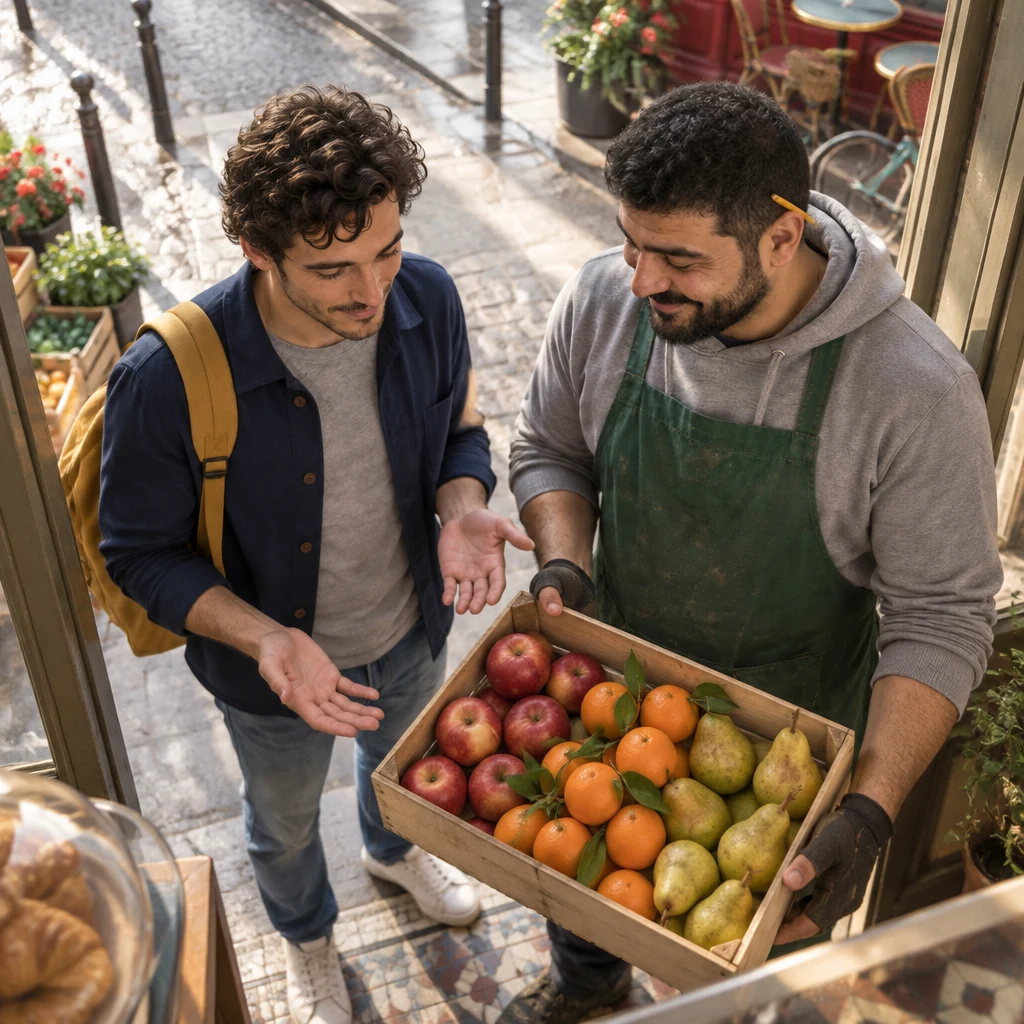
The window table stays empty with its blank brass sign. Karim leans in the door with a crate of fruit from the market.

Learn — more, less, the same
Six lines let you compare two things: more, less, as good, about the same, and better.
You'll also ask which one costs less.
C'est plus cher que ça.
It's more expensive than that.
When to use it: Say this when one thing costs more than another.
Put plus, then the quality, then que and the other thing.
Say it: The s in plus is silent before cher.

C'est moins fort que l'autre.
It's weaker than the other one.
When to use it: Say this when this one is weaker than the other.
Put moins, then the quality, then que and the other thing.
Say it: L'autre drops the e of le before autre.

C'est aussi bon que l'autre.
It's as good as the other one.
When to use it: Say this when both things are equally good.
Put aussi, then the quality, then que, to mean equally.

C'est à peu près pareil.
They're about the same.
When to use it: Say this when two things are nearly the same.
À peu près is one piece and means about.
Say it: The s at the end of près is silent.

C'est mieux que l'autre.
It's better than the other one.
When to use it: Say this when this one is better than the other.
Mieux is the better form of bien, then que.
Say it: The x in mieux is silent.
Lequel est moins cher ?
Which one is cheaper?
When to use it: Ask this to find the cheaper of two things.
Lequel asks which one when the thing is masculine.
Story — Gaspard compares
Gaspard compares the two cups. Odile disagrees, and Karim brings in market coffee.
The highlighted words are the lines you just learned. Turn on Show English if you need it.
- Saturday at the zinc. Two cups sit side by side. The window table stays empty.
 OdileVoilà, mon grand.Here you go, dear.
 SamCelui-ci ou celui-là ?This one or that one?
- Gaspard looks at Sam's cup, then at his own unfinished crème.
 GaspardC'est plus cher que ça.It's more expensive than that.
- SamC'est trop cher. Lequel est moins cher ?That's too expensive. Which one is cheaper?
- GaspardLe mien.Mine.
- He nods at his own unfinished crème.
- GaspardC'est moins fort que l'autre.It's weaker than the other one.
- Odile wipes the zinc. She does not sit at the window table.
- OdileC'est à peu près pareil.They're about the same.
- SamC'est aussi bon que l'autre.It's as good as the other one.
- Karim lifts a paper cup from the crate.
 KarimJe préfère ça. C'est mieux que l'autre.I prefer that. It's better than the other one.
Practice — plus or moins
Eleven short exercises mix listening, gaps, matching, and a swap.
You'll pick the line that fits the cups on the table.
0 of 11 done
What did you hear?
What did you hear?
Match the pairs
French
C'est plus cher que ça.Drop the English hereC'est moins fort que l'autre.Drop the English hereC'est aussi bon que l'autre.Drop the English hereEnglish
What does it mean?
What does it mean?
C'est moins fort que l'autre.
What do you say?
What do you say?
Odile thinks the two cups are close. Agree they taste equally good.
Fill the gap
Fill the gap
They're about the same.
C'est à peu près ____.
Swap the word
Swap the word
Karim holds market coffee next to the café crème. Say it is better.
C'est ____ que l'autre.
Pick the reply
Gaspard says:
Pick the reply
Je ne sais pas lequel prendre.
I don't know which one to take.
And you reply with:
Build the line
Build the line
It's more expensive than that.
.
Tap the words in order.
What do you say?
What do you say?
Two café crèmes are on the zinc. Ask this one or that one.
True or false?
True or false?
This means it tastes too strong.
Fill the gap
Fill the gap
I prefer that
Je ____ ça.
Say it — your call
Now you're Sam at the counter with two cups to compare. When it's your turn, tap the microphone and speak the line.
Tap ▶ first if you want to hear the line. Your recording stays on your device.
- GaspardRegarde les deux cafés.Look at the two coffees.
- Sam (you)Ask which one is cheaper.
Ask which one is cheaper.
Lequel est moins cher ?
Which one is cheaper?
0 of 5 said
Recap — what you can say now
| French | English | Play |
|---|---|---|
| C'est plus cher que ça. | It's more expensive than that. | |
| C'est moins fort que l'autre. | It's weaker than the other one. | |
| C'est aussi bon que l'autre. | It's as good as the other one. | |
| C'est à peu près pareil. | They're about the same. | |
| C'est mieux que l'autre. | It's better than the other one. | |
| Lequel est moins cher ? | Which one is cheaper? |
Save your progress — it’s free
Keep your place in the course and see which lines you’ve learned.
Want the next lesson in your inbox?
Get the next lesson by email, one a day.
Join the newsletterDaily lesson emails are coming soon. Newsletter subscribers get them first.
Keep practicing with Yak Cards
Want to keep plus, moins and aussi handy? Grab the Yak Cards for this lesson and review them anywhere.
A quick round with the Yak Cards each day keeps plus, moins and aussi ready at the counter.
Open Yak Cards